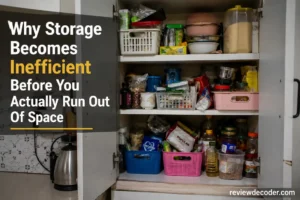
I used to declutter on Saturdays. The whole day. Eight hours of purging. Trash bags. Donation piles. Before-and-after photos. I felt heroic. Exhausted. Virtuous. By Wednesday the clutter had returned. Not all of it. But enough. A new pile on the chair. A new drawer of randomness. A new shelf of “just for now.”
The Saturday method was theater. Performance art. I performed cleanliness for one day. Then lived in gradual chaos for six. The cycle repeated monthly. Quarterly. Whenever I could not stand the sight of my own home anymore.
I stopped performing. Started removing. One item. Daily. No drama. No bags. No photos. Just a slow, invisible erosion of excess. It took longer to see results. But the results lasted. Because the method matched my actual life. Not my aspirational one.
What I Was Working With
My apartment is 850 square feet. Two people. No storage room. Four closets. One is mostly coats. One is office supplies and regret. The bedroom closets hold clothes. The kitchen cabinets hold everything else.
I am not a hoarder. I am an accumulator. Things enter. They do not leave. A free pen. A conference tote. A gift I did not want. A sale I could not resist. The volume is low. The persistence is high. One item per week becomes fifty-two per year. Over four years, that is two hundred items. In 850 square feet, two hundred items matter.
My partner is worse. Sentimental. Keeps movie tickets. Restaurant menus. Rocks from beaches. Not special rocks. Just rocks. I do not fight this. I manage my own accumulation. I model. I do not mandate. Marriage is not decluttering by force.
The One-a-Day Rule
One item. Every day. Into a bag. Donation. Trash. Recycling. One item. Not ten. Not a drawer. Not a closet. One.
The item must leave the house. Not move to another room. Not go to the “maybe” box. Out. Permanently. By sundown. Or by bedtime. Or by the time I remember, which is sometimes the next morning. But soon. Quickly. Before attachment returns.
Some days the item is obvious. A shirt with a stain I never fixed. A book I never opened. A gadget I used once. Other days I walk around looking. Opening drawers. Checking shelves. The search is part of the practice. It trains my eye to see excess. To notice what has become invisible through familiarity.
After one month, thirty items gone. After one year, three hundred sixty-five. In my apartment, that is significant. That is breathing room. That is the difference between cluttered and clear.
The one-a-day rule feeds into my simple organization system. Less stuff means less to organize. Less to maintain. Less to decide about.
The Categories I Cycle Through
I do not declutter randomly. I follow a cycle. Weekly themes. Prevents decision fatigue. Prevents the “I already did clothes” stagnation.
Week 1: Clothing. One item daily. Socks with holes. Shirts that fit wrong. Pants I never choose. The cycle repeats monthly. Four clothing items per month. Forty-eight per year. My wardrobe shrinks gradually. Becomes precise. Becomes used.
Week 2: Paper. Mail. Manuals. Receipts. Notes. Cards. One piece daily. Shred or recycle. The paper pile shrinks. The file cabinet breathes. I find things I forgot I kept. A warranty for a blender I replaced. A bill I already paid. Gone.
Week 3: Kitchen. Utensils. Gadgets. Containers without lids. Lids without containers. Expired spices. Duplicate tools. One daily. The kitchen simplifies. Drawers close easily. Cabinets have space. I cook more because finding things is easier.
Week 4: Miscellany. Everything else. Bathroom products. Office supplies. Decor. The junk drawer. The mystery box. One item daily. The catch-all week. Where randomness goes to die.
The cycle repeats. Month after month. Year after year. I never finish. I do not aim to finish. I aim to maintain. Decluttering is not a project. It is hygiene. Like brushing teeth. Like washing dishes. Continuous. Gentle. Non-dramatic.
The clothing week connects to seasonal rotation. I declutter before I store. Not after. Before.
The “Maybe” Box I Almost Eliminated
I used to have a maybe box. Items I was not ready to lose. Temporary storage. Reassessment in six months.
The box became permanent. A graveyard of indecision. I never reassessed. The items sat. Forgotten. The box was clutter with a label. Organized hoarding. Delayed disposal.
I eliminated it. Replaced with a rule: if I hesitate for more than ten seconds, the item leaves. Hesitation is attachment. Attachment is fear. Fear of need. Fear of loss. Fear of regret. I have regretted maybe three items in three years. I have not regretted the three hundred sixty-two others.
The ten-second rule is brutal. It is also liberating. No deliberation. No pro-con list. No “where would I use this.” Just yes or no. Stay or go. The maybe box was a purgatory I created for myself. I closed it.
💡 What I Learned the Hard Way
I once tried to declutter my partner’s stuff. Secretly. While they were at work. I removed three items. A broken umbrella. A stained mug. A stack of old magazines. I felt righteous. Productive. Helpful. They noticed the mug. Asked about it. I confessed. There was anger. Not about the mug. About the violation. The assumption. The unilateral decision. I apologized. Retrieved the mug from the donation bag. It sits in their cabinet still. Stained. Unused. Respected. The lesson: decluttering is personal. Intimate. You cannot purge someone else’s history. Even if it looks like trash to you. Even if it is trash. Their trash. Their decision. Their timeline. I declutter only my own items now. I model. I do not mandate. The mug is my reminder.
The Math of Slow Decluttering
| Method | Frequency | Items Removed Per Year | My Experience |
|---|---|---|---|
| Binge purge (8-hour Saturday) | Quarterly (4x/year) | ~200 (estimated) | Exhausting, temporary, followed by rebound clutter |
| One-a-day rule | Daily (365x/year) | 365 | Sustainable, gradual, permanent behavior change |
| Monthly drawer clean | Monthly (12x/year) | ~120 (estimated) | Moderate effort, moderate results, still project-based |
| KonMari category purge | Once (per category) | Variable, often large | Overwhelming, decision fatigue, abandoned mid-process |
⚠️ When This Won’t Work
If you are facing a hoarding situation — yours or someone else’s — the one-a-day rule is insufficient. Hoarding requires professional intervention. Therapists. Organizers trained in trauma. The attachment is not to the item. It is to the identity the item represents. The memory. The possibility. The protection against loss. You cannot logic someone out of hoarding. You cannot one-a-day your way out of it. Seek help. Also, if you are moving, downsizing, or settling an estate, the timeline is compressed. You need rapid decluttering. Binge methods. Professional help. The one-a-day rule is for maintenance, not crisis. Finally, if you are grieving, do not declutter the deceased’s belongings on a schedule. There is no correct timeline. One day. One year. Ten years. The items hold memory. The memory needs time. Do not rush grief into a donation bag. The bag will wait. The grief will not.
Frequently Asked Questions
What if I cannot find one item to remove?
Look harder. Open the junk drawer. Check the back of the closet. The expiration dates in the medicine cabinet. There is always one. Always. If you genuinely cannot find one, you have already succeeded beyond most people. Or you are not looking honestly. The second is more likely.
Do I count trash?
No. Trash is not decluttering. It is disposal. The item must be something you kept. Something you considered worth space. Removing trash is cleaning. Removing kept items is decluttering. Different practices. Different muscles.
What about items I might need someday?
The someday rule: if you have not needed it in one year, you will not need it. Exceptions: tools. Emergency supplies. Seasonal items. But even these have limits. How many flashlights? How many blankets? How many “just in case” items before the case becomes the clutter itself? I keep one. One flashlight. One blanket. One backup. The rest go. The probability of needing two simultaneously is lower than the cost of storing both.
How do I handle gifts?
Gifts are obligations given physical form. The giver wants you to have joy. Not guilt. Not storage burden. If the gift does not bring joy, it has failed its purpose. Remove it. Donate it. The giver will not know. If they ask, be honest. “I loved the thought. It did not fit my life. Someone else is enjoying it now.” This is kindness. To yourself. To the item. To the hypothetical someone else who will use it.
Does my partner have to do this too?
No. See the mug story. Model. Do not mandate. Your clear spaces will influence. Or they will not. That is okay. Your decluttering is yours. Their accumulation is theirs. Coexistence is possible. I have clear shelves. My partner has rocks. We are both happy. The apartment has balance.
Closing Thought
I no longer declutter on Saturdays. I no longer feel heroic. I no longer take before-and-after photos. The transformation is too gradual for photography. Too subtle for drama.
But my drawers close. My shelves have space. My closet holds only what I wear. My kitchen has no mystery containers. My paper pile is a file. My home breathes.
One item. Every day. No drama. No exhaustion. No rebound.
The slow drip wears away the stone. Not through force. Through persistence. Through the understanding that decluttering is not an event. It is a practice. A hygiene. A way of living with less without feeling deprived.
I am not a minimalist. I still own things. I still buy things. But I also remove things. Daily. Gently. Invisibly.
The accumulation slows. The space grows. The home becomes what it was meant to be: a container for living, not a storage unit for possibility.
Start today. One item. Any item. Into a bag. Out the door.
Tomorrow, another. The day after, another.
By next month, thirty items gone. By next year, three hundred sixty-five. By the year after, you will not recognize your home. Or yourself.
That is the goal. Not the destination. The becoming.
Sources and References
- American Psychological Association (APA) — Research on habit formation, decision fatigue, and how small daily actions create sustainable behavioral change more effectively than large intermittent efforts.
- Centers for Disease Control and Prevention (CDC) — Healthy Homes — Guidelines for maintaining organized, clean, and healthy residential environments through sustainable daily practices.
- International OCD Foundation — Information on hoarding disorder, including when to seek professional help and how to distinguish normal accumulation from clinically significant hoarding behavior.

Hamza Farooq is a home improvement and organization writer who shares practical advice on cleaning, simple DIY fixes, and smart home organization. He focuses on creating easy-to-follow guides that help readers solve everyday household problems with realistic, affordable solutions. His goal is to make home maintenance simpler, more efficient, and accessible for anyone looking to improve their living space.