
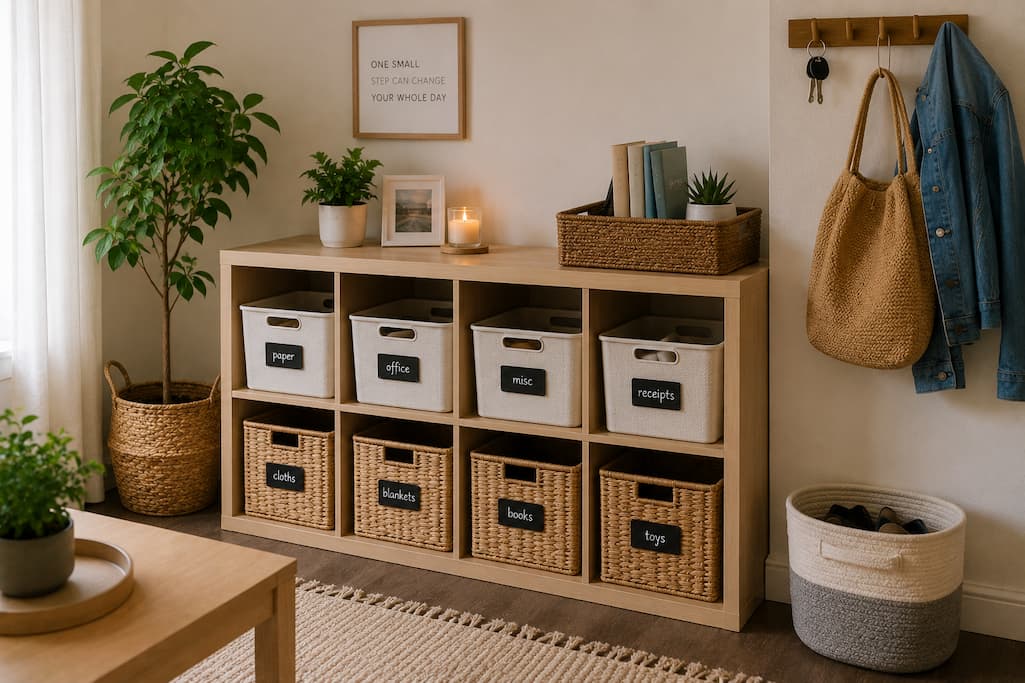
I once labelled my sock drawer. Not the drawer itself. The inside. Each pair had a slot. Athletic. Dress. Casual. Winter. The labels were laminated. Colour-coded. I took a photo. Posted it. Got twelve likes.
By Wednesday I was throwing socks in randomly. By Friday the labels were peeling. By Sunday I could not find matching athletic socks because the system required me to fold them a specific way. A way I refused to do at 6 AM.
The system lasted six days. It was beautiful. It was useless. It was the most organised my socks had ever been and the least functional.
I have since learned that systems that require perfection fail on Tuesday. Systems that require almost nothing survive for years. This is the one that survived.
What I Was Working With
My apartment is 850 square feet. Two people. No storage room. No garage. No basement. Four closets total. One is a coat closet by the door. One is in the office. Two are in the bedroom. That is the inventory.
I work from home three days. My partner is five. We generate paper. Mail. Packaging. Coffee cups. The debris of two lives lived in one small space. We do not have a cleaning service. We do not want one. The goal is not cleanliness. It is navigability. Can we find things? Can we move through rooms? Can we sit on the couch without relocating laundry?
We have no children. No pets. No hobbies that require equipment. We are boring. Boring is easier to organise. Boring is the point.
The System: Four Boxes and a Question
That is it. Four boxes. One question. Everything else is optional.
Box 1: Incoming
A basket by the door. Everything that enters the house goes here first. Mail. Keys. Wallet. Phone. Receipts. The random object from the car. The thing from work. The Amazon package.
Nothing bypasses the incoming basket. Nothing goes directly to a table, counter, or chair. The basket is the airlock. The decontamination zone. The place where outside meets inside and pauses.
I empty the basket once daily. Usually evening. Sometimes in the morning if it is full. The emptying is not organising. It is sorting. Mail to the trash or file. Keys to hook. Wallet to pocket or shelf. The package was opened, the contents put away, and the box recycled. The basket is never the final destination. It is the holding pattern.
The incoming basket is the foundation of my daily mess management. Without it, everything spreads. With it, everything waits politely.
Box 2: Action
A tray on the desk. Not a bin. A tray. Open. Visible. Shallow. Things that require doing live here. Bills to pay. Forms to sign. Items to return. The book I am reading. The notebook I am using.
The rule: if it sits in the action tray for more than one week, it dies. Not literally. But it gets moved. To file. To trash. To the “someday” box. The action tray is not storage. It is pressure. It forces decisions. It prevents the slow accumulation of “I will get to that.”
Currently in my action tray: a warranty card for a blender. A return label for shoes that did not fit. A handwritten note with a phone number. Three items. Manageable. Visible. Annoying enough to motivate action.
Box 3: File
A simple accordion file. Twelve slots. One per month. Receipts. Statements. Documents. Things I might need for taxes or returns or proof.
I do not organise within the month. January is a jumble. February is a jumble. The jumble is fine. I need to know that a receipt from March is in the March slot. I do not need it alphabetised. I do not need it categorised. I need it findable in a five-minute search once a year.
At year end, the file empties. Shred most. Keep some. The keepers go in a labelled envelope. Tax year. Into a box. The box goes on a shelf. I have three boxes. 2023. 2024. 2025. That is the archive. That is all.
The file system prevents overwhelm by limiting categories. Month. Year. Done.
Box 4: Someday
A shoebox on the closet shelf. Things I might need. Might want. Might do. Not now. Later. Maybe.
The rule: if I do not open the someday box for three months, it all goes. No review. No sorting. Everything. The someday box is a probationary holding cell. Most things die here. That is the point. It is a slow trash can. A gentle filter. A way to delay decisions until they become obvious.
Currently in the box: a manual for a device I no longer own. A coupon for a restaurant that closed. A photograph of a place I do not remember. They will not survive the next purge. They do not know it yet.
The Question: Where Does This Go?
Every item that enters. Every item that moves. I ask it. Out loud. Sometimes. “Where does this go?”
If the answer is clear, it goes there. Immediately. Not in a minute. Now.
If the answer is unclear, it goes to incoming. To action. To someday. To the appropriate box. The question forces categorisation. The boxes accept the answer. The system processes the item. Nothing floats. Nothing drifts. Everything lands.
If the answer is “nowhere”, it goes out. Trash. Donation. Recycling. The system has no “miscellaneous” category. Miscellaneous is where organisation dies. Miscellaneous is the junk drawer of the soul. I do not have a junk drawer. I have a someday box with a death sentence.
💡 What I Learned the Hard Way
I once created a “miscellaneous” file. For things that did not fit other categories. It grew. Became the largest file. Became unsearchable. Became meaningless. I spent three hours one Saturday sorting it. Most of it was trash. Some were important. I found a tax document from two years ago. A check I never cashed. A reminder for a dentist appointment I missed. The miscellaneous file was not organised. It was procrastination in alphabetical form. I eliminated it. Now everything must answer the question. Everything must land in a box with a purpose. Or it leaves. The someday box is the only exception. And it has a three-month death penalty.
What the System Does Not Include
| Common System Element | Why I Do Not Use It | What I Do Instead |
|---|---|---|
| Label maker | Creates pressure to maintain categories perfectly | Handwritten tape labels, easily replaced, low commitment |
| Color coding | Requires remembering the code, adds cognitive load | No colours. Location is the code. Basket, tray, file, box. |
| Digital inventory | More work than value for a small home | Physical visibility. If I cannot see it, I do not own it. |
| Calendar reminders for organizing | Turns maintenance into obligation, creates guilt | Evening emptying of the basket. Habit, not schedule. |
| “Organize” as a weekend activity | Leads to binge-purge cycles, unsustainable | Daily five-minute maintenance. No weekends required. |
⚠️ When This Won’t Work
If you have a large home with multiple floors, four boxes are insufficient. You need zones. One set per floor. Or one set per person. The system scales by duplication, not complexity. Also, if you have children, the incoming basket becomes a toy chest. The action tray becomes art supplies. The file becomes school papers. The someday box becomes “I might fix this.” You need kid-specific adaptations. Bins at their height. Labels they understand. A daily reset they participate in. The system works for adults who can answer the question. Children answer differently. Adapt accordingly. Finally, if you are a collector, a hobbyist, or someone whose work generates physical materials – fabric, wood, electronics, or art – the someday box is too small. You need a someday room. A someday closet. The principle still applies: designated space, limited volume, and periodic purge. But the volume is larger. The purge is less frequent. The system is the same. The scale is different.
Frequently Asked Questions
What if I forget to empty the incoming basket?
The basket overflows. Visibly. Annoyingly. It blocks the door. It becomes impossible to ignore. This is by design. A hidden mess stays hidden. A visible mess demands action. I let it overflow sometimes. The overflow is the reminder. Not a calendar. Not an alarm. Gravity and volume. Natural consequences.
How do you handle digital clutter?
Separately. The four-box system is physical. Digital has its own rules. But the principle transfers: one inbox. One action folder. One archive. One trash. Review weekly. Delete ruthlessly. I do not mix physical and digital. They are different species. Different predators. Different survival strategies.
Does your partner use the same system?
Mostly. They have their own incoming basket. Their own action tray. We share the file and, someday, boxes. The shared boxes require negotiation. “Is this yours or mine?” “Does this go to file or someday?” The questions slow us down. They also prevent unilateral decisions. The system is not perfect. It is collaborative. That is harder. That is also better.
What about sentimental items?
One box. Same as someday. But separate. Labelled “Keep”. Not “Someday.” “Keep.” The distinction matters. Someday is probationary. Keep it permanent. But the box is the same size. When it fills, something leaves. The keep box enforces curation. Not accumulation. I have a letter from my grandmother. A photograph of my parents. A small stone from a meaningful place. That is all. The box has room. I am careful about what earns entry.
How long did it take to build this habit?
The basket habit: two weeks. The evening emptying: one month. The question reflex: six weeks. The someday purge: three months to trust. The full system: about four months to become automatic. Not fast. But permanent. I have used it for three years. Through a move. Through job changes. Through stress. It survived because it asks almost nothing. It gives almost everything.
Closing Thought
My sock drawer is no longer labelled. It is a drawer. Socks go in. I grab two in the morning. They match or they do not. I do not care at 6 AM. No one sees my socks. The system does not require sock perfection.
The system requires only this: everything enters through the basket. Everything answers the question. Everything lands in a box. Everything that does not land leaves.
Four boxes. One question. Five minutes a day. No weekends. No labels. No colour codes. No laminated perfection.
The apartment is not organised. It is navigable. I can find things. I can sit on the couch. I can walk through rooms without stepping over objects. That is enough.
Organisation is not beauty. Organisation is the absence of friction. The system reduces friction to almost zero. Not by adding complexity. By removing it. By asking less of me than my previous systems demanded.
Start with a basket. By the door. Put everything in it. Empty it nightly. Ask where each thing goes. If you do not know, it leaves.
That is the system. Everything else is optional. Everything else is elaboration. The basket is the core. The question is the engine. The boxes are the destination.
Four boxes. One question. A life with less searching. More findings. Less staring. More doing.
That is the goal. Not perfection. Function. Daily. Quiet. Almost invisible.
Sources and References
- American Psychological Association (APA) — Research on decision fatigue, cognitive load, and how simplified environmental systems reduce mental burden and support consistent behaviour.
- Centers for Disease Control and Prevention (CDC) — Healthy Homes — Guidelines for maintaining organised, clean, and healthy residential environments through sustainable daily practices.
- U.S. Environmental Protection Agency (EPA) Safer Choice Program — Recommendations for reducing household waste and maintaining sustainable home organisation with minimal product use.

Hamza Farooq is a home improvement and organization writer who shares practical advice on cleaning, simple DIY fixes, and smart home organization. He focuses on creating easy-to-follow guides that help readers solve everyday household problems with realistic, affordable solutions. His goal is to make home maintenance simpler, more efficient, and accessible for anyone looking to improve their living space.