
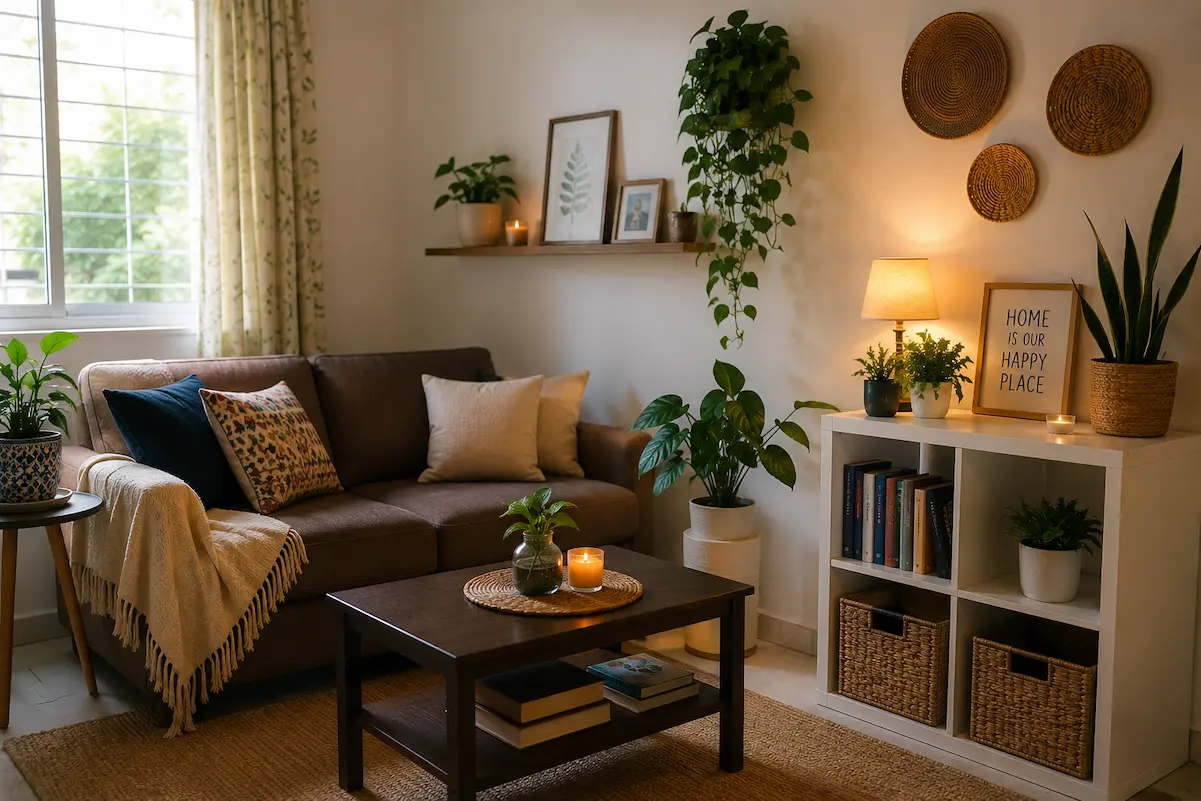
I once spent eighty-seven dollars on a throw pillow. It was velvet. It had a geometric pattern. It matched nothing I owned. I bought it because I was sad and the store was warm. The pillow lived on my couch for six months. Then it moved to the closet. Then to the donation bag. I do not remember what sadness felt like that day. But I remember the eighty-seven dollars.
That was my approach to home improvement. Emotional retail. Buying things to feel better. The things did not help. The credit card statement made me feel worse. The apartment looked the same. Just more cluttered. More evidence of failed moods.
I stopped buying. Started changing. Free changes first. Cheap changes second. Strategic purchases third. The apartment improved. My bank account stabilized. I learned that improvement is not about acquisition. It is about attention.
What I Was Working With
My apartment is 850 square feet. Rental. Beige walls. Beige carpet. Beige countertops. The landlord chose beige because beige offends no one. It also inspires no one. It is the color of waiting rooms. Of temporary. Of “I do not live here, I just sleep here.”
My budget was zero. Literally zero. I had spent the pillow money. I was in recovery. No discretionary spending. Just observation. Just rearrangement. Just using what I already owned differently.
I gave myself one rule: no purchases for thirty days. Only changes that cost nothing. If I still wanted something after thirty days, I could buy it. Most wants died before the month ended. The ones that survived were worth it.
Free Change 1: The Furniture Shuffle
I moved everything. The couch against the opposite wall. The bed rotated ninety degrees. The desk near the window instead of the corner. The bookshelf horizontal instead of vertical.
The apartment felt new. Not because anything was new. Because the paths changed. The light hit differently. The shadows fell in unfamiliar places. I bumped into the couch arm for three days. Then I adapted. The new normal became normal.
The bed rotation was the best change. Previously against the wall with the window. Morning light hit my face at 6 AM. Now against the interior wall. The window is to my left. I wake gradually. I sleep deeper. The room feels larger because the walking path is straighter. I did not buy a new bed. I did not buy blackout curtains. I moved the bed. Zero dollars.
The furniture shuffle is the fastest way to change perceived space. No tools. No money. Just effort.
Free Change 2: The Empty Surface Policy
I cleared every horizontal surface. Counters. Tables. Shelves. The top of the refrigerator. Everything that was not functional or beautiful went away.
Functional: the coffee maker. The lamp. The book I am reading. Beautiful: one plant. One candle. One object that makes me pause.
Everything else found a home or left. Mail went to a folder. Keys to a hook. Random objects to the trash or donation. The surfaces breathed. The rooms expanded. Not physically. Perceptually. Empty space reads as larger space. Clutter reads as smaller. The math is psychological. It works anyway.
I took before and after photos. The difference was embarrassing. I had been living in a storage unit. Now I lived in a home. Same stuff. Less visible. Decluttering is free. It is also hard. But free.
Free Change 3: The Light Redirect
I opened blinds I kept closed. Removed curtains that blocked afternoon sun. Moved a mirror to reflect the window light deeper into the living room. The mirror was already there. On the opposite wall. Reflecting a blank wall. I moved it three feet. Now it reflects the window. The light doubles.
I also cleaned the windows. Inside and out. The outside required a long-handled squeegee. I borrowed it. The glass was filthy. Years of grime. I could not see it from inside. But I could feel it. The room was dimmer than it should be. After cleaning, the light poured in. Aggressive. Almost too much. I adjusted.
Light improvement does not require fixtures. Sometimes it requires Windex.
Cheap Change 1: Paint One Thing
After thirty days, I allowed one purchase. A quart of paint. Twelve dollars. I painted the inside of the front door. Not the outside. The landlord sees the outside. The inside is mine.
I chose navy. Deep. Saturated. The door became a feature. A moment of intention in a beige world. Visitors comment on it. They do not comment on the beige. The navy cost twelve dollars. The beige cost the landlord more. My twelve dollars had more impact.
The painting took two hours. Tape. Brush. Roller. Cleanup. The door dried overnight. The apartment felt different immediately. One colored wall. One decision. One identity.
Cheap Change 2: Hardware Swap
I bought four cabinet knobs. Matte black. Fourteen dollars total. Replaced the brass ones in the kitchen. The cabinets looked updated. Not new. But considered. Like someone chose them. Not like they came with the apartment.
I kept the old knobs. Labeled bag. Under the sink. When I move, the black ones come with me. The brass ones return. The fourteen dollars is an investment, not an expense. It travels.
Hardware is the cheapest way to signal intention. It says: someone lives here. Someone cares.
Cheap Change 3: Textile Rotation
I did not buy new textiles. I rotated existing ones. The living room throw moved to the bedroom. The bedroom throw became a table runner. The table runner became a wall hanging. The wall hanging became a curtain for the closet opening.
Everything looked different because everything was in a different place. The textures changed contexts. The colors read differently against new backgrounds. It was like shopping in my own home. Without spending.
I did buy one textile after sixty days. A new shower curtain. Twenty dollars. The old one was mold-stained at the bottom. Beyond cleaning. The new one was white. Simple. Clean. The bathroom felt renovated. Twenty dollars. One item. Maximum impact.
💡 What I Learned the Hard Way
I once bought a “statement piece.” A chair. Bright yellow. Mid-century reproduction. Two hundred dollars. On sale. I was proud. I placed it in the living room. It dominated. It demanded attention. It fought with everything else. I spent six months trying to make it work. New rug to complement it. New pillows to soften it. New art to balance it. The chair cost two hundred. The accessories cost another three hundred. The chair still did not work. I sold it for eighty. Lost four hundred twenty dollars and six months of visual discomfort. The lesson: one dramatic purchase requires everything else to change. It is not a statement. It is a dictator. Now I add quietly. Gradually. Nothing dominates. Everything belongs.
Free vs. Cheap: What Worked Where
| Change | Cost | Time | Impact |
|---|---|---|---|
| Furniture shuffle | $0 | 3–4 hours | High — new flow, new light, new feel |
| Empty surfaces | $0 | 2–3 hours | High — perceived space, reduced anxiety |
| Light redirect (mirror, clean windows) | $0 | 1–2 hours | Medium — brighter, more open |
| Paint one door/wall | $12 | 2–3 hours | High — identity, intention, color |
| Cabinet hardware swap | $14 | 30 minutes | Medium — updated, considered |
| Textile rotation | $0 | 1 hour | Medium — new colors, new contexts |
| New shower curtain | $20 | 10 minutes | High — feels like renovation |
⚠️ When This Won’t Work
If your apartment has actual problems — water damage, broken appliances, pest infestation, mold — no amount of furniture shuffling fixes it. Call the landlord. Call a professional. Do not paint over mold. Do not rearrange around a leak. Fix the real problem first. Cosmetic improvement is for cosmetics. Also, if you are depressed, the empty surface policy can backfire. The energy required to clear surfaces may be beyond your capacity. In that case, do not force it. Hire help. Ask a friend. Or accept the clutter as temporary. Your mental health matters more than your horizontal surfaces. Finally, if you live with someone who resists change, the furniture shuffle creates conflict. I am lucky. My partner adapts. But if your partner hates change, negotiate. One room at a time. Their input on what moves. Compromise. The apartment belongs to both of you. Improvement should not cost peace.
Frequently Asked Questions
How do I know what to buy after thirty days?
If you still want it. If you have imagined it in the space daily. If the absence feels specific, not general. “I need color on that wall” is specific. “I need something new” is general. General wants are mood-based. They pass. Specific wants are design-based. They persist. Buy only the persistent ones.
What if I hate the change?
Move it back. The furniture shuffle is reversible. The paint is reversible. The hardware is reversible. Everything I suggest is low-commitment. Test. Adapt. Revert. No permanence required. The only loss is time. And time spent learning what you hate is not wasted. It is education.
Can I do this in a shared space?
Yes. But communicate. “I want to try the couch against the other wall for a week.” Not “I moved the couch.” Give notice. Allow veto. Shared space requires shared decisions. The thirty-day no-buy rule applies to the household, not just you. Do not unilaterally impose minimalism on a maximalist partner. Or vice versa.
What is the biggest impact for under ten dollars?
Clean windows. Seriously. The difference is shocking. Second: move a mirror to reflect light. Third: clear one surface completely. Just one. The coffee table. The kitchen counter. The effect is disproportionate. Ten dollars of effort. Hundred dollars of perceived improvement.
Should I buy matching sets?
No. Matching sets are boring. They read as “I bought this all at once from one store.” Eclectic reads as “I collected this over time.” Collected is interesting. Bought is efficient. Efficiency is not the goal. Interest is. Mix textures. Mix eras. Mix colors that almost clash but do not quite. The almost-clash is where life lives.
Closing Thought
I no longer buy throw pillows when I am sad. I no longer buy anything when I am sad. I sit with the sadness. I move furniture. I clear a surface. I clean a window. I change what costs nothing and see if the mood shifts.
Sometimes it does. Sometimes it does not. But my bank account is intact. And my apartment is better than it was.
The navy door is still there. The black knobs. The rotated textiles. The empty surfaces. The reflected light. They accumulated slowly. Intentionally. Without debt. Without regret.
Home improvement is not a purchase. It is a practice. Of noticing. Of adjusting. Of making small changes and observing the result. Of patience over impulse. Of attention over acquisition.
Start with the thirty-day rule. Move one thing. Clear one surface. Clean one window. Wait. Watch. Want less. Notice more.
The space will improve. And so will you.
Sources and References
- American Psychological Association (APA) — Research on impulse control, emotional spending, and how environmental changes affect mood and decision-making.
- Centers for Disease Control and Prevention (CDC) — Healthy Homes — Guidelines for maintaining safe, clean, and healthy residential environments through sustainable practices.
- U.S. Environmental Protection Agency (EPA) — Lead paint safety guidelines for homes built before 1978, including precautions for DIY painting projects.

Hamza Farooq is a home improvement and organization writer who shares practical advice on cleaning, simple DIY fixes, and smart home organization. He focuses on creating easy-to-follow guides that help readers solve everyday household problems with realistic, affordable solutions. His goal is to make home maintenance simpler, more efficient, and accessible for anyone looking to improve their living space.