
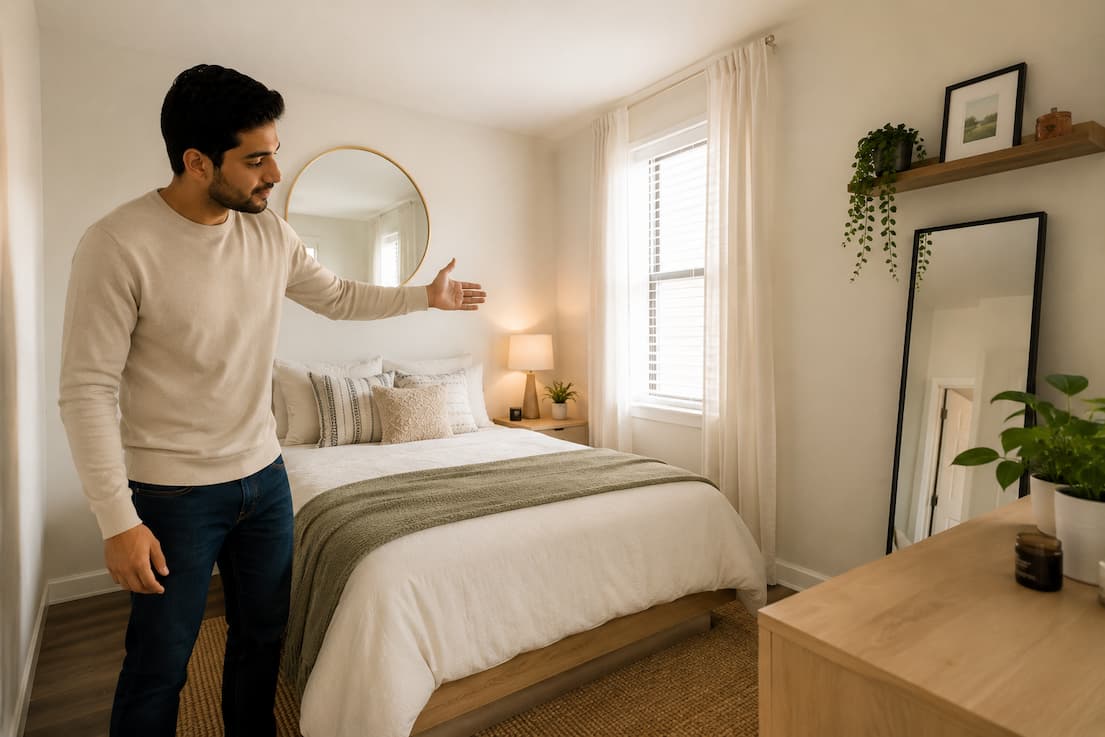
My bedroom is 9 feet by 10 feet. That is 90 square feet. I measured it three times because I refused to believe a grown adult could live in a space smaller than some walk-in closets. The bed is a full-size frame I bought used for $80. It takes up exactly 42 square feet. Nearly half the room. When I first moved in, I felt like I was sleeping in a storage unit with a window.
I spent a year convincing myself I needed a bigger apartment. Bigger rent, bigger bills, bigger everything. Then one Saturday I sat on my bed and realized the problem was not the room. It was how I was using it. I had a desk crammed in the corner, a floor lamp that ate walking space, and dark curtains that made the room feel like a cave by 3 PM. I started making changes that weekend. Some worked. Some made the room look worse. Here is what actually helped.
What I Was Working With
Let me be exact. The room is 9 feet wide, 10 feet deep. The ceiling is 8 feet high. The window is 3 feet wide and 4 feet tall, centered on the far wall. The closet is a sliding-door style, 5 feet wide with a single shelf and a hanging rod. No built-in drawers. No under-closet space. The door swings inward, which means every time I open it, it blocks the path to the closet.
My budget was $150 total. Not $150 per item. $150 for everything. I was not buying new furniture. I was working with what I had, rearranging, and adding a few cheap fixes.
What I Tried First (And Why It Failed)
My first idea was mirrors. Everyone says mirrors make a room look bigger. I bought a 4-foot by 3-foot mirror from a thrift store for $12 and leaned it against the wall opposite the window. It reflected the window light, sure. But it also reflected my messy bed, the pile of laundry I had not folded, and the tangled charging cables on my nightstand. Instead of making the room feel bigger, it made the clutter feel doubled.
I moved the mirror to the back of the closet door. Better. But the real lesson was this: mirrors only help if what they reflect is clean and open. A mirror in a cluttered room is a magnifying glass for mess.
My second failure was dark paint. I thought a deep navy accent wall would look sophisticated. I painted the wall behind my bed. It looked stunning for about two hours. Then the sun set. The room shrank. The navy wall absorbed every photon of light in the space. At night, with just my bedside lamp, the room felt like a shoebox. I repainted it a warm off-white two weeks later. The can of navy paint is still in my garage, judging me.
What Actually Worked
1. I Got Rid of the Floor Lamp
The floor lamp had a wide base and a heavy shade. It sat in the corner between my bed and the window, taking up roughly 2 square feet of floor space. I replaced it with a $15 clip-on LED light from Amazon that attaches to my headboard. It gives the same reading light but frees up the corner entirely. That one change made the walking path feel wider instantly.
2. I Raised the Bed
I bought four bed risers for $8 at Walmart. They lifted my bed frame 5 inches off the floor. That does not sound like much. But it created enough space underneath for three flat storage bins. I store my off-season clothes there. Before, those clothes lived in a plastic drawer unit that sat next to my bed, taking up floor space. Now the drawer unit is gone. The floor is open. The room breathes.
I wrote about how I use that under-bed space in detail in my guide to under-bed storage. That system is what made the bed risers worth it. Without a plan for what goes underneath, you just end up with a dusty void.
3. I Swapped the Curtains
My old curtains were dark gray, heavy fabric, and hung just above the window frame. They made the window look smaller than it was. I bought a pair of sheer white curtains for $18 and hung them from a rod mounted 6 inches above the window frame and 4 inches wider on each side. The sheer fabric lets light through even when closed. The higher, wider rod makes the window look larger. The room feels brighter by 9 AM than it used to feel at noon.
4. I Removed One Piece of Furniture
I had a small bookshelf, 2 feet wide, next to my desk. It held maybe fifteen books and a dying succulent. I moved the books to the closet shelf and gave the succulent to my neighbor. Then I removed the bookshelf entirely. That 2-foot gap changed the flow of the room. My desk chair could now swivel without hitting anything. I could walk from the door to the window in a straight line. Sometimes the best way to make a room feel bigger is to own less stuff.
5. I Used One Color Palette
Before, my room was a patchwork. Blue sheets, green throw pillow, red rug, brown desk, white walls. It looked like a clearance sale exploded. I did not buy new things. I just rearranged. I moved the green pillow to the living room. I rolled up the red rug and stored it. I kept the blue sheets and added a $12 beige throw blanket from Target that matched the off-white walls. Suddenly the room felt intentional instead of accidental. One friend visited and said, “Did you repaint?” I had not. I just stopped fighting myself.
💡 What I Learned the Hard Way
Do not buy furniture without measuring your doorways first. I found a perfect narrow nightstand on Facebook Marketplace for $10. Brought it home. It would not fit through my bedroom door. I had to return it, which meant borrowing my neighbor’s truck and losing an entire Saturday. Now I measure door width, hallway turns, and stairwells before I buy anything. My bedroom door is 30 inches wide. My hallway turn is tight. Anything deeper than 16 inches is a gamble. I keep a tape measure in my car now.
When This Won’t Work
⚠️ When This Won’t Work
These tricks work for visual expansion, but they do not create actual square footage. If you genuinely need more space for a home office, a nursery, or a roommate situation, no amount of curtain hanging will solve that. I am one person with a laptop and a bed. My needs are modest. If you need to fit a desk, a dresser, a bookshelf, and a workout area into 90 square feet, you will need to prioritize ruthlessly or consider a different room. Also, these tips assume you have some natural light to work with. My window faces east and gets decent morning sun. A north-facing basement room with one small window will not respond to sheer curtains the same way. In that case, invest in quality artificial lighting before anything else.
The Specific Changes, One by One
Here is exactly what I changed, what it cost, and whether I would do it again:
| Change | Cost | Time | Worth It? |
|---|---|---|---|
| Bed risers (4-pack) | $8 | 10 minutes | Yes — game changer |
| Sheer white curtains + rod | $28 | 30 minutes | Yes — biggest visual impact |
| Clip-on LED light | $15 | 5 minutes | Yes — freed up floor space |
| Beige throw blanket | $12 | Instant | Yes — tied the room together |
| Removing bookshelf | $0 | 20 minutes | Yes — zero cost, huge gain |
| Dark navy accent wall | $22 (paint + supplies) | 4 hours | No — repainted two weeks later |
| Large thrift store mirror | $12 | 5 minutes | Partially — works on closet door now |
Total spent on things that worked: $63. Total wasted on failures: $34. Net cost to make my room feel twice as big: $97. That is less than one month of the rent difference for a one-bedroom upgrade in my city.
What Others Suggested
I asked for advice on a Reddit thread in r/ApartmentDecorating last spring. The responses ranged from genius to useless.
One person said: “Mount your TV on the wall.” I do not own a TV. Another said: “Get a Murphy bed.” Those start at $800. Not helpful. But one comment stuck with me. A user named “tinyroomdweller” wrote: “Vertical space is your friend. Look up.” I had been so focused on the floor that I forgot about the walls. I installed two floating shelves above my desk for $14 total. They hold my books, a small plant, and my charging station. The desk surface is now completely clear. That one tip made my workspace feel twice as functional.
Another friend suggested over-the-door organizers. I bought one for $9 and hung it on the back of my bedroom door. It holds my shoes, my gym bag, and a few accessories. The floor near my closet used to be a shoe pile. Now it is empty. Small win. Big feeling.
Lighting: The Thing Nobody Talks About Enough
Here is the truth about small rooms. They do not need to be bright. They need to be layered. One overhead light in a small room creates harsh shadows in the corners. Those shadows make the walls feel closer than they are.
I added a $9 string of warm white LED fairy lights along the top of my window frame. They plug into a USB adapter. At night, with the overhead light off and just the fairy lights and my clip-on reading lamp, the room feels cozy instead of cramped. The light draws your eye to the window, which is the room’s best feature. It is a trick I learned from a YouTube video about theater set design. Light where you want attention. Shadow where you do not.
I also wrote about how I improved lighting in my home more broadly in my lighting improvement guide. The bedroom was just the start.
The One Rule That Changed Everything
After all these changes, I made one rule. Everything in this room must earn its place. If I have not used it in three months, it leaves. No exceptions. That rule forced me to donate a second pillow I never liked, a stack of magazines I kept “just in case,” and a decorative box that held nothing. The room did not just look bigger. It felt lighter. Mentally lighter. I sleep better. I wake up calmer.
That rule also connects to how I think about my whole apartment. I wrote about the small changes that made my home comfortable across every room. The bedroom was the proving ground.
FAQ
Will painting my room white automatically make it look bigger?
Not automatically. White helps reflect light, but if your room has no natural light and poor artificial lighting, white walls can look flat and sterile. I chose a warm off-white, not a stark clinical white. The warmth keeps it from feeling like a hospital room. Test paint samples on your wall and look at them morning, afternoon, and night before committing.
Do I need to buy new furniture?
No. I bought zero new furniture for this project. I removed furniture. That is the secret. Most small rooms feel crowded because people keep adding storage solutions instead of removing clutter. Before you buy anything, take something out. See how the room feels. Then decide what, if anything, you actually need.
What if my room has no windows?
That is tough. Windows are the single best tool for making a room feel larger because they create depth and connection to the outside. If you have no windows, focus on lighting layers. Use warm bulbs, not cool white. Add a large piece of art that depicts an outdoor scene. It sounds silly, but a landscape painting can trick your brain into perceiving depth. I have a friend who did this in her windowless basement bedroom and said it helped.
Are bed risers safe?
Yes, if you buy the right kind. Mine are plastic risers with a deep cup that the bedpost sits inside. They are rated for 1,200 pounds total. My bed frame is wood, not metal, and the legs fit snugly. If you have a metal frame with wheels, risers might not grip properly. Check the product specs. Also, if you are a restless sleeper, the extra height might feel weird at first. I got used to it in two nights.
How do I keep a small room from getting cluttered again?
The three-month rule I mentioned is the backbone. But also: do not use your bedroom as a dumping ground for things that belong elsewhere. I used to toss mail on my desk, drop gym clothes on the chair, and pile books on the nightstand. Now everything has a home. Mail goes to the kitchen counter. Gym clothes go straight to the hamper. Books go on the floating shelf. It takes 30 seconds longer to put things away, but the room stays open.
Related Articles
- How I Use Under-Bed Space for Storage — The system that makes my bed risers actually useful instead of just creating a dusty cave
- How I Improved Lighting in My Home — How I applied the layered lighting approach to my whole apartment, not just the bedroom
- Small Changes That Made My Home Comfortable — The broader philosophy of doing more with less across every room
Conclusion
My bedroom is still 9 by 10 feet. It has not grown. But it no longer feels like a punishment. It feels like a room I chose. The bed risers gave me storage I did not know I had. The curtains turned my window into a feature instead of an afterthought. Removing the bookshelf gave me space to breathe. And the navy paint failure taught me that bigger is not always better, brighter is.
If you are staring at your own small room right now, feeling trapped, start with one thing. Not ten. One. Move a lamp. Swap a curtain. Remove one piece of furniture you do not need. See how it feels. Then do the next thing. Small rooms do not need grand gestures. They need smart choices. And sometimes, the smartest choice is to own less.
Sources and References
- Energy Star — Lighting and Fans — Guidance on selecting energy-efficient lighting options for home use. I referenced this when choosing my LED clip-on light and fairy lights to ensure I was not wasting electricity in a small space.
- Apartment Therapy — Small Space Living — Practical advice on maximizing small rooms through layout, color, and furniture choices. Helped me validate my decision to remove furniture rather than add more.
- Better Homes & Gardens — Small Bedroom Ideas — Tips on color palettes, curtain placement, and vertical storage for small bedrooms. Confirmed my approach to mounting curtains higher and wider than the window frame.

Hamza Farooq is a home improvement and organization writer who shares practical advice on cleaning, simple DIY fixes, and smart home organization. He focuses on creating easy-to-follow guides that help readers solve everyday household problems with realistic, affordable solutions. His goal is to make home maintenance simpler, more efficient, and accessible for anyone looking to improve their living space.