I used to think keeping a home clean meant spending a certain amount of time cleaning every room on a regular schedule. That approach sounds sensible until everyday life gets busy. Some parts of the house can go several days without needing much attention, while other surfaces seem to collect fingerprints, dust, food residue, and grime almost immediately. Door handles, light switches, faucet handles, appliance controls, cabinet pulls, and frequently used tables can look dirty again shortly after they have been cleaned.
Over time, I stopped treating all surfaces as though they needed the same level of attention. Instead, I started paying more attention to how often something is touched and what is transferred onto it. That changed my routine considerably. Rather than repeatedly cleaning entire rooms, I focus on the smaller areas that receive constant contact and address them before buildup becomes noticeable. The result is a home that feels cleaner without requiring me to spend hours wiping every surface every day.
I Start With the Places My Hands Actually Reach
The easiest way to identify high-touch areas is simply to pay attention during a normal day. I notice what I touch when I enter the house, prepare food, use the bathroom, open a cabinet, turn on a light, or leave a room. Once I started observing these movements, I realized how many surfaces were being contacted repeatedly without receiving much attention during my normal cleaning routine.
Door handles are an obvious example, but they are only part of the picture. Cabinet pulls, refrigerator handles, drawer handles, faucet levers, light switches, remote controls, frequently used appliance buttons, and the edges of commonly handled furniture can all receive repeated contact. I do not automatically clean every one of these areas every day. Instead, I keep a mental list of the surfaces that become visibly dirty or collect noticeable residue most quickly and give those areas priority.
I Separate High-Touch Cleaning From General Cleaning
One change that made my routine easier was separating high-touch cleaning from ordinary household cleaning. Dusting shelves, vacuuming floors, cleaning windows, and wiping countertops are useful tasks, but they do not necessarily need to happen at the same frequency as cleaning surfaces that are constantly handled.
This distinction prevents me from turning a small task into a whole-house cleaning session. If a cabinet pull looks dirty, I can clean the pull without deciding that the entire kitchen needs to be cleaned at that moment. Likewise, if a frequently used light switch has visible marks, I can deal with that particular surface instead of creating another large chore. The smaller the task feels, the easier it is to complete consistently.
My Kitchen Gets the Most Attention
The kitchen is where I notice the biggest difference because hands move between food, packaging, utensils, appliances, cabinets, and faucets throughout the day. Handles and controls can accumulate grease or food residue even when the rest of the kitchen looks reasonably clean. I therefore pay particular attention to the refrigerator handle, cabinet pulls, drawer handles, faucet controls, and the areas around appliances that are used repeatedly.
I usually combine this with my normal kitchen routine rather than creating a separate cleaning session. If I am already wiping the counter after preparing food, I can deal with the nearby handles when they need it. When something becomes visibly greasy or sticky, I do not wait for a particular day on the calendar. Addressing the residue while it is still fresh is generally easier than allowing it to build up over several days.
I Do Not Use the Same Cleaner on Everything
One habit I have become more careful about is assuming that one cleaning product is appropriate for every frequently touched surface. A cabinet handle, painted light switch, stainless-steel appliance, finished wood surface, and plastic control panel may all have different finishes and care requirements.
Before using a product repeatedly on a surface, I consider what the material is and whether the manufacturer provides cleaning instructions. I also avoid applying liquid directly to electrical switches or controls. Instead, I use an appropriate amount of cleaner on a suitable cloth or follow the care instructions for the specific item. The goal is to remove grime without gradually damaging the finish through unnecessary moisture, abrasive materials, or unsuitable chemicals.
Door Handles Are Easy to Forget
Door handles are among the first things I think about when I am doing a high-touch cleaning pass because they are used constantly but rarely look dramatic enough to attract attention. A handle can collect skin oils and everyday residue without appearing obviously dirty from across the room. The same applies to the surrounding area of a door where hands regularly make contact.
I pay more attention to doors that are used repeatedly throughout the day, particularly entrances, bathrooms, kitchens, and other high-traffic areas. Rather than cleaning every handle automatically every day, I check the surfaces and clean them when they need attention. This keeps the routine practical and prevents me from spending time on low-use doors simply because they happen to be on a checklist.
Light Switches Need a Gentle Approach
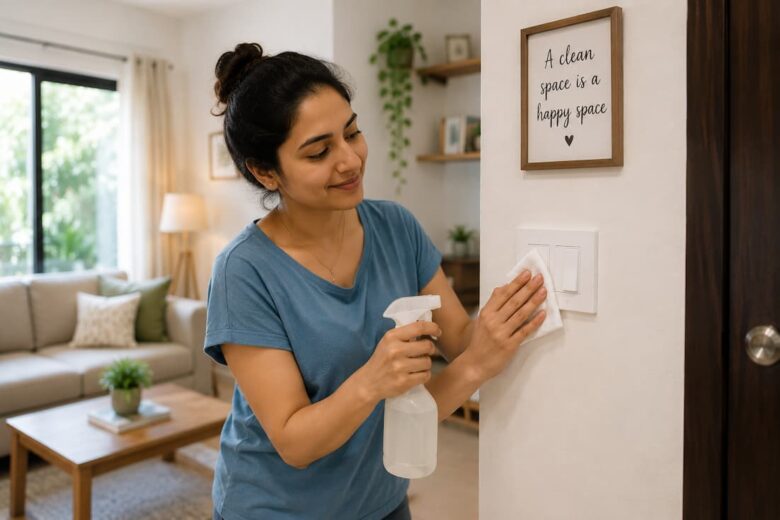
Light switches are another area that can accumulate fingerprints and marks surprisingly quickly. Because they are frequently touched, they deserve occasional attention, but they also require more care than a countertop because of their electrical components.
I make sure the cleaning method does not introduce unnecessary moisture into the switch or surrounding electrical area. A lightly dampened cloth, when appropriate for the surface, is very different from spraying cleaner directly onto a switch. I also pay attention to the finish of the wall plate because some materials can show scratches or discoloration if abrasive products are used repeatedly.
The point is simple: high-touch does not mean high-moisture.
Faucet Handles Tell Me When a Surface Needs Attention
Kitchen and bathroom faucets are useful indicators because they can accumulate both fingerprints and water-related residue. In the kitchen, the handle may also be touched while cooking, which means it can become greasy even when the faucet itself looks relatively clean.
I usually deal with the handle when I am already cleaning the surrounding sink area. If there is visible buildup, I use a cleaning method appropriate for the fixture’s finish rather than assuming that a stronger product will produce a better result. I also make sure the surface is not left unnecessarily wet, particularly around areas where water tends to collect.
This takes very little time when done regularly, but the difference is noticeable because faucet handles are among the surfaces that immediately reveal repeated use.
Cabinet and Appliance Handles Need Different Attention
Kitchen cabinet handles are easy to overlook because they are small, but they receive repeated contact throughout the day. Grease from cooking can make the problem more noticeable, especially on cabinets close to the stove or food preparation area.
Appliance handles can behave similarly. Refrigerator doors, oven handles, microwave controls, and dishwasher handles may receive contact from hands that have just been handling food or other objects. I do not treat every appliance as equally dirty, but I pay attention to the ones that are used most often. If a handle becomes greasy, I deal with it rather than waiting until the next major kitchen cleaning.
I Keep a Small Cleaning Kit for Quick Jobs
One reason small cleaning tasks become bigger chores is that the required supplies are inconvenient to find. If I have to search through a cabinet for a cloth and cleaning product every time I notice a dirty handle, it becomes easier to ignore the problem.
Keeping a small collection of appropriate supplies in a convenient location makes quick cleaning more realistic. I keep suitable cloths available and use cleaning products according to the surfaces they are designed for. The exact products matter less than having a simple setup that does not require preparation every time a small area needs attention.
I also avoid creating a huge collection of specialized products. Too many cleaners can make the routine more complicated and increase the chance of using something inappropriate on a particular surface.
I Clean Remote Controls and Frequently Used Devices Carefully
Remote controls, keyboards, appliance controls, and other frequently handled devices can be overlooked because they do not look like traditional household surfaces. Yet they can accumulate oils, dust, and residue simply because they are touched so often.
These items require a more careful approach than a countertop. I avoid getting liquid into buttons, openings, seams, or electronic components and follow the manufacturer’s cleaning guidance when it is available. For devices with removable batteries or other specific care requirements, I follow the appropriate instructions rather than improvising.
The important thing is to recognize that something being small does not mean it should be soaked in cleaner.
I Pay Attention to the Area Around the Handle Too
Sometimes the handle itself is clean while the surrounding surface is not. This is particularly noticeable around doors, cabinets, refrigerators, and frequently used drawers where hands repeatedly touch the same nearby area.
When I clean a high-touch point, I therefore take a moment to look at the surrounding surface. If there are fingerprints, food marks, or grime nearby, I clean those areas at the same time when the material allows it. This prevents the routine from becoming too narrowly focused on the hardware itself.
It also makes the cleaning more effective visually. A clean handle surrounded by obvious fingerprints can still make the whole area appear dirty.
I Use Frequency Rather Than a Rigid Daily Checklist
I have found that a strict rule such as “clean every high-touch surface every day” is harder to maintain than a flexible routine based on actual use. Some surfaces genuinely need frequent attention, while others can go much longer without becoming dirty.
For example, a refrigerator handle in a busy kitchen may need attention several times a week, while a guest-room door handle may require far less. A bathroom faucet used by several people may need more frequent cleaning than a fixture in a rarely used bathroom.
This approach also prevents unnecessary cleaning. If something is clean, I do not feel obligated to clean it again simply because the calendar says so.
I Give Extra Attention to High-Traffic Rooms
Not every room in the house generates the same amount of contact. Kitchens, bathrooms, entrances, living rooms, and frequently used work areas usually deserve more attention than rooms that are rarely occupied.
I think about who uses the space, how often it is used, and what people are doing there. An entrance may have several frequently touched surfaces because everyone passes through it. A home office may have a keyboard, mouse, desk edge, drawer handle, and chair controls that receive repeated contact. A guest bedroom may have very little high-touch activity most of the time.
This allows me to spend my cleaning time where it produces the greatest visible and practical benefit.
A Simple High-Touch Cleaning Routine
When I want to do a quick pass through the house, I do not try to clean everything. I move through the areas where hands are most active and look for obvious residue, fingerprints, dust, or buildup.
| Area | What I usually check | Typical attention |
|---|---|---|
| Kitchen | Refrigerator handle, cabinet pulls, faucet controls | Frequent/as needed |
| Bathroom | Faucet handles, door handles, switches | Frequent/as needed |
| Entryway | Door handles, switches, nearby surfaces | Several times a week/as needed |
| Living room | Remote controls, frequently touched tables | Weekly/as needed |
| Home office | Keyboard, mouse, drawer handles | Regularly/as needed |
| Bedroom | Door handles, switches, commonly touched furniture | Weekly/as needed |
| Laundry area | Appliance handles and controls | Weekly/as needed |
These frequencies are not rules that every household needs to follow. I adjust them based on how much each area is actually used. If something remains clean, there is no reason to clean it simply to satisfy a schedule. If something becomes dirty quickly, I shorten the interval rather than waiting for a particular day.
I Do Not Turn High-Touch Cleaning Into Whole-House Cleaning
This is probably the most important part of the routine for me. High-touch cleaning works because it is selective. If I turn every dirty handle into an excuse to clean the entire room, a five-minute maintenance task becomes a much larger project.
When I notice a dirty surface, I ask whether it can be dealt with immediately. If the answer is yes, I clean it and move on. If the surface needs a deeper cleaning method, I add it to the appropriate household task instead of trying to solve everything at once.
That approach keeps small problems from accumulating while also preventing cleaning from taking over the day.
I Watch for Recurring Grime Instead of Simply Wiping It Away
Repeated buildup can sometimes tell me something about the way a space is being used. If a cabinet near the stove constantly becomes greasy, the issue may simply be cooking activity. If a particular door area repeatedly develops marks, it may be receiving more contact than expected.
Sometimes the solution is not to clean more frequently but to change the surrounding routine. A frequently used appliance may need to be repositioned, a kitchen surface may need better ventilation, or an item may need to be stored somewhere that reduces unnecessary contact.
Cleaning can remove the evidence of a problem, but observing the pattern can sometimes prevent the buildup from happening so often.
What I Do When I Am Short on Time
When I only have a few minutes, I prioritize the surfaces that are both frequently touched and visibly dirty. I do not worry about completing an entire checklist. A quick pass over several important handles and controls can be more worthwhile than spending the same amount of time on a low-use decorative surface.
I also combine cleaning with tasks I am already doing. After cooking, I can check the refrigerator handle and cabinet pulls. After cleaning the bathroom sink, I can look at the faucet handle and nearby door handle. When leaving a room, I can notice whether the switch or handle needs attention.
These small moments add up, and they make the larger cleaning sessions easier because high-touch grime is less likely to accumulate.
Frequently Asked Questions
How often should frequently touched surfaces be cleaned?
There is no universal schedule because frequency depends on household activity, the surface itself, and how quickly visible residue develops. A busy kitchen or bathroom may need attention several times a week, while low-use areas may need much less. I find it more practical to use a flexible routine based on actual use rather than treating every high-touch surface identically.
Which areas of a home are touched the most?
Common examples include door handles, cabinet pulls, drawer handles, light switches, faucet handles, refrigerator handles, appliance controls, remote controls, and frequently used furniture surfaces. The exact list varies by household, so observing normal daily activity is one of the easiest ways to identify the areas that deserve priority.
Can I use one cleaner for all high-touch surfaces?
It is better not to assume that one cleaner is suitable for every material or finish. Painted surfaces, wood, stainless steel, plastic, glass, and electronic controls can have different care requirements. Check manufacturer instructions when available and use the gentlest appropriate method that effectively removes the residue.
Should I disinfect every frequently touched surface?
Routine cleaning and disinfection are not necessarily the same thing. Ordinary cleaning removes dirt and residue, while disinfection is intended for a different purpose and should be performed according to the product’s directions and the circumstances in which it is needed. There is no need to automatically use a strong disinfectant on every surface simply because it is frequently touched.
How can I keep high-touch areas clean without cleaning all day?
Focus on the surfaces that actually receive frequent contact, combine quick cleaning with tasks you are already doing, and respond to visible buildup rather than following an unnecessarily rigid schedule. Keeping appropriate supplies accessible also makes small maintenance tasks easier to complete before they become larger jobs.
I Focus on What Makes the Home Feel Used
A clean home does not require every surface to receive the same amount of attention. In fact, trying to clean everything equally can make routine maintenance unnecessarily exhausting. The surfaces that matter most are often the ones that show the evidence of everyday life: the refrigerator handle covered with fingerprints, the cabinet pull that has collected cooking residue, the light switch marked by repeated contact, or the faucet handle that is used dozens of times.
Once I started focusing on those areas, cleaning became much more manageable. I no longer felt that noticing one dirty handle meant I needed to start cleaning an entire room. I could deal with the specific surface, use an appropriate method for the material, and move on.
The biggest benefit is consistency. A small amount of attention given regularly prevents high-touch areas from becoming noticeably grimy, while the rest of the house can follow its own cleaning rhythm. For me, keeping frequently touched areas clean is less about cleaning more and more about cleaning the right things at the right time.

Hamza Farooq is a home improvement and organization writer who shares practical advice on cleaning, simple DIY fixes, and smart home organization. He focuses on creating easy-to-follow guides that help readers solve everyday household problems with realistic, affordable solutions. His goal is to make home maintenance simpler, more efficient, and accessible for anyone looking to improve their living space.