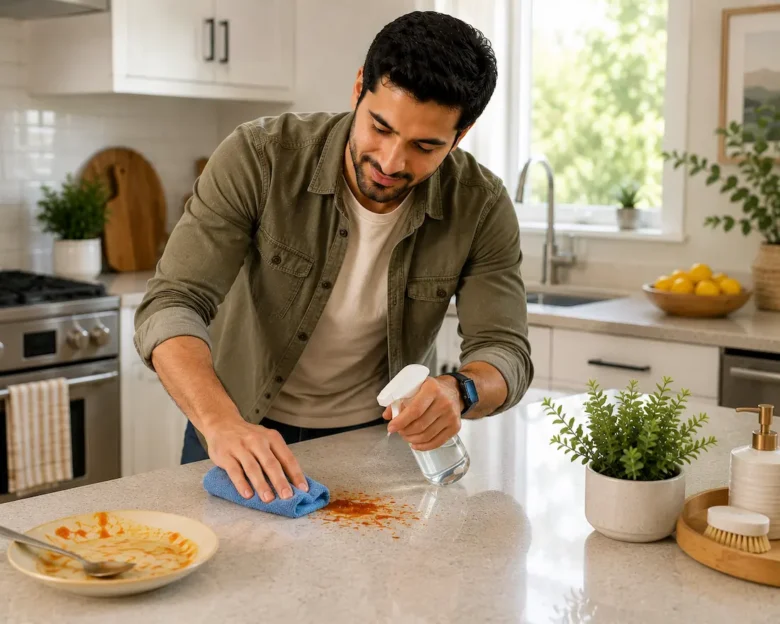
Red wine on white laminate. Two minutes before my mother-in-law arrived. I did not panic. I lied. I panicked completely. I stood in my kitchen holding a paper towel and a prayer.
The stain was the size of a quarter. Growing. Seeping into the seam between countertop and backsplash. I had no special cleaner. No magic eraser. No time to run to the store. Just me, the stain, and the sound of a car pulling into the driveway.
I fixed it. In four minutes. She never knew. But I knew. And now I prepare for stains the way some people prepare for earthquakes. Not because they happen often. Because once is enough.
What I Was Working With
My kitchen surfaces are a museum of bad decisions. White laminate countertops from the 1990s. A wooden cutting board with more scars than a horror movie villain. A glass stovetop that shows every fingerprint. And a tile backsplash with grout that absorbs splatter like a sponge.
I cook daily. Not well. Enthusiastically. Tomato sauce splatters. Oil pops. Wine tips. Coffee drips. I have stained every surface I own at least twice. Some stains I won. Some stains own me still. I will tell you about both.
The Universal Rule I Break Constantly
Blot, do not rub. Everyone knows this. I know this. I still rub sometimes. Panic makes you rub. Rubbing spreads the stain, pushes it deeper, and creates a fuzzy halo that looks like a bruise.
When I remember the rule, I grab a clean cloth. White. No dyes that might transfer. I press down. Lift. Press. Lift. No sideways motion. The stain transfers to the cloth gradually. It is boring. It works.
When I forget the rule, I create a bigger problem. The red wine incident? I rubbed for ten seconds before my brain engaged. Made the stain three times larger. Had to treat the whole area, not just the spot. Grease stains are even worse for spreading when rubbed. Oil loves to travel.
Method by Surface, Tested in Actual Panic
Laminate Countertops
For fresh spills: blot with water. Plain water. Most food stains are water-soluble when wet. If water does not lift it, I make a paste of baking soda and water. Thick. Like toothpaste. Spread it on the stain. Wait ten minutes. Wipe. The baking soda is mildly abrasive. It lifts without scratching.
For set stains: hydrogen peroxide. Three percent. The pharmacy kind. I pour a small amount on the stain. Cover with plastic wrap. Wait an hour. The peroxide bubbles. Lifts the stain from below. Wipe. Rinse. Dry.
I learned the plastic wrap trick from a dentist’s office magazine. It keeps the peroxide from evaporating. Without it, the peroxide dries in five minutes and does nothing. With it, the stain surrenders.
Wooden Cutting Boards
Wood absorbs. That is its job. Salt and lemon are my fix. Coarse salt sprinkled on the stain. Half a lemon squeezed over it. Scrub with the lemon half, cut side down. The salt abrasives. The lemon acid lifts. Rinse immediately. Dry standing up, not flat. Standing lets air circulate. Flat lets moisture pool and warp the wood.
For deep stains: sand lightly with 220 grit. Re-oil with mineral oil. I do this quarterly anyway. The board looks new each time. Wood care is wood care, whether it is furniture or a board. Same principles.
Glass Stovetop
Sugar is the enemy. Caramelized sugar scratches glass. If you spill something sweet, turn off the burner. Let it cool. Do not wipe while hot. The sugar hardens into glass-eating sandpaper.
Once cool: razor blade. Flat. At a thirty-degree angle. Scrape the residue. It sounds violent. It is gentle. The blade lifts without scratching if you keep it flat. Then I clean with a paste of baking soda and water. Wipe with a microfiber cloth. The stovetop shines. The sugar is gone. My blood pressure returns to normal.
Tile Backsplash Grout
Grout is the stain magnet of the kitchen. It is porous. It is light-colored. It is everywhere. I keep a spray bottle of equal parts water and white vinegar. When something splatters, I spray. Wait two minutes. Wipe. The acid neutralizes most food stains before they set.
For set stains: oxygen bleach paste. Thick. Applied with an old toothbrush. Wait fifteen minutes. Scrub gently. Rinse. The grout returns to its original color. Or close enough. I do this monthly now. Prevention is easier than rescue. Frequent cleaning of splatter zones keeps the grout from becoming a project.
💡 What I Learned the Hard Way
I once used bleach on a laminate counter to remove turmeric. The turmeric left. But the bleach left a yellow halo where it had lightened the laminate itself. The stain was gone. The halo remained. I covered it with a cutting board for six months. The lesson: bleach is for white grout and white grout only. It will damage colored surfaces, wood, and some plastics. I now keep bleach in the bathroom, not the kitchen. Out of reach. Out of panic range.
Quick Reference: Stain vs. Surface vs. Fix
| Stain Type | Surface | First Response | If Set |
|---|---|---|---|
| Red wine | Laminate | Blot with water | Hydrogen peroxide + plastic wrap |
| Turmeric / curry | Any | Baking soda paste immediately | Oxygen bleach, may not fully lift |
| Grease / oil | Laminate, stovetop | Dish soap + warm water | Degreaser or baking soda paste |
| Coffee / tea | Laminate, grout | Blot, then vinegar solution | Hydrogen peroxide or oxygen bleach |
| Sugar / caramel | Glass stovetop | Cool completely, then scrape | Razor blade flat, then baking soda paste |
⚠️ When This Won’t Work
If your countertop is natural stone — marble, granite, quartzite — do not use vinegar, lemon, or hydrogen peroxide without testing. Acid etches stone. It will remove the stain and replace it with a dull spot that never goes away. Use a pH-neutral stone cleaner instead. Also, if your laminate is old and the top layer is peeling, no cleaner will fix the discoloration. The stain is in the exposed substrate. You need replacement, not restoration. Finally, if you have a stain on unsealed wood — a butcher block, a table — the stain has penetrated deep. Surface cleaning will not reach it. You need sanding or professional refinishing. Do not soak wood. It warps. It cracks. It remembers your mistakes.
Frequently Asked Questions
Does club soda actually work on wine stains?
It works on fabric. On countertops, it is just carbonated water. The carbonation does nothing. The water dilutes the stain. Plain water does the same thing. Save the club soda for your carpet. Or your glass.
What if I do not have hydrogen peroxide?
Baking soda paste is your backup for almost everything. It is not as fast. It is not as dramatic. But it works. Mix thick. Wait longer than you think. Ten minutes minimum. Patience is the ingredient you cannot buy.
Can I use a magic eraser?
I have. They work. They are also micro-abrasive. They remove the stain by removing a thin layer of the surface. On laminate, this is fine once or twice. Repeated use creates a worn patch that catches light differently. Use sparingly. Emergency only. Not weekly maintenance.
Why does turmeric stain everything permanently?
Turmeric contains curcumin. It binds to surfaces at a molecular level. It is literally a dye. Fresh turmeric is worse than powder. If you get it on white grout or laminate, treat immediately. Baking soda paste. Wait. Scrub gently. If it sets for days, it may never fully lift. I have a faint yellow memory on my cutting board. I call it character. It is actually defeat.
Should I seal my grout to prevent stains?
Yes. I finally did. Penetrating sealer. Applied after a deep clean. Now splatters bead up instead of soaking in. I still clean them. But the panic is gone. The stain sits on top, waiting for me. Not inside, laughing at me.
Closing Thought
Stains are not failures. They are evidence of cooking. Of living. Of wine that was good enough to spill.
But they do not have to stay. The right response, fast, saves the surface. The wrong response, panicked, creates a story you tell for years. I have both kinds of stories.
Keep baking soda in the cabinet. Keep vinegar in the spray bottle. Keep hydrogen peroxide in the bathroom, not the kitchen, so you have to walk there and think before you bleach something.
And keep a white cloth under the sink. For blotting. Not rubbing. Never rubbing.
My mother-in-law still does not know about the wine. She complimented the countertops. I smiled and changed the subject. Some victories are private.
Sources and References
- U.S. Food and Drug Administration (FDA) — Information on turmeric and curcumin properties, including their use as color additives and their staining characteristics.
- U.S. Environmental Protection Agency (EPA) Safer Choice Program — Guidelines for selecting safer cleaning products for food preparation surfaces and residential kitchens.
- Centers for Disease Control and Prevention (CDC) — Healthy Homes — Recommendations for maintaining clean and safe kitchen environments, including proper cleaning practices for food contact surfaces.

Hamza Farooq is a home improvement and organization writer who shares practical advice on cleaning, simple DIY fixes, and smart home organization. He focuses on creating easy-to-follow guides that help readers solve everyday household problems with realistic, affordable solutions. His goal is to make home maintenance simpler, more efficient, and accessible for anyone looking to improve their living space.