
I used to have a chair. You know the chair. Every home has one. The chair that is not for sitting. It is for holding. Coats. Bags. Clean laundry that never quite made it to the closet. The chair grew. It became a mountain. Then a range. Then an ecosystem. I found a receipt from three months ago in its lower layers. A banana that had achieved sentience. A sock that did not belong to me.
The chair was not the problem. I was the problem. I brought things into my home faster than I assigned them purpose. The mail came in. It stayed. Groceries came in. They stayed on the counter. Shoes came off. They stayed in the hallway. Everything entered. Nothing left. The chair was just where the excess went to die.
I fixed it not by organizing. But by slowing the intake. By making leaving as natural as entering. By building a system where items flow through instead of accumulating.
What I Was Working With
My apartment is 850 square feet. Two people. No entryway. The front door opens directly into the living room. There is no mudroom. No foyer. No transition zone. Shoes, bags, and mail hit the floor within three steps of entering.
I work from home three days a week. My partner works from home five. We generate mess faster than a household that leaves for offices. Coffee cups. Notebooks. Chargers. Headphones. The debris of two lives lived in one small space.
We do not have a cleaning service. We do not want one. The goal is not to hide mess. It is to prevent mess. To stop the chair before it becomes a mountain.
The Principle: Everything Needs a Door
Not literally. Metaphorically. Every item that enters needs a clear path to exit. A decision point. A moment where it either gets used, stored, or removed. Without that moment, it stays. It becomes clutter.
I built these moments into my daily routine. Five of them. Small. Invisible. But they keep the flow moving.
Moment 1: The Threshold
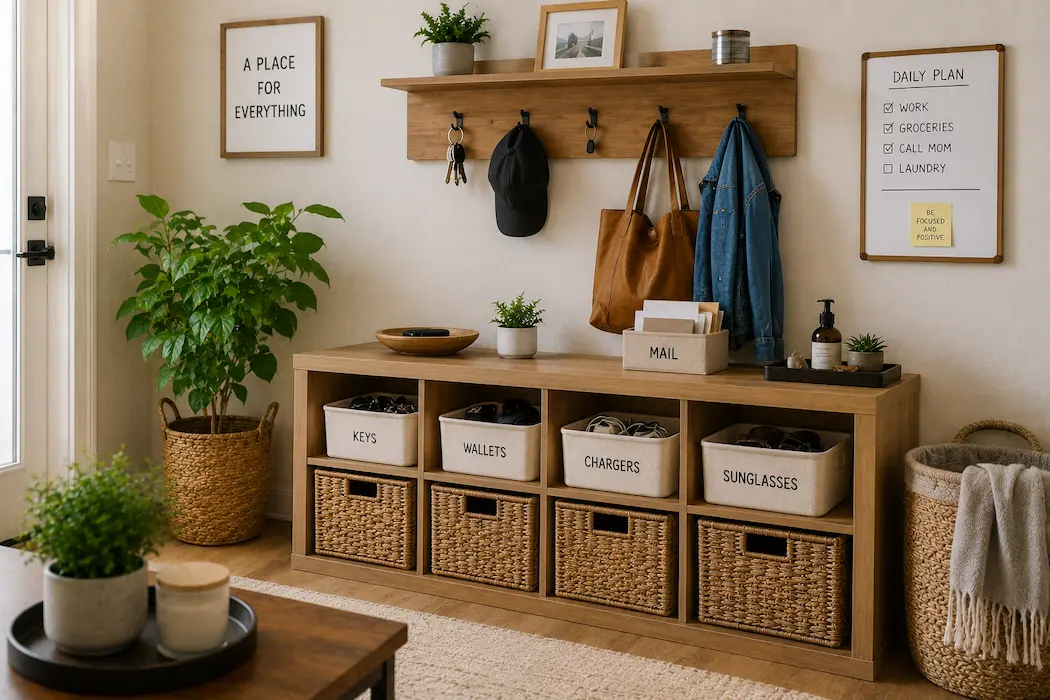
When I enter, I stop. I do not walk past the door. I stand there. I remove my shoes. They go on a rack. Not a mat. A rack. Elevated. Visible. If the rack is full, I know I have too many shoes out. The rack is my limit. Four pairs. That is the rule.
My bag goes on a hook. One hook. Not a row. One. If the hook is occupied, I must empty the bag first. Remove what I need. Put the bag away. The hook enforces emptiness.
Mail goes from my hand to a small basket. Not a box. A basket. Open. Visible. I sort it standing up. Junk to recycling immediately. Bills to a folder. Magazines to a reading pile. Nothing stays in the basket overnight. The basket is temporary. Temporary means daily. Daily means done.
The threshold system is the first domino. If it fails, the rest follows.
Moment 2: The Counter
Kitchen counter. Six feet. Two feet are sink. Two feet are stove. Two feet are mine. I guard them.
Nothing lives on the counter permanently. Not the toaster. Not the coffee maker. Not the knife block. They live in cabinets. They come out for use. They return after. The counter is workspace. Not storage.
This sounds extreme. It is not. I use the toaster daily. But it takes ten seconds to retrieve. Ten seconds to return. The counter stays clear. Clear means usable. Usable means I cook instead of ordering delivery because I do not want to clear space first.
Dirty dishes go directly to the sink. Not the counter. The sink is for dirty. The counter is for working. I do not let dishes migrate. Migration is how counters die.
The kitchen organization supports this discipline. Everything has a cabinet. Every cabinet is reachable.
Moment 3: The Evening Sweep
At 9 PM, I do a sweep. Not a clean. A sweep. I walk through the apartment with a basket. I pick up everything that is not where it belongs. A cup on the coffee table. A charger on the floor. A jacket on the chair. The chair.
I do not put things away during the sweep. I collect. The basket fills. Then I distribute. Kitchen items to the kitchen. Clothes to the closet. Trash to the trash. The sweep takes ten minutes. The distribution takes five. Fifteen minutes total. Every night.
I do not skip. Skipping once means skipping twice. Skipping twice means the chair returns. I have seen the chair. I do not want to see it again.
Moment 4: The One-Out Rule
New shirt enters. Old shirt leaves. New book enters. Old book leaves. New gadget enters. Old gadget leaves. One in, one out. Ruthless. Automatic.
I keep a donation bag in the closet. When something enters, I look at what it replaces. The replaced item goes in the bag. When the bag is full, I drop it off. No second thoughts. No “maybe I will wear it again.” The replacement has already happened. The decision is made.
This rule applies to everything except consumables. Food. Toilet paper. Soap. Those deplete naturally. Everything else: one in, one out.
The wardrobe is where this rule started. It spread. Now it governs everything.
Moment 5: The Sunday Review
Every Sunday, I sit down. I look around. I ask: what accumulated this week? What slipped through? What is on the counter that should not be? What is in the chair that returned?
I fix one thing. Not everything. One. Last week, it was a pile of magazines. I recycled half. Kept two. The week before, it was a drawer that had become a junk drawer. I emptied it. Sorted. Returned items to proper homes.
The review is not a deep clean. It is maintenance. Catching the leak before it floods. Ten minutes. One problem. Then I stop. Over-maintenance becomes obsession. I am not obsessed. I am consistent.
💡 What I Learned the Hard Way
I once tried to implement all five moments at once. Monday: threshold system. Tuesday: counter clearing. Wednesday: evening sweep. Thursday: one-out rule. Friday: Sunday review. I crashed by Saturday. The apartment was pristine. I was exhausted. The system failed because it required too much energy. I restarted with just the threshold. One week. Then added the counter. Another week. Then the sweep. Then the rule. Then the review. Each addition felt natural because the previous one was automatic. It took six weeks to build the full system. But it has lasted two years. The lesson: systems fail when they require willpower. Build them one habit at a time. Let each become invisible before adding the next.
The Flow: How Items Move Through
| Item Type | Enters Through | Decision Point | Exits To |
|---|---|---|---|
| Front door | Threshold basket, sorted immediately | Recycle, file, or read pile | |
| Clothing | Closet or laundry | One-in-one-out rule | Donation bag or laundry |
| Kitchen items | Grocery store | Counter use, then immediate return | Cabinet, fridge, or pantry |
| Daily carry | Front door | Hook and rack at threshold | Bag emptied, items distributed |
| Random objects | Anywhere | Evening sweep basket | Proper home or trash |
⚠️ When This Won’t Work
If you live with people who refuse to participate, the system breaks at the threshold. I am lucky. My partner adapted. But if you have children, roommates, or a partner who genuinely does not see mess, you cannot enforce this alone. You will become the mess police. Resentment will grow. In that case, create a personal zone. Your desk. Your side of the bed. Your shelf. Let the rest be communal chaos. Control what you can control. Also, if you are currently in a life transition — moving, new baby, new job, illness — abandon the system. Just survive. The system requires stability. Instability requires flexibility. Finally, if you are a collector, a hobbyist, or someone who genuinely needs many items accessible for creative work, the one-in-one-out rule is too rigid. Modify it. One in, one stored. Not out. Just rotated. The principle is flow, not minimalism. Adapt the flow to your actual life.
Frequently Asked Questions
How do you handle mail from a partner who does not sort?
I sort it. Not because I should. Because I cannot stand the pile. I have tried waiting. The pile grows. It attracts more pile. I sort their mail with mine. I do not resent it. It takes thirty seconds. The alternative is a two-hour weekend sorting session. I choose thirty seconds.
What about items you use daily but do not want to put away?
Define “daily.” If you use it every single day, it gets a designated spot. My coffee mug lives on a small hook by the machine. My headphones live in a bowl by my desk. These are not clutter. They are assigned. The rule is: if it has a spot, it can stay out. If it does not have a spot, it goes in. Assign spots sparingly. Or everything claims one.
Does the evening sweep ever feel like too much?
Sometimes. On Fridays. After a hard week. When I want to collapse. I do the sweep anyway. It takes ten minutes. The collapse feels better in a clear space. I have tested both. Collapsing in chaos feels worse. The sweep is self-care disguised as cleaning.
What about sentimental items?
One box. Small. Under the bed. If it does not fit, something leaves. The box is the limit. Not the heart. The heart wants to keep everything. The box enforces reality. I have a ticket stub from a concert. A letter from my grandmother. A stone from a beach. That is all. The box has room for more. I am careful about what earns entry.
How do you prevent the chair from returning?
I removed the chair. Seriously. I do not own a chair that invites draping. I have a desk chair. It has arms. It is uncomfortable for holding clothes. The couch is too far from the door. The bed is too formal. There is no convenient landing zone. The rack, hook, and basket handle everything that used to go to the chair. Without the chair, the system works. With the chair, it would fail. Environment shapes behavior. I shaped my environment.
Closing Thought
My apartment is not minimalist. It is not pristine. There are coffee mugs. There are books. There is a cat who sheds on everything.
But there is no chair. No mountain. No ecosystem of forgotten items.
Everything that enters has a path to exit. The threshold. The counter. The sweep. The rule. The review. Five moments. Fifteen minutes a day. Ten minutes on Sunday.
The system is invisible now. I do not think about it. I just do it. The mail sorts itself because the basket is there. The shoes rack themselves because the rack is there. The items flow because the channels are built.
You do not need discipline. You need channels. You need a basket by the door. A hook for your bag. A rack for your shoes. A clear counter. A donation bag in the closet.
Build the channels. The flow will follow.
And if you have a chair, ask yourself: what is it holding? And why?
Then remove the chair.
Sources and References
- American Psychological Association (APA) — Research on decision fatigue, habit formation, and how environmental design reduces cognitive load and supports consistent behavior.
- Centers for Disease Control and Prevention (CDC) — Healthy Homes — Guidelines for maintaining organized, clean, and healthy residential environments through routine practices and clutter reduction.
- U.S. Environmental Protection Agency (EPA) Safer Choice Program — Recommendations for sustainable home maintenance and reducing household waste through mindful consumption and disposal practices.

Hamza Farooq is a home improvement and organization writer who shares practical advice on cleaning, simple DIY fixes, and smart home organization. He focuses on creating easy-to-follow guides that help readers solve everyday household problems with realistic, affordable solutions. His goal is to make home maintenance simpler, more efficient, and accessible for anyone looking to improve their living space.