
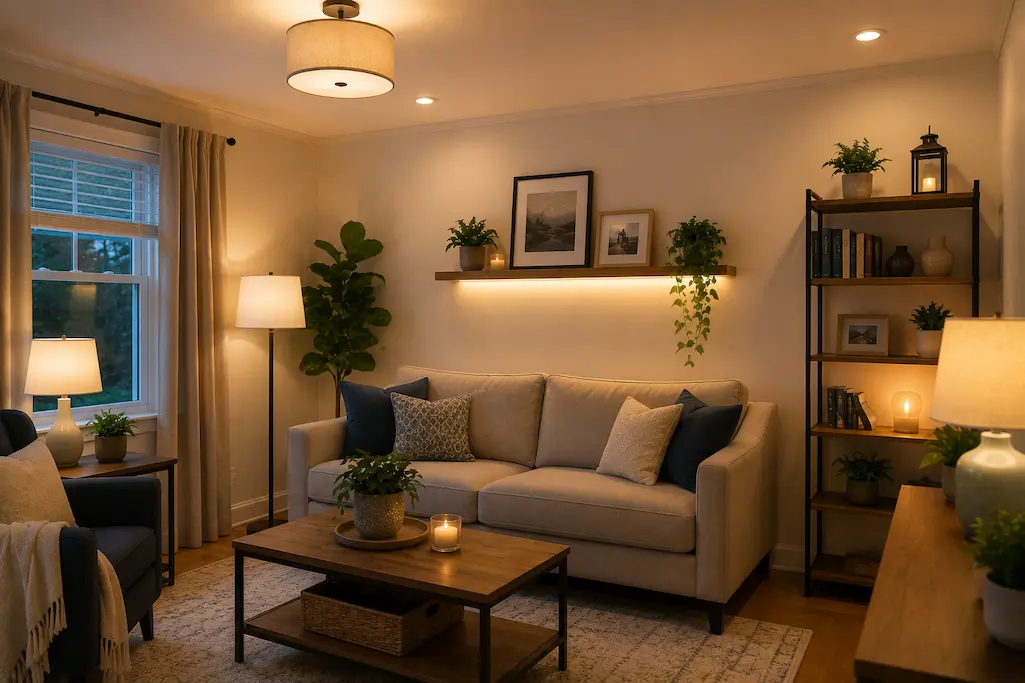
I used to call my apartment “moody.” Dim. Atmospheric. Like a candlelit restaurant, I told guests. They squinted at menus. They bumped into furniture. They did not return for dinner.
The truth was simpler. I had one overhead light per room. A single bulb in a cheap fixture. The kind that came with the apartment. The kind that buzzed slightly and cast shadows like a horror film. I lived in gloom and called it ambiance.
My breaking point was a Tuesday. I was reading a recipe. Could not tell if the sauce was brown or burnt. Leaned closer. Still could not tell. Turned on my phone flashlight. The sauce was charcoal. I had been cooking in twilight for twenty minutes without knowing.
That was the end of moody. The beginning of seeing.
What I Was Working With
My apartment has eight-foot ceilings. White walls. Good bones for light. But the fixtures were wrong. A flush-mount dome in the living room. A bare bulb in the bedroom closet. A fluorescent tube in the kitchen that flickered for ten minutes before reaching full brightness. A bathroom light above the mirror that shone directly into my eyes while leaving my face in shadow. The worst possible placement.
The windows face north. Indirect light all day. No direct sun. In winter, the apartment felt like a cave by 3 PM. I compensated with lamps. Three floor lamps. Two table lamps. All with warm bulbs. All pointing up. The light hit the ceiling and died. I was illuminating my popcorn texture, not my life.
I needed layers. Direction. Purpose. Not more brightness. Better brightness.
Layer 1: Overhead (The Base)
I started with the living room dome. Removed it. Replaced with a semi-flush mount. Three bulbs. Dimmable. Pointing in different directions. The light spread instead of pooling. The room felt larger immediately. Not because it was brighter. Because the shadows were softer. Less dramatic. Less haunted house.
I chose 3000K bulbs. Warm white. Not daylight. Daylight at 5000K feels like an office. Harsh. Clinical. 2700K is too yellow for tasks. 3000K is the compromise. Warm enough to feel homey. Clear enough to read by.
The dimmer switch was the real change. A simple rotary dimmer. Fifteen dollars. Took twenty minutes to install. I turned off the breaker first. Learned that lesson elsewhere. Electricity deserves respect.
Now the living room has settings. Full brightness for cleaning. Medium for cooking. Low for evening. The same room. Three moods. All functional. None gloomy.
Layer 2: Task (The Work)
The kitchen fluorescent died. I did not mourn it. I replaced the fixture with LED recessed lights. Four of them. Evenly spaced. 4000K. Brighter than the living room. Kitchens need clarity. You are handling knives. Reading labels. Judging color. The 4000K is cool but not cold. Accurate. Honest.
Under-cabinet lights came next. Battery-powered LED strips. Motion-sensored. I installed them with adhesive backing. Took ten minutes. Cost twenty dollars. They illuminate the counter where the overhead light was blocked by my own body. The shadow I cast while chopping is gone. I can see the knife. The vegetable. My fingers. This seems basic. It was not available before.
The desk got a task lamp. Adjustable arm. Directed beam. 4000K. For work. For detail. The overhead light in the office is 3000K. General. Ambient. The task lamp adds focus where needed. I turn it on for spreadsheets. Off for thinking. The choice matters.
Lighting is part of daily practicality. If you cannot see what you are doing, you cannot do it well.
Layer 3: Accent (The Mood)
I bought a picture light. Battery operated. LED. Mounted above a print in the hallway. It draws the eye. Creates a destination. The hallway was a passage before. Now it is a gallery. One light. One print. One moment of interest.
Plants got grow lights. Not purple. White full-spectrum. They sit on shelves. Illuminate the plants and the wall behind them. The greenery pops. The room feels alive. The plants actually grow now. Before, they survived. Now they thrive. Light is food for them too.
Bedside lamps got smart bulbs. 2200K at night. Candle warm. Dimmable to almost nothing. I read before sleep. The warm light does not suppress melatonin like daylight bulbs do. I fall asleep faster. Wake less during the night. The science is real. The difference is noticeable.
Accent lighting is the cheapest renovation. A twenty-dollar picture light changes a wall. A fifteen-dollar bulb changes sleep.
Layer 4: Natural (The Free One)
I cleaned the windows. Not the glass. The frames. The tracks. The screens. I removed the screens in winter. More light enters without them. I washed the glass inside and out. The difference was shocking. Not dramatic. But noticeable. Like removing sunglasses.
I rearranged furniture away from windows. A bookshelf had blocked half the living room window. Moved it. The light spread. I trimmed the bush outside the bedroom window. It had grown tall. Shadowed the glass. Now morning light enters. Not much. But enough to wake me naturally. Enough to reduce the cave feeling.
Mirrors. I added one opposite the north window. It reflects the indirect light. Bounces it deeper into the room. The mirror is not decorative. It is functional. A light amplifier. Positioned precisely. Aimed at the darkest corner.
💡 What I Learned the Hard Way
I once installed daylight bulbs in every fixture. 5000K everywhere. The apartment felt like a hospital. I could not relax. My eyes ached by evening. The color of everything shifted. My skin looked gray. My food looked unappetizing. I thought more light was better light. It is not. The right light is better light. I returned half the bulbs. Kept 5000K only in the kitchen and desk. Everything else is 3000K or warmer. The lesson: brightness is a tool, not a virtue. Use the right temperature for the right activity. Do not blast your home with daylight and call it improvement. It is just glare.
What Changed Where
| Location | Before | After | Cost |
|---|---|---|---|
| Living room overhead | Single flush-mount dome, 2700K bulb | Semi-flush 3-light, 3000K dimmable | $45 fixture + $15 dimmer |
| Kitchen overhead | Flickering fluorescent tube | 4 LED recessed lights, 4000K | $60 (DIY install) |
| Kitchen counter | Shadowed by body, no direct light | Battery LED under-cabinet strips | $20 |
| Desk | Overhead only, shadowed by head | Adjustable arm task lamp, 4000K | $35 |
| Bedside | Table lamp, single brightness, too bright for night | Smart bulb, 2200K–3000K dimmable | $25 |
| Hallway | Overhead only, purely functional | Added picture light above print | $20 |
⚠️ When This Won’t Work
If your home has no overhead wiring — some older apartments have only switched outlets, no ceiling fixtures — adding overhead light requires an electrician. Not a DIY project. Also, if you rent and your lease prohibits fixture changes, stick to plug-in solutions. Floor lamps. Table lamps. Battery strips. Command-hook picture lights. You can improve lighting dramatically without altering wiring. Finally, if you have migraines or light sensitivity, more light is not better. Layered light with dimmers is crucial. The ability to reduce brightness matters as much as the ability to increase it. I have a friend with migraines. She uses only warm, dim light in her home. Her version of improved lighting is darker than my version. Improvement is personal. Not universal.
Frequently Asked Questions
What color temperature should I use where?
Living spaces: 2700K–3000K. Warm. Relaxing. Kitchens and workspaces: 3500K–4000K. Clear. Accurate. Bedrooms at night: 2200K–2700K. Sleep-friendly. Bathrooms: 3000K–4000K. You need to see your face. Be honest with yourself. Hallways and accents: whatever you prefer. These are guidelines, not laws. Your eyes matter more than my chart.
Are smart bulbs worth it?
For bedrooms, yes. The ability to dim and warm without getting out of bed is worth the cost. For other rooms, standard dimmable LEDs are enough. I have smart bulbs only in the bedroom. Everywhere else, simple dimmers. The technology is nice. It is not necessary. Do not overcomplicate.
How do I add light without adding fixtures?
Clean windows. Remove screens seasonally. Add mirrors. Use lighter paint colors. Declutter surfaces that block light. These cost little. They amplify what you have. Before you buy a lamp, maximize the natural and reflected light already available.
What about dark rooms with no windows?
Layer aggressively. Overhead for base. Task for work. Accent for interest. Use cooler temperatures to compensate for the absence of natural light. Add plants with grow lights. They provide life and light simultaneously. A dark room can feel like a cave or a lounge. The difference is lighting design. Not brightness. Direction.
Do I need an electrician?
For anything beyond replacing a fixture or installing a dimmer: yes. Recessed lights. New wiring. Ceiling fans with lights. If you are not comfortable turning off the breaker and using a voltage tester, hire someone. The cost of an electrician is less than the cost of a mistake. I installed my own fixtures because I am cautious and patient. If you are neither, do not risk it.
Closing Thought
I no longer call my apartment moody. I call it lit. Properly lit. Layered. Functional. Warm when it should be warm. Clear when it should be clear.
The sauce no longer burns. The guests no longer squint. The plants grow. The hallway invites. The bedroom sleeps.
Light is not decoration. It is infrastructure. Like plumbing. Like heat. You notice it only when it fails. When it works, you simply live better. See better. Feel better.
I spent two hundred dollars total. Over six months. One layer at a time. The change was gradual. The result was transformative.
Look at your darkest room. Not with your eyes. With your memory. How did it feel at 4 PM in February? How did it feel to cook? To read? To find your keys?
Now imagine it with the right light. Not brighter. Better. Directed. Layered. Yours.
That is the goal. Not illumination. Clarity. In every room. At every hour. For every task.
Turn on the light. The right light. And see what you have been missing.
Sources and References
- U.S. Department of Energy — LED lighting selection guidelines, including color temperature recommendations for residential applications and energy efficiency standards.
- Centers for Disease Control and Prevention (CDC) — NIOSH — Workplace and residential lighting recommendations for visual comfort, task performance, and circadian health.
- National Sleep Foundation — Research on light exposure and sleep quality, including the effects of color temperature on melatonin production and sleep onset.

Hamza Farooq is a home improvement and organization writer who shares practical advice on cleaning, simple DIY fixes, and smart home organization. He focuses on creating easy-to-follow guides that help readers solve everyday household problems with realistic, affordable solutions. His goal is to make home maintenance simpler, more efficient, and accessible for anyone looking to improve their living space.