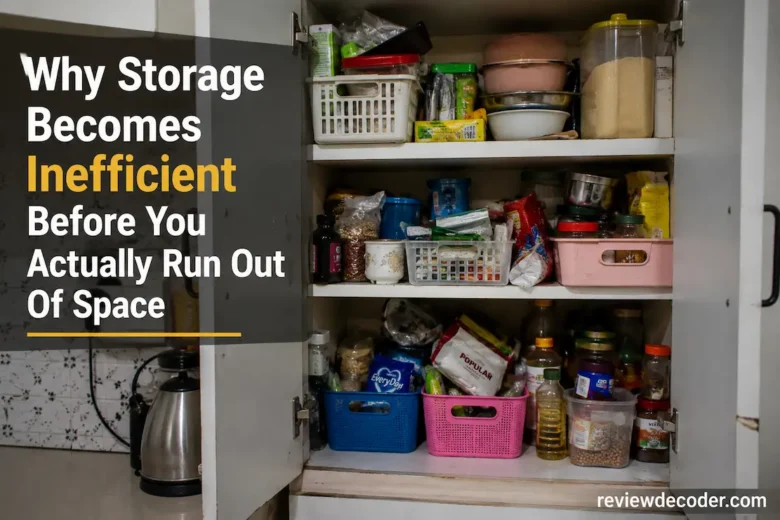
A home can have plenty of cupboards, drawers, shelves, wardrobes, and cabinets and still feel as though it has nowhere to put anything. The strange part is that the storage itself may not be full. You can open a cabinet and see space, yet still struggle to put away the next item. A drawer may have room at the edges but be too disorganized to hold anything useful. A wardrobe can have unused space above the clothes while the lower section becomes increasingly difficult to access.
This happens because storage capacity and usable storage capacity are not the same thing. Physical space tells you how much a cabinet can theoretically hold. Usable space depends on whether you can reach it, find what is stored there, retrieve one item without disturbing everything else, and put things away without creating another problem.
Storage therefore becomes inefficient gradually. It often starts with small inconveniences that seem harmless: stacking one more item, pushing something toward the back, keeping rarely used belongings in easy-access locations, or filling a drawer without considering how it will be used later. Eventually, those small decisions turn available space into difficult space to use.
Empty Space Can Become Functionally Unavailable
One of the clearest signs of inefficient storage is an area that is technically empty but practically unusable.
A deep cabinet may have several inches of free space behind its contents. A wardrobe may have a large gap above the hanging rail. A drawer may have room beneath its contents but no convenient way to use that vertical space. From a purely mathematical perspective, the capacity is still there. From a homeowner’s perspective, it may as well not exist.
Accessibility is what changes the calculation. If reaching an item requires removing five other things, the space behind those items becomes less valuable. If a shelf is too high to access comfortably, its capacity is limited by how often you are willing to retrieve something from it.
This is why simply measuring the dimensions of a storage unit can create a misleading impression. A large cabinet does not necessarily provide more useful storage than a smaller one that is easier to access and better suited to the objects being stored.
The First Problem Is Often Poor Visibility
Storage becomes inefficient when you stop knowing what is inside it.
A shelf can contain plenty of useful belongings while still contributing to clutter if everything is hidden behind something else. Items that cannot be seen are easily forgotten, and forgotten items often lead to duplicate purchases.
This is particularly common with kitchen cupboards, bathroom cabinets, wardrobes, and deep drawers. Something gets pushed toward the back because it isn’t currently needed. Another item is placed in front of it. A few weeks later, the original item is effectively removed from the household’s mental inventory.
Eventually, the home contains several versions of things that were already owned.
The result isn’t simply excess possessions. It is a storage system that has stopped communicating what it contains. When visibility declines, the amount of space required to manage the same belongings increases.
Deep Storage Is Not Automatically Efficient Storage
Depth sounds useful because a deeper cabinet can technically hold more objects. But depth becomes a problem when it exceeds the practical reach of the people using it.
A shallow shelf may hold fewer items but allow everything to remain visible and accessible. A deep shelf may hold considerably more while turning the rear section into a forgotten zone.
This is why deep cupboards often develop layers. Frequently used items stay near the front, while less-used belongings migrate backward. Eventually, the back becomes a place for things that are still considered useful but are rarely retrieved.
The issue isn’t necessarily that the cabinet is badly designed. It may simply be poorly matched to the way its contents are used.
If an area is deep enough to require stacking or multiple rows, the organization needs to account for access as well as capacity. Otherwise, every additional item reduces the practicality of everything behind it.
Stacking Can Create Hidden Costs
Stacking is one of the easiest ways to make a small storage area appear more efficient.
A pile uses vertical space that might otherwise remain empty. The problem begins when the item needed most often is placed underneath the items used less frequently.
Now the storage system has gained capacity but lost convenience.
Repeatedly removing and replacing a stack creates friction. People begin leaving frequently used objects outside the storage area because putting them away is inconvenient. Those objects then become visible clutter, which creates the impression that the home needs more storage.
In reality, the home may have enough capacity. The problem is that the available capacity requires too much effort to use.
Good storage therefore isn’t simply about fitting more objects into the same volume. It is about arranging those objects so that the amount of effort required to access them remains reasonable.
Storage Can Fail When Everything Is Given Equal Importance
Not everything in a home deserves the same amount of accessible storage.
Everyday items, occasional items, seasonal belongings, emergency supplies, sentimental objects, and rarely used equipment all have different access requirements. Treating them as though they need identical storage can make the entire system inefficient.
A frequently used item buried behind something used once a year is in the wrong position even if both objects technically fit. Likewise, giving prime shelf space to rarely used belongings forces everyday objects into awkward locations.
This is one reason a home can feel short on storage while still containing plenty of space. The most valuable part of storage isn’t always its size. Often it is its accessibility.
When storage is organized according to frequency of use, the same physical capacity can become much more practical.
Small Items Consume More Space Than They Seem To
Small belongings create a different kind of storage problem.
Individually, a charger, cable, battery, tool, cosmetic item, stationery piece, or small kitchen accessory takes up very little room. But when you store dozens of small objects without grouping them, they create unusable gaps and make it difficult to identify what is available.
A drawer full of loose objects is a particularly relevant example. There may be considerable empty volume between individual items, but that doesn’t mean the drawer has meaningful spare capacity. The objects interfere with one another, become difficult to find, and encourage the addition of duplicates.
Grouping small items by function can make existing space more usable without reducing the number of belongings. The improvement comes from reducing the amount of space lost to searching, scattering, and awkward placement.
This is one area where organization can create more practical capacity without physically creating any new storage.
The Wrong Container Can Reduce Useful Space
Containers are often purchased with the intention of making storage more efficient. Occasionally they do the opposite.
A rigid container may leave gaps around its edges. A tall box may waste vertical space on a shelf. Several small containers may occupy more room than the items would have used when grouped differently. A container can also make access harder if the entire box must be removed to reach one item.
This doesn’t mean containers are ineffective It means they should solve a specific storage problem rather than being treated as an automatic improvement.
Before adding a container, consider the dimensions of the available space and the shape of what needs to be stored. The container should make the contents easier to access, identify, or protect without consuming more useful volume than necessary.
A Full-Looking Shelf May Actually Be Poorly Arranged
Visual fullness can be misleading.
A shelf with objects spread randomly across its surface can look crowded even when substantial vertical or horizontal space remains. Rearranging the contents may reveal capacity that wasn’t obvious before.
The opposite can also happen. A shelf may look neatly packed while being extremely difficult to use because objects are wedged tightly together.
This is where organization differs from simply making things look tidy. A visually neat arrangement is not necessarily an efficient one. Storage should support the way the objects are retrieved and returned, not just create an attractive photograph.
If putting something away requires moving several other objects, the system is probably using space inefficiently regardless of how orderly it appears.
The Storage Location Can Be The Real Problem
Sometimes the storage itself is fine, but it is located in the wrong place.
A household may have plenty of space for cleaning supplies, for example, but if those supplies are stored far from where they are normally used, people may leave frequently used products nearby instead. The same principle applies to shoes, paperwork, cooking equipment, laundry items, and everyday personal belongings.
This creates duplicate storage zones. The official storage area remains partially empty while temporary piles develop elsewhere.
When the same type of object repeatedly appears outside its assigned storage location, that is useful information. It may indicate that the storage location is inconvenient rather than that the household needs more capacity.
Moving storage closer to the point of use can sometimes eliminate clutter without adding a single shelf or cabinet.
Empty Space Becomes Less Valuable When It Is Hard To Reach
A large amount of storage space may exist in places that people naturally avoid using.
Very high shelves, narrow gaps, deep corners, awkward cabinet interiors, and spaces behind heavy furniture can technically increase the home’s storage capacity. But if accessing them requires considerable effort, they will usually be reserved for items that are rarely needed.
That isn’t necessarily inefficient. In fact, those areas can be excellent locations for seasonal belongings.
The problem occurs when everyday items end up in difficult locations because convenient storage areas have become overcrowded.
A useful storage system therefore has layers of accessibility. The easiest areas should handle frequent use, while harder-to-reach capacity can absorb things that do not need constant attention.
Clutter Is Sometimes A Storage Feedback Loop
Once storage becomes inefficient, it can start creating more clutter.
An item doesn’t have an easy place to go, so it stays on a nearby surface. Another item joins it. The surface becomes crowded, making the room feel more cluttered. The homeowner buys a new organizer to manage the visible mess.
But the underlying storage problem remains.
The new organizer may eventually become crowded too, especially if it is placed wherever there happens to be room rather than where the objects are naturally used.
This creates a cycle in which storage products multiply without improving the overall system. More containers are added, but access, visibility, and location remain poor.
Breaking that cycle usually requires examining why belongings are failing to return to their existing storage areas in the first place.
The Household Changes, But Storage Often Doesn’t
Storage systems are redesigned less frequently than household changes.
A room that once worked perfectly may become inefficient after children grow, hobbies change, work arrangements shift, or household routines develop. Items that were once used daily may become occasional belongings, while new categories of objects appear.
The storage system, however, often remains based on the old routine.
This can make a home feel as though it has suddenly become too small even though its physical storage hasn’t changed. The issue is that the relationship between the belongings and the storage has changed.
A useful storage audit should therefore happen whenever the way a space is used changes significantly. Storage should evolve with the household rather than becoming a permanent arrangement that nobody questions.
When You Start Buying Storage For Your Storage
One of the clearest warning signs is when the solution to crowded storage is another layer of storage products.
A cabinet gets bins. The bins get smaller containers. The containers need labels. Shelves receive additional organizers. Soon, a significant amount of the original storage volume is occupied by objects whose primary purpose is to organize other objects.
Sometimes this layered approach is useful. But it can also consume capacity while giving the impression that the home is becoming more organized.
Before buying another product, ask whether the problem is actually lack of storage or inefficient use of existing storage. If the answer is the latter, rearranging, grouping, relocating, or removing duplication may produce a better result.
The goal is to avoid owning a more sophisticated storage system. It is to make the belongings you already have easier to store and retrieve.
A Better Measure Of Storage Capacity
Instead of asking how many shelves, drawers, cupboards, or cabinets a home contains, consider a more practical question: How much of that storage can be used easily?
A useful storage area should allow you to find what you need, remove it without excessive disruption, and put it back without creating a new pile.
That makes accessibility, visibility, frequency of use, and retrieval effort just as important as dimensions.
A smaller storage area can outperform a larger one when you design it around these factors. This is why reorganizing an existing cupboard can sometimes produce a bigger improvement than buying a new cabinet.
You are not creating more physical volume. You are recovering capacity that had become functionally unavailable.
Before You Decide You Need More Storage
Walk through the home and look for signs of inefficient capacity rather than simply looking for space.
Are frequently used items buried behind rarely used ones? Are deep shelves becoming dumping grounds? Are drawers full of mixed small objects? Are belongings consistently left outside their assigned storage locations? Are containers consuming more room than the items inside them? Are things that are rarely needed occupying the easiest-to-reach areas?
Each of these points toward a different problem.
The solution might involve changing locations, reducing duplication, grouping similar items, improving visibility, or making better use of vertical space. In some cases, buying additional storage really is the right answer. But it should come after we understand why the existing capacity is failing.
Storage Efficiency Is About Friction, Not Just Volume
A home usually becomes storage-efficient gradually. It happens through small changes in the way belongings are placed, accessed, and returned.
One more item is pushed toward the back. Another is stacked on top. A drawer becomes slightly harder to open. A rarely used object occupies a convenient shelf. A container is added to solve a temporary problem. Eventually, the home has plenty of storage, but very little of it feels easy to use.
That is why running out of physical space and running out of practical storage are two different situations.
If you can identify where access, visibility, location, and organization are creating friction, you may be able to recover a surprising amount of capacity without expanding the home at all. The most efficient storage system isn’t necessarily the one that holds the highest number of objects.
It is the one that lets the household store what it actually needs, find it when necessary, and put it away again without turning every small task into a storage problem.

Hamza Farooq is a home improvement and organization writer who shares practical advice on cleaning, simple DIY fixes, and smart home organization. He focuses on creating easy-to-follow guides that help readers solve everyday household problems with realistic, affordable solutions. His goal is to make home maintenance simpler, more efficient, and accessible for anyone looking to improve their living space.