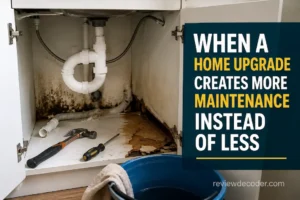
A cheap home improvement can feel like a smart decision when you finish the work, and the immediate bill is low. A fresh coat of paint, an inexpensive fixture, a quick patch, a basic storage solution, or a low-cost replacement can make a room look noticeably better without putting much pressure on the household budget. The problem sometimes appears much later, when the improvement starts requiring repairs, replacement, cleaning, adjustments, or more frequent attention.
The initial price tells only part of the story. An improvement also has a maintenance cost, a useful lifespan, and a level of effort required to keep it working or looking acceptable. A material that costs less at the beginning may wear faster, need more frequent touch-ups, or create problems around it. Another option might cost more initially but remain stable for much longer.
That doesn’t mean expensive materials are automatically better. The more useful question is whether the initial savings are large enough to justify the later maintenance costs.
The Lowest Purchase Price Is Not The Full Cost
Homeowners often compare improvements using one number: how much they cost to install. That makes sense when working with a limited budget, but it can hide what happens after installation.
Suppose one material costs $100 and another costs $180. The cheaper option appears to save $80 immediately. But if the $100 option needs repair or replacement twice as often, the original saving can disappear surprisingly quickly. The more expensive option may not be better in every situation, but its longer service life could make the difference meaningful.
Maintenance can include much more than replacing a broken item. It can involve repainting, resealing, tightening, cleaning, adjusting, repairing surrounding materials, or purchasing special products to keep the improvement in acceptable condition.
The right comparison is therefore not simply “What does this cost today?” but “What will keeping this in good condition require over the next several years?”
A Quick Fix Can Create A Repeating Task
Some inexpensive improvements are attractive because they solve a visible problem quickly. A patch covers damage. A temporary seal closes a gap. A decorative covering hides an unattractive surface. A low-cost fitting makes an old fixture look newer.
These solutions can be perfectly reasonable when the underlying problem is minor. The trouble starts when the improvement conceals a condition that continues to affect the area.
A patch over a moving crack, for example, may look excellent initially. If the movement continues, the crack can return and the patch needs attention again. The homeowner then spends money repeatedly addressing the same visible symptom.
A cheap improvement is therefore most valuable when it matches the actual problem. Saving money by postponing the underlying repair is different from choosing an efficient low-cost solution.
Paint Is A Good Example Of The Maintenance Trade-Off
Paint is one of the easiest ways to change a room without a major renovation, but the initial cost doesn’t tell you how well the finish will perform.
A very inexpensive paint may require more coats to achieve the desired coverage. It may also show marks more easily or require more frequent touch-ups in high-use areas. The time spent preparing, painting, drying, and correcting imperfections is part of the real cost even if it doesn’t appear on the receipt.
That doesn’t mean homeowners should always buy the most expensive paint available. Different rooms have different demands. A low-traffic decorative area may not need the same durability as a busy hallway, kitchen, or children’s room.
The better approach is to match the finish to the conditions. Spending slightly more where surfaces experience frequent contact can sometimes reduce the amount of maintenance required later.
Cheap Fixtures Can Shift The Cost Elsewhere
Replacing a visible fixture with an inexpensive alternative can make a room feel updated. The problem is that the purchase price may not account for installation quality, replacement parts, compatibility, or future maintenance.
A low-cost fitting that loosens frequently, develops a leak, has difficult-to-source replacement components, or requires repeated adjustment can become more expensive than its price suggests.
There is also the issue of surrounding materials. A component that doesn’t fit properly may place extra stress on connections or allow moisture to reach areas that should remain dry. A small saving on the fixture can therefore create additional maintenance somewhere else.
When comparing fixtures, durability and compatibility deserve attention alongside appearance and price. A component that is easy to maintain can be more economical than one that simply costs less at checkout.
Flooring Shows Why Durability Matters
Flooring receives constant wear. People walk across it, move furniture over it, drop objects on it, clean it, and expose it to moisture depending on the room.
Choosing a cheaper flooring material can make sense in a low-use area where replacement is straightforward. In a busy hallway, entrance, kitchen, or other high-traffic locations, the maintenance requirements may be more important than the initial savings.
A surface that scratches easily can require more care. One that shows dirt quickly may need more frequent cleaning. A material that does not tolerate moisture well can create additional problems if installed in an unsuitable location.
The cheapest flooring isn’t necessarily a poor choice. The mistake is using a material designed for light demands in an area that gives it heavy demands every day.
Decorative Improvements Can Have Hidden Upkeep
Not every maintenance cost comes from something that breaks.
Some improvements create additional surfaces, edges, grooves, finishes, or decorative elements that collect dust and require regular attention. A design may look impressive when first installed but demand considerably more cleaning than the simpler alternative.
This matters particularly in busy homes where the goal of an improvement is to make everyday life easier. An attractive feature that adds twenty minutes of cleaning every week has a different long-term cost from one that requires almost no additional care.
Before adding a decorative element, consider how it will look not just immediately after installation but after months of ordinary use. Dust, fingerprints, water marks, and everyday wear are part of the environment that the improvement must withstand over time.
Materials Behave Differently As They Age
Two materials can look nearly identical when new but can age very differently.
Some surfaces maintain their appearance with relatively little attention. Others gradually lose their finish, discolor, swell, scratch, fade, or develop visible wear. The difference may not be obvious when comparing samples in a store.
This is why material selection should consider the conditions around the improvement. Sunlight, moisture, temperature changes, cleaning products, friction, and frequent handling can all affect longevity.
A material isn’t inherently “cheap” or “expensive” in maintenance terms. Its performance depends partly on where it is used. A low-cost material that performs well in the right environment can be a better decision than an expensive material exposed to conditions it wasn’t designed to handle.
Poor Preparation Can Make A Cheap Improvement More Expensive
Sometimes the material isn’t the problem at all. The preparation is.
Painting over a dirty or unstable surface, installing a covering over an uneven base, applying a sealant to a damp area, or attaching hardware to deteriorated material can shorten the life of an otherwise reasonable improvement.
This is one reason low-cost projects can become unexpectedly expensive. The homeowner saves money on the initial work but skips preparation that would have helped the result last.
Preparation doesn’t always require expensive materials. It often requires time: cleaning thoroughly, removing loose material, checking measurements, allowing surfaces to dry, correcting small defects, or making sure the base is suitable before installation.
Saving money on preparation can therefore be very different from saving money on materials.
The Cheapest Option May Require More Skill
A product can be inexpensive because it requires more work to install correctly.
That isn’t automatically a disadvantage for someone who enjoys DIY work and has the necessary skills. But if an inexpensive material is difficult to install accurately, mistakes can lead to additional purchases, wasted material, or premature failure.
This is especially relevant when comparing two solutions that appear similar but have unique installation requirements.
A slightly more expensive option that is straightforward to install may produce a better overall result than a cheaper option that requires specialized tools or a high level of precision. The value comes from the complete project rather than the price printed on the packaging.
Maintenance Time Is A Real Cost
Home maintenance consumes more than just money.
If an inexpensive improvement requires frequent cleaning, adjustment, repainting, tightening, or repair, the homeowner is paying with time. Over several years, those small tasks can accumulate.
Consider two improvements that cost different amounts. One requires almost no attention for several years. The other requires a short maintenance task every few months. The second may still be the right choice if the initial saving is significant, but the time requirement should be recognized rather than treated as free.
This is particularly important for improvements intended to make a home easier to live in. If the new feature creates another recurring chore, its practical value may be lower than its appearance suggests.
Some Savings Disappear When Replacement Becomes Difficult
Availability is another hidden part of maintenance.
An inexpensive product may seem like a good choice until a small component fails and the replacement is difficult to find. A standard part that is widely available can sometimes be more convenient than a cheaper proprietary component that requires replacing an entire assembly.
This matters with fixtures, hardware, fittings, storage components, and other products made from multiple replaceable pieces.
Before choosing an unusual low-cost solution, consider whether you will be able to obtain compatible replacement parts later. A product that can be repaired piece by piece may have a lower long-term cost than one that must be discarded when a small component fails.
When Spending More Actually Makes Sense
There are situations where paying more at the beginning is justified, particularly when the improvement affects a high-use or difficult-to-reach area.
If replacing something later would require removing other materials, hiring labor, moving furniture, or disrupting an important part of the home, durability becomes more valuable. The same principle applies when failure could cause secondary damage.
A more durable material can also make sense when maintenance itself is difficult. A surface that is easy to access and repaint may not justify a premium material, while an improvement installed in a difficult location may benefit from lasting longer.
The important point is not to turn “buy cheap, buy twice” into a universal rule. Some inexpensive options are excellent. The goal is to spend more where failure would be expensive or inconvenient, not simply because a higher price sounds like better quality.
When A Cheap Improvement Is Actually The Better Choice
There are plenty of situations where choosing the inexpensive option is sensible.
A temporary improvement may be appropriate when the homeowner expects to renovate later. A low-cost decorative change can make sense when appearance matters more than long-term durability. A basic storage solution may be perfectly adequate in an area with light use.
The key is knowing what you are buying.
If an improvement is inexpensive because it has a shorter expected lifespan and you are comfortable replacing it later, there may be nothing wrong with that decision. Problems arise when the short lifespan is discovered only after installation.
Being realistic about how long you need the improvement to last can make a budget option perfectly reasonable.
A Simple Way To Compare Improvements Before Buying
Before choosing between two home improvement options, look beyond their price tags.
Consider how often the surface or component will be used. Think about exposure to water, sunlight, dirt, heat, and cleaning. Ask how straightforward it will be to repair if something goes wrong. Consider whether replacement parts are available. Consider how difficult installation will be and whether the surrounding area would be affected if the improvement failed.
Then think about maintenance over a realistic period rather than just the first year.
You don’t need a complicated spreadsheet for a small household project. A simple comparison can be enough: initial cost + likely maintenance + replacement difficulty + your time + consequences of failure.
That gives you a much more useful picture of value than the purchase price alone.
A Budget Improvement Should Reduce Costs, Not Just Delay Them
There is nothing wrong with improving a home on a limited budget. In fact, you can make many useful household changes inexpensively. The important distinction is between a genuinely efficient low-cost improvement and a cheap solution that creates repeated work later.
The best budget decisions usually come from matching materials and methods to the demands of the space. Invest in durability where it matters, simplify where it doesn’t, and avoid incurring repeated costs for the same issue.
A slightly higher initial price can be worthwhile when it significantly reduces future maintenance. At the same time, an inexpensive option can be the smarter choice when it performs adequately, is easy to replace, and suits the way the space is actually used.
The real measure of a home improvement is therefore not how little it costs on installation day. It is how much value it continues to provide after the newness has worn off—and how much time, money, and effort you have to spend keeping it that way.

Hamza Farooq is a home improvement and organization writer who shares practical advice on cleaning, simple DIY fixes, and smart home organization. He focuses on creating easy-to-follow guides that help readers solve everyday household problems with realistic, affordable solutions. His goal is to make home maintenance simpler, more efficient, and accessible for anyone looking to improve their living space.