A door that suddenly rubs against its frame, a drawer that stops sliding properly, or a cabinet handle that begins to wobble can all lead to the same first reaction: something needs fixing. The difficult part is working out what actually needs fixing. A component can be loose, sitting in the wrong position, or physically damaged, and those conditions can produce surprisingly similar symptoms. Treating them as the same problem is one reason simple household repairs sometimes turn into repeated adjustments, unnecessary replacements, or damage that becomes more difficult to correct.
The distinction is particularly useful because the obvious symptom is not always the cause. A crooked cabinet door might have a loose hinge, but it could also have a perfectly secure hinge that has shifted out of adjustment. A handle that keeps moving might need tightening, or the material holding its fastener may have become too weak to provide a reliable grip. Before choosing a repair, it helps to understand what each condition actually means and what evidence separates one from another.
When A Part Is Loose
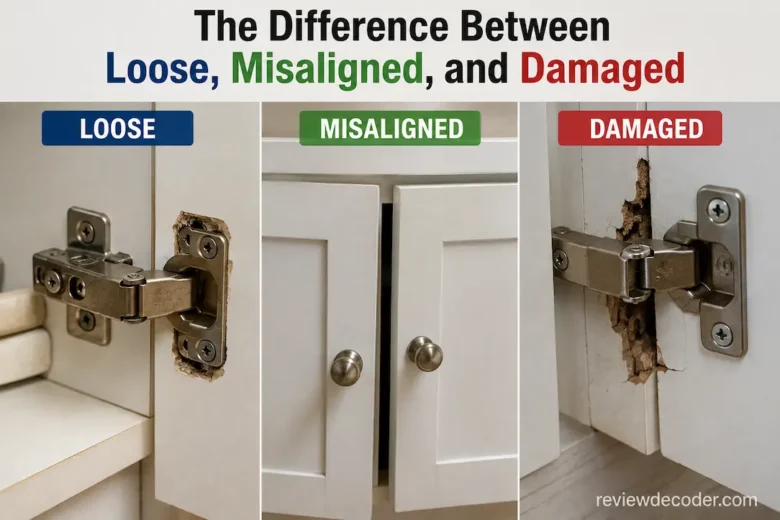
A loose part has generally moved when it should remain fixed. The component itself may still be in good condition, and its position may even be correct, but the connection holding it in place is no longer secure. A cabinet handle is a straightforward example. If the handle moves slightly when you pull it but remains in the correct location on the door, the most obvious possibility is that the fastening hardware has loosened.
The same principle applies to hinges, brackets, knobs, furniture joints, fittings, and other components attached with screws, bolts, or similar hardware. The important clue is unwanted movement between the component and the surface supporting it. You may feel a slight wobble, see a fastener sitting differently from the others, or notice that the part shifts when normal pressure is applied.
However, a loose part does not automatically mean that tightening the fastener will solve the problem. If the screw has lost its grip because the surrounding material is damaged, tightening it may only provide a temporary improvement. The connection can feel firm for a short time and then begin moving again. When looseness keeps returning, the condition of the mounting point is just as important as that of the fastener itself.
When A Part Is Misaligned
Misalignment is different because the component may be completely secure. Nothing may be loose, broken, or visibly damaged, yet the part is no longer sitting in the position required for it to work correctly. This happens frequently with doors, drawers, cabinet fronts, hinges, latches, and other components that have to line up with something else.
A cabinet door, for example, can remain firmly attached while sitting slightly too high on one side. The hinges may not wobble at all, but the door can rub against its neighbor or fail to meet the frame evenly. A drawer can be securely mounted to its runners but sit at an angle that causes it to catch when opened. In both cases, tightening hardware isn’t necessarily the answer because the underlying issue is positioning rather than looseness.
Misalignment usually becomes most obvious when two parts are supposed to interact. A door closes but catches at one point. A latch reaches the strike plate from the wrong angle. A drawer slides normally for part of its travel and then begins rubbing. Uneven gaps can also be revealing, particularly when one side of a door or cabinet front sits noticeably closer to the surrounding frame than the other.
That is why simply looking for movement can be misleading. A misaligned part may barely move at all when you touch it. Its problem becomes obvious only when it is operated in the way it was designed to operate.
When The Part Is Actually Damaged
Damage means that the component or the material supporting it has changed in a way that affects its strength, shape, or ability to function. The change may be obvious, such as a cracked bracket or bent hinge, but it can also be subtle. A worn contact point, enlarged screw hole, split mounting surface, deformed fitting, or deteriorated material can all cause a component to behave differently from when it was new.
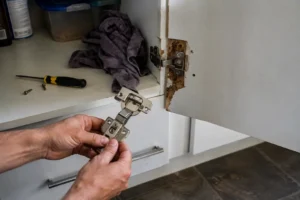
Damage is particularly easy to confuse with looseness. Imagine a screw holding a cabinet hinge. If the screw has simply backed out, tightening it may restore the connection. But if the wood around the screw has become enlarged or split, the screw may tighten without actually restoring the original strength of the joint. The hinge then becomes loose again because the supporting material can no longer hold it properly.
The same thing happens with repairs to walls, furniture, doors, and other household components. A visible crack or gap may be the result of damage somewhere beneath the surface. Repositioning the visible part can temporarily improve its appearance, but the original weakness remains. If the problem returns after an adjustment, that repeated failure is evidence that something more than positioning may be involved.
Why The Three Problems Are Easy To Confuse
Consider a cabinet door that has started sitting lower than it used to. At first glance, there is no obvious difference between a loose hinge, an alignment problem, and a damaged hinge or mounting surface. All three can cause the door to appear crooked.
If the hinge screws have loosened, the door may have shifted because the hinge is no longer being held firmly. If the screws are secure but the hinge position has changed, the door may simply need adjustment. If the hinge is bent or the material around the mounting screws has deteriorated, however, adjustment may only hide the underlying damage for a short period.
The same confusion occurs with furniture. A chair leg that wobbles might have a loose joint, but the joint could also be distorted or cracked. A drawer that sits unevenly could be out of alignment, or one of its runners could be worn. A door that doesn’t latch may have shifted slightly, or the latch itself may have been damaged. The symptom tells you what has gone wrong from the user’s perspective, but it does not automatically identify the failed component.
This is why replacing parts based only on appearance can be wasteful. You can replace a perfectly functional hinge because the door is crooked, only to discover that the mounting surface was the real problem. Likewise, repeatedly tightening a handle will not provide a lasting solution if the material around the fastener has already deteriorated.
Look At How The Part Behaves Under Normal Use
One of the simplest ways to narrow down the problem is to observe the component while it performs its normal job. The observation should be gentle rather than an attempt to force the part until something moves or breaks.
A loose component generally shows unwanted movement at its attachment point. A handle may shift relative to the door. A bracket may move against the wall. A hinge may have noticeable play. A furniture joint may move independently when the rest of the structure remains stable.
A misaligned component behaves differently. It may remain firmly attached but fail when it reaches another part. The door rubs against the frame, the drawer catches at one point, or the latch doesn’t line up correctly. The component is stable, but its relationship with surrounding components is wrong.
Damage can produce either type of behavior, which is what makes it more difficult to identify. A bent hinge can cause misalignment. A cracked mounting point can create looseness. A worn mechanism can cause abnormal movement even when the fasteners are tight. Physical evidence such as cracking, bending, deformation, corrosion, unusual wear, or deteriorated material therefore becomes especially important when a problem doesn’t respond to ordinary adjustment.
Don’t Ignore The Fasteners
Fasteners provide useful information, but they should not be treated as the entire diagnosis. A screw that has backed out slightly is a straightforward clue. So is hardware that visibly moves when the attached component is used. In these cases, the connection itself deserves attention.
The more interesting situation is when the fastener appears tight but the component still moves. That can happen when the fastener is no longer gripping the supporting material effectively. Wood, drywall, composite materials, and other substrates can become damaged or enlarged around a fastening point. The screw may turn until it feels tight without actually creating the same secure connection it had originally.
Repeated loosening is therefore worth taking seriously. If a fastener needs to be tightened again and again, the question shouldn’t simply be how to tighten it better. Something may be causing repeated stress, or the material may no longer be capable of holding the fastener as intended.
This is also where previous repairs can complicate the situation. A hole may have already been enlarged, filled, moved, or repaired before. Adding another fastener without understanding what happened previously can produce a connection that looks secure without actually being strong.
Misalignment Usually Reveals Itself At The Point Of Contact
When a part interacts with another component, the contact point can tell you more than the part itself. A door that scrapes only near the top corner is giving different information from a door that moves loosely at the hinges. A drawer that catches halfway through its travel suggests a different problem from one that wobbles on its runners.
Look for rubbing marks, uneven gaps, contact points, scraping sounds, or a latch that reaches its target from an unusual angle. These details help establish whether the component is simply sitting in the wrong place.
It is also worth comparing the problem area with a similar component nearby. If one cabinet door sits differently from the others, the comparison may reveal a change that isn’t obvious when examining the affected door by itself. The same approach can work with drawers, hinges, handles, and furniture joints.
A comparison doesn’t prove the cause, but it provides a useful reference for what normal alignment looks like in the same environment.
Sometimes The Part Is Fine And The Mounting Surface Is Not
Homeowners often inspect the visible component and forget to inspect what holds it in place. This can lead to unnecessary replacements.
A handle may be perfectly intact while the door around its mounting holes has weakened. A hinge may be straight and functional while the cabinet material supporting it has split. A wall bracket may not be damaged even though the surface behind it is unable to provide adequate support.
This distinction is especially important when the same repair keeps failing. If a new or properly adjusted component develops the same problem repeatedly, the surrounding material deserves closer inspection.
Look for enlarged holes, cracks, soft areas, crumbling material, moisture-related deterioration, gaps, or movement around the mounting point. These signs can indicate that the repair needs to address the supporting structure rather than simply replacing the visible hardware.
A Loose Part Can Create A Misalignment Problem
The three conditions aren’t always separate. One can lead directly to another.
A hinge begins to loosen, allowing a door to shift. The shifted door becomes misaligned with its frame. Continued use puts additional pressure on the hinge and mounting area. Eventually, the mounting material becomes damaged.
Now the same door has all three problems: the connection is loose, the door is misaligned, and the mounting area is damaged.
This scenario explains why a quick tightening can sometimes appear to work and then fail again. The tightening addresses the first symptom but doesn’t necessarily reverse the damage that developed afterward.
The sequence of events matters. If you can determine which condition appeared first, you have a better chance of choosing a repair that actually stops the cycle rather than treating whichever symptom happens to be most visible today.
A Part Can Also Be Misaligned Without Being Damaged
It is important not to assume that every crooked or uneven component needs replacement. Normal adjustment can sometimes be enough.
Cabinet doors and similar components are designed with adjustment points precisely because small changes in position can occur over time. Changes in use, minor settling, repeated movement, or ordinary wear can alter alignment without meaning that the component has failed.
If the hardware remains sound, the supporting material is intact, and the component operates normally after appropriate adjustment, replacement may be unnecessary.
The key is to distinguish a change in position from a change in condition. A part being somewhere slightly different from where it used to be is not automatically evidence that the part itself has been damaged.
Repeated Problems Change The Diagnosis
A one-time loose screw is not particularly informative. A screw that loosens every few weeks is.
A door that needs one alignment adjustment over several years may simply have shifted through ordinary use. A door that repeatedly returns to the same misaligned position may indicate a deeper problem with the hinges, mounting surface, frame, or forces acting on it.
The same principle applies to damaged components. If a replacement part fails in the same way as the original, the replacement may not be the problem. Something else could be putting the same stress on every component installed there.
Repeated failure is therefore more valuable than a single failure when diagnosing household problems. It gives you a pattern to work with.
Choosing The Right Response
Once the condition is understood, the appropriate response becomes much less complicated.
A genuinely loose component may need its fastening restored, provided the fastener and supporting material are still sound. A misaligned component may need repositioning or adjustment rather than replacement. A damaged component may need repair or replacement, while damaged supporting material may need to be addressed before the component can be securely installed again.
The difficult part is resisting the urge to choose the repair before identifying the condition.
That distinction can save money, but it can also prevent unnecessary damage. Excessive tightening, repeated drilling, aggressive adjustment, or replacing parts that are still functional can turn a small household problem into a larger one.
For anything involving structural support, significant weight, electrical systems, gas, or other potentially hazardous conditions, uncertainty is a good reason to stop experimenting and seek appropriate professional assessment.
The Most Useful Question Is Not “What Part Is Broken?”
When a household component stops behaving normally, it is tempting to search for the broken part immediately. A better starting point is to describe exactly what has changed.
Is the part moving when it should be stationary? Is it firmly attached but sitting in the wrong position? Has its shape, strength, surface, or supporting material changed?
Those observations separate looseness from misalignment and damage far more effectively than appearance alone.
The distinction may seem minor, but it can determine whether a repair lasts or becomes another temporary fix. A loose connection needs a secure connection. A misaligned component needs correct positioning. A damaged component needs its lost strength or function restored.
And when one condition has caused another, the lasting solution is to address the underlying weakness rather than repeatedly correcting the symptom. Once you know what kind of problem you are actually looking at, the repair becomes a much more informed decision.

Hamza Farooq is a home improvement and organization writer who shares practical advice on cleaning, simple DIY fixes, and smart home organization. He focuses on creating easy-to-follow guides that help readers solve everyday household problems with realistic, affordable solutions. His goal is to make home maintenance simpler, more efficient, and accessible for anyone looking to improve their living space.