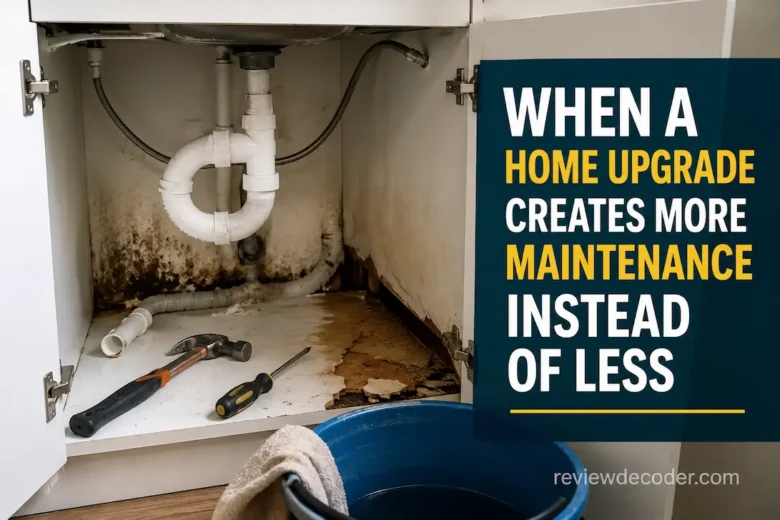
There is a particular kind of home repair that becomes more frustrating each time you attempt it. You tighten the fitting, replace the damaged piece, adjust the hinge, seal the gap, or make the small repair that seemed to be the obvious answer. For a while, everything appears normal. Then the same problem returns. Sometimes it comes back within days, while other problems take weeks or months to show themselves again.
When that happens, the first instinct is often to assume that the repair was not done well enough. Sometimes that is true, but a repeated failure can also mean that the repair was addressing a symptom rather than the reason the problem developed in the first place. A replacement part can fail because something around it is still moving, a crack can reopen because the material continues to shift, or a loose fitting can keep loosening because it is being subjected to forces that were never corrected.
A repair that keeps failing is therefore worth investigating in a different way. Instead of asking, “How do I fix this problem again?” the more useful question is, “What is causing this repair to need fixing in the first place?”
Start With What Changed After The First Repair
Before taking anything apart again, think about what happened immediately after the original repair. This small review can reveal more than another round of trial and error. Did the problem disappear completely, or did it only become less noticeable? Did it stay fixed until the item was used several times? Did the same symptom return in exactly the same place, or did it appear somewhere nearby?
The timing matters because different patterns suggest different causes. A repair that fails immediately may point toward incorrect installation, incompatible parts, poor adhesion, insufficient tightening, or a problem that was never actually corrected. A repair that lasts for months before failing may suggest a different cause. It could indicate gradual movement, repeated stress, moisture exposure, normal wear, or a component reaching the limit of what it can handle.
Write down what you actually observed rather than what you expected to happen. “The drawer worked for two weeks and then started catching on the left side” is more useful than “the drawer repair didn’t work.” Specific changes give you something to investigate.
The Part You Repaired May Not Be The Source Of The Problem
One of the easiest mistakes in home repair is to assume that the part showing the symptom is the cause. A loose screw is visible, so it gets tightened. A cracked section is visible, so it is filled. A dripping component is visible, so it is replaced. The repair may temporarily improve the situation without addressing the force, movement, pressure, moisture, or alignment responsible for the original failure.
Think about a door that repeatedly develops a loose handle. Tightening the screws may solve the immediate problem, but if the mounting holes have become enlarged or the handle is being pulled sideways every time the door is used, the screws are being asked to solve a problem they did not create. The same principle appears throughout the home. The visible failure is sometimes the last link in a chain rather than the beginning of it.
This is why recurring repairs deserve a wider inspection. Look beyond the exact piece that failed and examine what it connects to, what moves around it, and what forces it experiences during normal use.
Look For Movement That Shouldn’t Be There
Many recurring household problems are connected to movement. Something may shift slightly every time it is used, even though the movement is too small to notice during ordinary operation. Over time, this repeated movement can loosen hardware, reopen joints, damage finishes, or place stress on replacement parts.
Cabinet doors, drawers, furniture joints, handles, shelves, and fixtures are particularly affected by this type of movement. A component can appear secure when you inspect it at rest but move when weight is applied or when the item is operated. Tightening the visible hardware does not necessarily remove that movement.
Try to observe the entire assembly while someone reproduces the problem, where it is safe to do so. Don’t just watch the failed part. Watch the surrounding connections. If one section moves before another section responds, that sequence can reveal where the unwanted movement begins.
Check Whether The Replacement Part Actually Matches The Job
A replacement part can look correct and still be unsuitable. Small differences in dimensions, thread type, thickness, shape, mounting method, or material can affect how well a component performs. A part may physically fit while still placing forces in the wrong location.
This happens frequently with generic replacement hardware. The replacement may be slightly shorter, longer, thinner, or shaped differently from the original. The difference may not be obvious until the item is used repeatedly. What appears to be a successful repair can therefore become another failure several weeks later.
Before assuming that a replacement was defective, compare it with the original and check the manufacturer’s specifications where available. If a component is designed to work as part of a particular system, substituting a visually similar piece can change how the load is distributed.
The Material Around The Repair Matters Too
A strong replacement part cannot compensate for a weak surface around it. This is especially important when screws, anchors, fasteners, brackets, or fittings are attached to wood, drywall, plaster, masonry, or another material that can deteriorate.
For example, tightening a screw into a damaged mounting point may make the component feel secure temporarily. But if the surrounding material is cracked, crumbling, stripped, swollen, or otherwise unable to hold the fastener properly, the repair is likely to fail again.
The same idea applies to adhesives and fillers. A repair compound may adhere well to a clean, stable surface but fail when the underlying material continues to move or shed particles. Looking only at the repaired area can hide this problem because the new material may appear perfectly intact until the surrounding structure moves again.
Ask Whether Moisture Is Playing A Role
Recurring repairs in kitchens, bathrooms, utility areas, around windows, and near exterior walls deserve a closer look at moisture. Water does not always create an obvious leak. Repeated condensation, small splashes, humidity, or slow seepage can gradually affect materials and connections.
Wood can swell or change shape. Some finishes can deteriorate. Adhesives can lose performance under unsuitable conditions. Metal components can corrode. Repeated dampness can also weaken the surrounding area even when there is never enough water to create a visible puddle.
If a repair repeatedly fails in an area exposed to moisture, fixing the damaged component without addressing the water source may only postpone the next failure. Look for discoloration, soft material, peeling finishes, unusual odors, corrosion, or changes that appear after wet weather or heavy use.
Sometimes The Repair Is Being Asked To Handle Too Much
A repair can fail because the item is being subjected to more force than the repaired component was designed to withstand. This isn’t necessarily caused by misuse. Normal household use can become excessive for a worn or weakened component.
A drawer may be repeatedly overloaded. A shelf may carry more weight than its supports were designed for. A door may be pulled from the handle at an angle. A piece of furniture may be repeatedly dragged rather than lifted. Even small forces can become significant when they occur hundreds or thousands of times.
Consider how the item is actually being used rather than how it is supposed to be used. If the same part repeatedly breaks at a particular point, ask what load reaches that point during normal operation. The answer may explain why replacing the component with an identical one produces the same result.
Check For Alignment Before Tightening Everything
Misalignment is another common reason repairs don’t last. Two parts may technically connect while being positioned slightly out of line. The item can still operate, but every movement places additional stress on one side of the connection.
Doors and drawers are obvious examples. If a hinge is slightly out of position, tightening the screws may not solve the underlying issue. The door can continue pulling against the hinge or frame, eventually causing the same hardware to loosen again.
Look at gaps, contact points, and the way the item moves through its normal range. Uneven gaps, rubbing, resistance at one point in the movement, or a component that appears to shift as it operates can all suggest alignment problems.
The important point is that alignment is not always visible when the item is sitting still. Sometimes the problem only becomes obvious while the component is opening, closing, carrying weight, or moving.
A Repair Can Fail Because The Original Damage Was Larger Than It Looked
Small visible damage does not always mean small underlying damage. A crack on the surface may extend farther underneath. A loose fitting may have damaged the surrounding mounting point. A water stain may indicate moisture that has traveled beyond the visible area.
This is one reason a repair can appear successful and then fail again after a short period. The new material is holding, but it is attached to a section that remains compromised.
If the same damage keeps returning in exactly the same location, don’t automatically assume that the repair material is the problem. Examine whether the original damaged area was fully addressed. In some cases, the visible symptom is simply the place where a larger underlying problem becomes noticeable.
Pay Attention To What The Failure Looks Like The Second Time
The second failure is often more informative than the first because you can compare the two.
Did the new crack follow the original line? Did the same screw loosen while nearby hardware remained secure? Did the seal separate from one edge first? Did the replacement component bend in the same direction as the original? Did the problem move to another part after the first repair?
These details can reveal the direction of the force or the point where the system is struggling.
A repair that fails differently from the original may suggest that the first repair changed how the load was distributed. A repair that fails in exactly the same way may suggest that the original cause remains. Neither observation proves the diagnosis by itself, but both are useful clues.
Don’t Ignore The Parts That Still Look Fine
When something breaks, attention naturally goes to the damaged component. The surrounding parts are often ignored because they appear normal. Yet those apparently healthy components may be responsible for the repeated failure.
A bracket can remain intact while the surface holding it weakens. A hinge can be functional while the frame around it shifts. A replacement washer can work correctly while another component creates excessive pressure. While the mounting area has deteriorated, a new handle can still be perfectly sound.
Look at the whole assembly rather than treating the damaged part as an isolated object. Home systems are connected. The part that fails first is not necessarily the part that deserves the most attention.
When Repeated Repairs Become A Sign To Stop Repairing
There is a point where repeatedly repairing the same problem stops being sensible. That doesn’t mean every recurring issue requires a major replacement, but a pattern of repeated failure is useful information.
If the same component has failed several times, if the surrounding material is deteriorating, if the problem is becoming more extensive, or if the repair requires increasingly complicated work, then replacement may make more sense than another temporary fix. The cost isn’t just the price of the replacement. Time, inconvenience, additional damage, and the possibility of another failure all matter.
Safety changes the calculation as well. Problems involving structural elements, significant water intrusion, electrical systems, gas appliances, or other potentially hazardous conditions should not be treated as ordinary trial-and-error repairs. When the consequences of a wrong diagnosis are serious, professional assessment is usually more appropriate than repeated experimentation.
A Useful Way To Investigate A Recurring Repair
Instead of immediately repeating the original repair, treat the problem like a small investigation. Start with the exact symptom and when it returns. Then examine the surrounding components, movement, alignment, material condition, moisture exposure, and the way the item is being used.
Thereafter, compare the failed repair with the original one. What changed? What remained exactly the same? If the same part failed in the same way, look for a cause that was present both times. If a different part failed, consider whether the first repair transferred stress somewhere else.
This approach takes a little longer at the beginning but can save considerable effort later. You are no longer choosing repairs based solely on what is easiest to see. You are trying to understand why the home keeps having the same problem.
The Goal Is To Fix The Cause, Not Just The Evidence
A recurring repair is a useful warning that something has been missed. The answer isn’t always a more expensive part, a stronger adhesive, or tighter hardware. Sometimes the real issue is alignment. Sometimes it is movement, moisture, excessive load, deteriorating material, or a component that was never suitable for the job.
The most useful thing you can do before attempting another repair is slow down long enough to compare the failure with what happened the first time. Look at the surrounding area, observe the item while it operates, and consider what forces or conditions could be acting on the repaired section.
A successful repair should change the reason the problem occurs, not simply hide the evidence that it happened. When a repair keeps failing, that distinction becomes especially important. The repeated failure isn’t just another inconvenience to fix; it is information about the problem that the first repair didn’t solve.

Hamza Farooq is a home improvement and organization writer who shares practical advice on cleaning, simple DIY fixes, and smart home organization. He focuses on creating easy-to-follow guides that help readers solve everyday household problems with realistic, affordable solutions. His goal is to make home maintenance simpler, more efficient, and accessible for anyone looking to improve their living space.