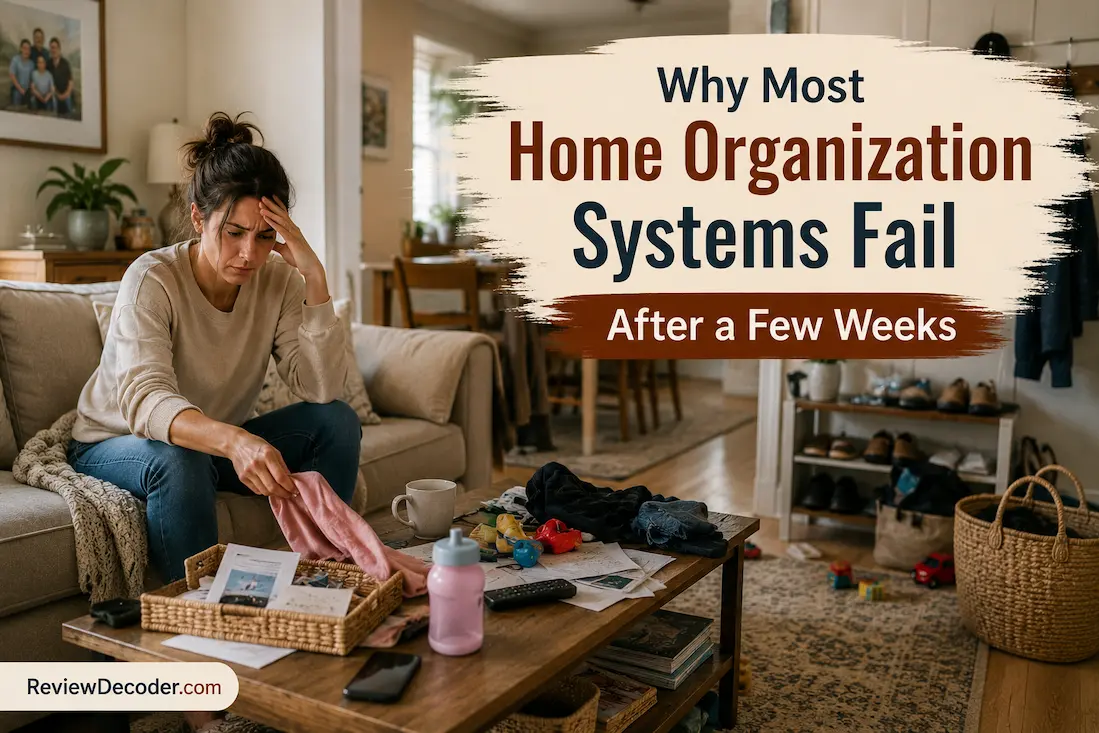
A home can look perfectly organized on a Sunday afternoon and still be cluttered again by the following weekend. Bins are labeled, shelves are arranged, drawers have been divided, and every item appears to have a designated place. Yet after a few weeks, shoes collect near the door, paperwork forms a pile on the counter, and the storage containers that were supposed to solve the problem become part of it.
The problem is often not a lack of discipline. It is that the organization system was designed for an imagined version of daily life rather than the way the household actually behaves. A system that requires several extra steps, depends on everyone remembering where things belong, or ignores how often an item is used will gradually be bypassed.
A lasting system does something different. It makes the preferred behavior easier than the messy alternative. That means looking at where clutter actually appears, what causes it to accumulate, and how much effort people are realistically willing to spend putting things away.
The First Sign of a Failing System Is Usually Not Clutter
Clutter is the visible result, but the underlying problem often appears earlier. People start leaving certain items beside their storage location instead of putting them away. A drawer is opened less often because it is difficult to use. A container becomes overloaded. Frequently needed objects are moved onto a nearby surface because retrieving them takes too long.
These small workarounds are useful clues. They show where the organization system is fighting against normal behavior.
Suppose a family keeps placing mail on the kitchen counter even though a filing box has been installed in a nearby cabinet. The obvious conclusion might be that everyone needs to be more disciplined. A better question is why the counter is winning. Perhaps the cabinet requires opening a door, finding the correct section, sorting several pieces of paper, and then closing everything again. The counter requires none of that.
The system is not necessarily being ignored. It may simply have too much friction.
This is why repeatedly putting things back into their assigned locations is not always a solution. If the same items repeatedly escape their storage area, the storage arrangement deserves investigation.
Organization Fails When Storage Is Designed Around Categories Instead of Behavior
One of the easiest mistakes is organizing according to what seems logical on paper.
Kitchen items might be grouped by type. Cleaning supplies might be placed together. Clothing might be arranged by category. Office materials might all have a dedicated drawer.
That sounds sensible, but categories do not always match how people use things.
A person who prepares coffee every morning may need several related items at the same time. If the coffee maker, filters, mugs, and frequently used supplies are stored in four different places simply because they belong to different categories, the arrangement may be technically organized but inconvenient.
The same problem appears throughout a home. The best location for an item is not necessarily the place that makes the most sense according to its category. It is often the place that makes sense according to its frequency of use and relationship to other items.
An item used every day should generally be easier to reach than something used twice a year. Items commonly used together may also benefit from being stored together, even when they belong to different categories.
This small change in thinking can prevent an organization system from becoming decorative rather than functional.
Too Many Containers Can Make a Home Harder to Maintain
Storage products can create the impression that a system is working before there is any evidence that it actually does.
A collection of matching bins can make a shelf look excellent immediately after organizing. The problem appears later when someone needs one item from the middle of a stack or cannot remember which container holds it. If every container requires opening, moving, labeling, or rearranging something else, the storage system introduces work instead of removing it.
Containers are useful when they solve a specific problem. They are less useful when they simply hide an existing one.
Before adding another box, consider what is happening to the items already being stored. Are they difficult to access? Are there too many duplicates? Is the container too large? Is it being used for objects that should remain within easy reach?
Open storage can sometimes work better for frequently used objects, while enclosed storage can be more appropriate for things that are seasonal, rarely needed, or visually distracting.
The goal is not to maximize the number of things that can fit inside a container. It is to make the entire process of finding, using, and returning an item reasonably easy.
The “Perfect” System Often Breaks When Life Gets Busy
Many organization plans work beautifully under ideal conditions.
There is enough time to fold everything correctly. Every item is returned immediately. The kitchen is reset every evening. Children cooperate. Work schedules remain predictable. Nobody comes home exhausted and drops a bag beside the door.
Real households are not that consistent.
A system that only works when everyone has plenty of time is fragile. The better test is what happens on an ordinary difficult day.
Can laundry still be put away without a complicated sequence? Can shoes be stored quickly when someone is rushing out the door? Can paperwork be handled when there are several other tasks competing for attention?
This is why convenience matters more than visual perfection.
A practical organization system should have a “low-energy version.” If the ideal behavior takes five steps but the realistic behavior usually gets only one step, the system should be designed around that reality.
For example, a basket near the entrance may be more effective than requiring every family member to carry miscellaneous items to separate rooms immediately. The basket is not necessarily the final destination. It is a controlled place that prevents those items from spreading across the house.
The important thing is that the system accommodates real behavior without allowing temporary clutter to become permanent clutter.
Storage Capacity Can Be the Problem, Not Organization
Sometimes a room does not become disorganized because items lack designated places. There simply isn’t enough appropriate storage for the quantity of things being kept.
This is particularly noticeable in small kitchens, bedrooms, entryways, and bathrooms.
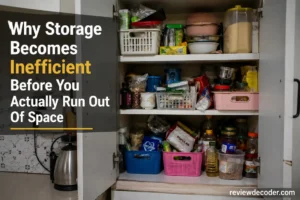
When a drawer is consistently packed beyond its useful capacity, reorganizing the same contents can only accomplish so much. Items become difficult to retrieve, objects get pushed toward the back, and eventually people start leaving things on nearby surfaces.
A useful system needs a little breathing room.
If every shelf, drawer, and cabinet is filled to its absolute limit, there is no flexibility when something new enters the home. Even a small purchase can disrupt the arrangement.
Leaving some unused capacity is therefore not wasted space. It provides room for ordinary changes.
This is also where decluttering and organization should not be confused. Organization determines where things belong. Decluttering determines whether everything needs to remain.
If a storage system repeatedly fails despite sensible placement, the number of possessions may deserve as much attention as their arrangement.
A Good System Makes Returning Things Easier
Finding something is only half the job.
The real test is whether the item gets returned after use.
Imagine a bathroom cabinet where everyday toiletries are stored in small containers on an upper shelf. Everything looks neat, but putting an item away requires opening the cabinet, moving another container, placing the product inside, and rearranging the shelf.
The arrangement may photograph well. It may not survive normal use.
A better setup might place frequently used items in a more accessible location while reserving the less convenient storage areas for backups and occasional-use products.
This principle can be applied almost anywhere:
| If an item is… | A practical storage approach |
|---|---|
| Used several times a day | Keep it immediately accessible |
| Used daily | Store it within easy reach |
| Used weekly | Convenient but not necessarily visible |
| Used seasonally | Higher or less accessible storage can work |
| Rarely used | Enclosed or secondary storage is usually reasonable |
| Used together with another item | Consider storing them near each other |
The exact arrangement depends on the home, but the underlying principle remains useful: access should reflect actual use.
Shared Spaces Need Different Rules
A system can work well for one person and fail completely when several people use the same space.
One person may remember that batteries belong in a particular drawer. Another person may put them wherever there is room. Someone may know that spare towels are stored on the top shelf, while another household member naturally looks in the bathroom cabinet.
This is not always a motivation problem. It can be a communication problem built into the system.
Shared storage works better when the location is obvious and the number of decisions is small. A complicated system that requires everyone to remember several rules is likely to deteriorate.
This is especially important for children and guests. If someone needs detailed instructions to return an everyday item, the storage location may be too complicated for its purpose.
Simple labels can help, but labels should support an intuitive arrangement rather than compensate for a confusing one.
The Most Useful Organization Test Is What Happens After Two Weeks
An organization project should not be judged immediately after it is completed.
The first day is misleading because motivation is high and everything has just been arranged. A better evaluation comes after the system has experienced ordinary use.
After a couple of weeks, look for the items that have migrated.
Which objects are repeatedly left on counters? Which drawer has become difficult to close? Which basket is overflowing? Which items are being stored somewhere different from their assigned location?
Those are not merely signs of failure. They are feedback.
Instead of forcing everything back into place, ask why it moved.
If the same object keeps ending up on a countertop, perhaps the countertop is closer to where it is used. If a particular drawer becomes chaotic, perhaps the categories inside it are too broad. If a storage box remains untouched for months, its contents may not need prime storage space.
The second version of an organization system is often much better than the first because it is based on observed behavior rather than assumptions.
When an Organization System Needs Fewer Rules
One of the clearest signs of an overly complicated system is that maintaining it feels like a separate household task.
If keeping a room organized requires constant sorting, labeling, folding, transferring, stacking, and rearranging, the system may be creating unnecessary work.
The strongest systems often have surprisingly few rules.
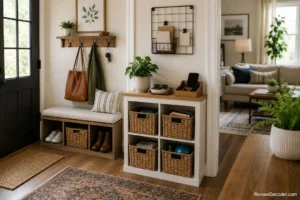
A hallway might have one obvious place for shoes, one place for frequently used bags, and one temporary basket for items that belong elsewhere. A kitchen might keep everyday cooking equipment near the main preparation area while rarely used equipment is moved farther away.
This approach does not eliminate mess. Homes are lived in.
Instead, it controls where mess is allowed to occur and makes recovery relatively easy.
That distinction matters. The goal of organization is not to produce a home that never becomes untidy. The goal is to make ordinary untidiness easier to correct.
What to Change When a System Keeps Failing
When the same organization problem returns repeatedly, don’t immediately buy more storage.
Start by identifying the recurring failure point.
If something is difficult to reach, move it.
If two things are always used together, consider storing them together.
If a container is constantly overflowing, reduce its contents or increase appropriate capacity.
If people repeatedly leave an item beside its storage location, reconsider the location.
If a category requires too many decisions, simplify it.
If a system only works when everyone has extra time, remove unnecessary steps.
And if an area is still difficult to maintain after these changes, question whether everything currently stored there needs to remain.
This approach turns organization into a process of adjustment rather than a one-time makeover.
The Best Systems Are Designed for the Home You Actually Have
A successful organization system does not require a household to behave differently every day. It starts with the behavior that already exists and makes it easier to manage.
That may mean keeping everyday items visible instead of hiding them. It may mean using one large basket instead of several small containers. It may mean leaving extra shelf capacity rather than filling every available inch. In another home, it could mean the opposite.
There is no universal arrangement that works equally well for every household.
The strongest system is the one that answers practical questions: Where does this item naturally get used? How often is it needed? Who uses it? How much effort does it take to put away? What happens when everyone is busy? And where does the clutter go when the system is ignored?
Those questions are more useful than simply asking whether a room looks organized.
A home organization system is successful when it continues to work after the motivation of organizing day has disappeared. If the arrangement survives rushed mornings, busy evenings, unexpected purchases, and ordinary human habits, it has a much better chance of lasting.
The objective, then, isn’t a perfectly organized home. It is a home in which the easiest place to put something is usually the right place, and recovering from everyday clutter doesn’t require starting over.

Hamza Farooq is a home improvement and organization writer who shares practical advice on cleaning, simple DIY fixes, and smart home organization. He focuses on creating easy-to-follow guides that help readers solve everyday household problems with realistic, affordable solutions. His goal is to make home maintenance simpler, more efficient, and accessible for anyone looking to improve their living space.