
My bedroom door used to open exactly seventy-three degrees. Not ninety. Not all the way. Seventy-three before it hit the laundry basket. I measured it one night at 2 AM. Could not sleep. Again.
That was my life for a year. A room that technically fit a bed, a desk, and a dresser. Functionally? It fit anxiety.
The room is nine feet by ten. One closet. One window. The closet is four feet wide with a single rod and a shelf. That is the entire storage inventory. That is what I had to work with.
I tried the Pinterest approach first. Matching bins. Labels. Woven baskets that looked like they belonged in a farmhouse. Within a month the bins were half-empty, the labels were peeling, and the baskets held exactly one scarf and a lot of dust.
Here is what actually worked. None of it is aesthetic. All of it is functional.
The Measurement I Got Wrong
For two years I believed I had no space. I was wrong. I had space. I just could not see it because I was looking for obvious space. Empty floor. Empty shelves. But small rooms do not have obvious space. They have hidden space. Vertical space. Door space. Under-bed space. The six inches between furniture and wall.
I bought a tape measure. Not the flimsy kind. A real metal one. I measured every gap, every height, every depth. The area under my bed? Eleven inches. The back of my door? Three inches of clearance. The closet shelf height? Fourteen inches, but only ten inches of usable depth because the door frame cut into it.
Those numbers changed everything. Storage is not about buying containers. It is about buying correctly sized containers.
Idea 1: The Door I Ignored
I used to throw clothes on a chair. The chair was my closet’s overflow zone. Jeans from yesterday. The sweater I might wear again. It piled up until the chair became a sculpture.
I tried Command hooks first. The sticky kind. They held a hoodie for four hours then peeled off the paint at 11 PM. Scared the cat. Not recommended.
What worked was an over-the-door rack with hooks. Not adhesive. Actual hooks that hang over the top of the door. It sits on the door frame, not the wall. No drilling. No sticky residue. I hung five items there. Hoodies, a robe, the bag I use daily. The chair became a chair again. Revolutionary.
The key was measuring the door thickness first. My interior door is one and three-eighths inches. Most over-door hooks fit up to one and three-quarters. But some cheap ones only fit one and a half. Check before you buy. I learned that after buying the wrong size and watching it rattle every time I closed the door.
Idea 2: The Bed I Never Looked Under
My bed sat directly on the floor. I never thought about the space underneath because I never saw it. It was just a dark zone where socks went to die.
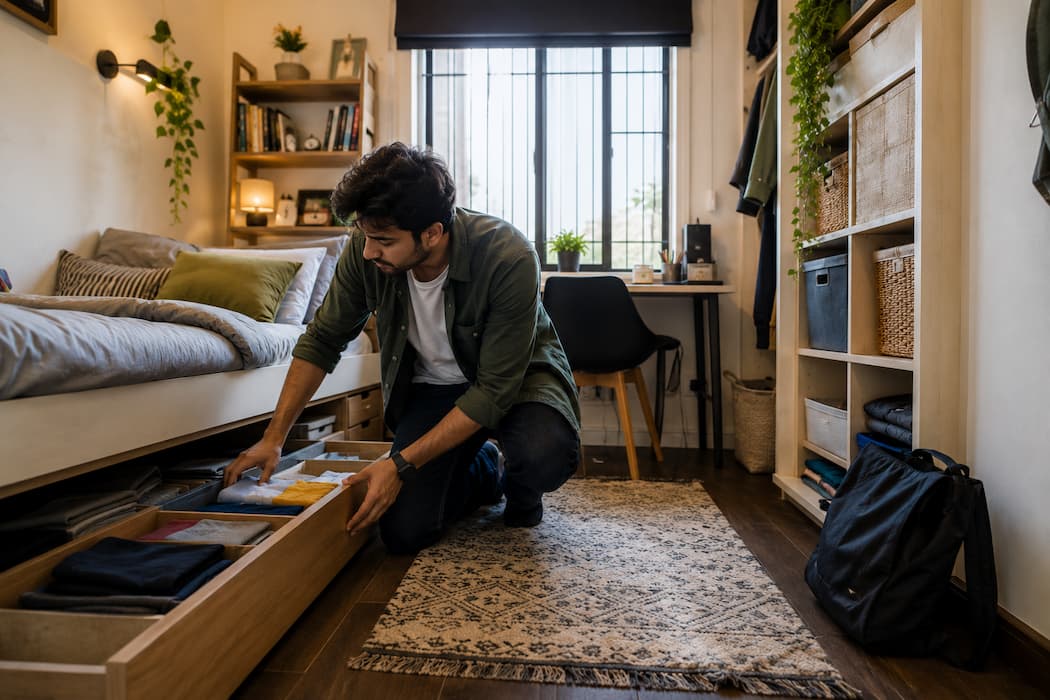
I bought bed risers first. Four-inch lifts. Plastic. About twelve dollars. That gave me eleven inches of clearance total. Then I bought two rolling under-bed bins. Not cardboard. Not fabric that collapses. Hard plastic with wheels. The wheels matter. If you have to drag a bin out from under a bed, you will not do it. You will leave it there. Wheels mean you pull it out with one hand while holding a shirt in the other.
I store off-season clothes there. Sweaters in summer. Shorts in winter. The bins are clear so I can see what is inside without opening them. Labels on the ends. I wrote a full guide on my under-bed system here if you want the exact dimensions and bin type.
Idea 3: The Closet Rod Hack
My closet had one rod. One. For all my clothes. I tried stacking bins on the shelf above but reaching up there required a step stool and a prayer. I knocked down a bin of winter hats once. It snowed acrylic beanies on my head.
The fix was a tension rod installed vertically inside the closet, not horizontally. I placed it in the corner, floor to ceiling. Then I added S-hooks. Bags hang there. My belt collection. A small mesh basket for scarves. It turned dead corner space into vertical storage without drilling a single hole.
Tension rods fail if you overload them. I learned the weight limit the hard way when mine collapsed at 6 AM and woke up the neighbors. Now I keep it light. Under five pounds total. Bags, not books.
Idea 4: The Nightstand I Replaced With Air
I had a nightstand. It took up two square feet of floor space and held a lamp, a phone charger, and a glass of water. That is it. Two square feet for three items.
I got rid of it. Mounted a small shelf above the bed at pillow height. The lamp went there. The charger became a wall-mounted USB outlet. The water glass? I started using a bottle instead. Gained two square feet of floor space. In a nine-by-ten room, two square feet is 2.2 percent of your total floor area. That matters.
That floor space alone made the room feel significantly larger. Not because of the shelf. Because I could actually see the floor.
Idea 5: The One Rule That Holds It All Together
Storage solutions are useless if you keep adding stuff. I implemented a rule. Brutal. Simple. One in, one out. New shirt means an old shirt goes to donation. New book means an old book goes to the library sale. No exceptions. Not for birthdays. Not for sales.
I keep a paper grocery bag in the closet. When it is full, I drop it off. The bag costs nothing. The habit saves my sanity. My wardrobe organization guide explains how I rotate items without creating new clutter.
Without this rule, the best storage ideas in the world will drown under new purchases. The containers do not matter if the volume keeps growing.
⚠️ When These Ideas Won’t Work
If your room is under eighty square feet total, these ideas help but they cannot create space that does not exist. You may need to remove furniture, not reorganize it. Also, if you rent a room with strict no-alteration rules and your landlord considers a tension rod an “alteration,” check first. Mine did not care. Yours might. Finally, over-the-door racks need doors that close properly. If your door already scrapes the frame, adding weight will make it worse. Fix the door first.
What I Actually Spent
| Storage Solution | My First Attempt (Failed) | What Worked | Cost |
|---|---|---|---|
| Door storage | Adhesive hooks ($8) | Over-door hook rack ($14) | $14 |
| Under-bed | Cardboard boxes (free) | Hard plastic rolling bins ($22) | $22 |
| Closet corner | Stacked shelf bins ($18) | Tension rod + S-hooks ($11) | $11 |
| Nightstand | Small floor table ($35) | Wall shelf + USB outlet ($19) | $19 |
Total spent: sixty-six dollars. Total floor space gained: roughly six square feet. Total closet functionality: tripled. The failed attempts cost me sixty-one dollars. So my net is actually a savings if you count the mistakes.
💡 What I Learned the Hard Way
I once bought a “space-saving” hanging closet organizer. Fabric. Shelves. Looked perfect online. I hung it from the closet rod and loaded it with sweaters. Within three weeks the rod bowed in the middle. Sagged two inches. I thought the rod was broken. It was not. The organizer weighed eleven pounds empty. Full of sweaters? Twenty-three pounds. My closet rod was never designed to hold that. The fix was not a stronger rod. The fix was removing the organizer entirely. Sometimes the best storage solution is admitting you own too much.
Frequently Asked Questions
Do I need tools for any of this?
No. The tension rod twists by hand. The over-door rack hangs. The wall shelf for the lamp used a small bracket that came with screws, but I used heavy-duty adhesive strips rated for ten pounds instead. No drill. No holes. If you are allowed to hang a picture, you can do this.
How do I keep under-bed bins from getting musty?
I leave the lids slightly unsealed. Not open. Just not clicked shut tight. Air needs to move. I also toss a silica gel packet into each bin. The kind that comes with shoe boxes. Free. Effective. I replace them every six months.
What if I have carpet and bed risers sink in?
Get risers with a wide base. At least four inches in diameter. Narrow ones punch into carpet and padding. I have low-pile carpet and the wide-base risers left no mark after two years. If you have plush carpet, put a flat piece of rigid plastic or wood under each riser to distribute weight.
Does the one-in-one-out rule really work long-term?
It works if you are honest. The trick is doing it immediately. Not “I will donate it next weekend.” The weekend never comes. I keep the donation bag in my car trunk. When something goes in, it leaves the house within twenty-four hours. Out of sight is not out of mind if it is still in your closet.
Can I do this in a shared room?
Yes, but you need agreement. My partner and I share the closet now. We split it fifty-fifty by rod length. Twenty-four inches each. Sounds rigid but it prevents the slow takeover. Boundaries are storage too.
Closing Thought
My room is still nine by ten. It will never be large. But the door opens ninety degrees now. Fully. I measured it last Tuesday. The laundry basket lives in the closet, on a hook, where it belongs.
Small rooms do not need more storage. They need correct storage. And less stuff. The second part is harder than the first. But it is the part that actually transforms the room.
Start with the tape measure. Not the bins. The numbers will tell you everything.
Sources and References
- American Psychological Association (APA) — Research on the relationship between household clutter, stress levels, and cognitive overload in residential spaces.
- National Sleep Foundation — Guidelines for maintaining a bedroom environment conducive to rest, including minimizing clutter and optimizing space usage.
- U.S. Consumer Product Safety Commission (CPSC) — Safety recommendations for vertical and wall-mounted storage to prevent furniture tip-over hazards in small spaces.

Hamza Farooq is a home improvement and organization writer who shares practical advice on cleaning, simple DIY fixes, and smart home organization. He focuses on creating easy-to-follow guides that help readers solve everyday household problems with realistic, affordable solutions. His goal is to make home maintenance simpler, more efficient, and accessible for anyone looking to improve their living space.