Replacing something that has broken seems like the most straightforward kind of home repair. A hinge bends, so you buy a new hinge. A tap starts leaking, so you replace the faulty fitting. A drawer runner breaks, so you install another one. Once the damaged component is gone, it is easy to assume the problem is finished.
Sometimes it is. But when the same failure happens again, the replacement part can become a useful clue that the original diagnosis was incomplete. The broken component may have been the one that finally showed the damage, rather than the one that caused it. Something around it may still be creating the same stress, movement, moisture exposure, pressure, or poor alignment that damaged the original.
This is why a brand-new part can fail in the same place as the old one. The replacement may be perfectly adequate. It has simply been placed back into the same conditions that caused the first failure.
The Part That Breaks Is Not Always The Part That Caused The Break
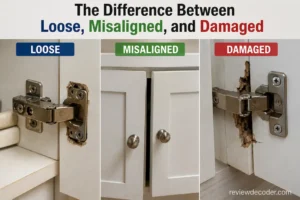
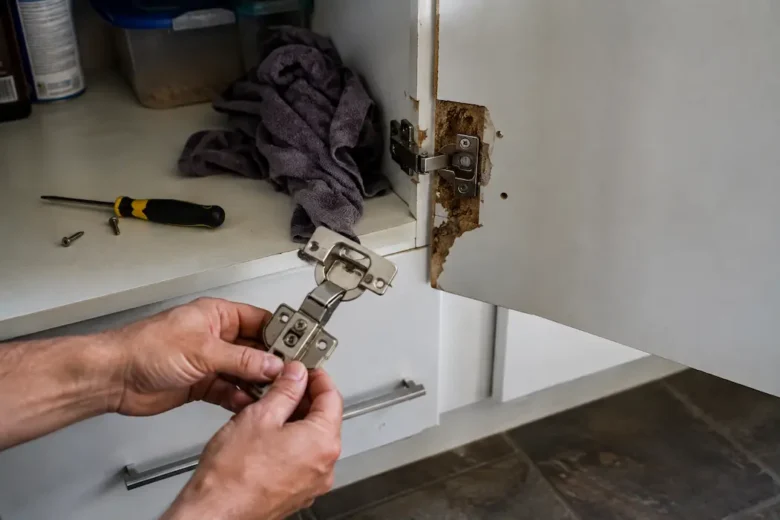
Think about a cabinet hinge that keeps bending. Replacing the hinge seems logical, since it is visibly damaged. But if the cabinet door is heavier than expected, the mounting points are weak, the door is misaligned, or the hinge is being forced sideways whenever the door closes, the new hinge is going to experience much of the same stress.
The original hinge was the visible casualty. It wasn’t necessarily the source of the problem.
This distinction appears throughout home maintenance. A screw can pull out because the material around it has weakened. A seal can fail because the joint is moving. A light fitting can become loose because its mounting point is unstable. A patch can crack because the surface beneath it continues to move.
In each case, replacing the visibly damaged item may restore the appearance temporarily without changing the condition that caused the failure.
That is why a replacement should be treated as the start of a diagnosis when the same problem has recurred, not as the end of one.
Repeated Failure Is The Biggest Warning
A replacement that fails once does not necessarily prove that the underlying repair was wrong. Parts wear out, defects happen, and household components have finite service lives.
But repeated failure deserves a different response.
If the original component failed and the replacement develops the same problem unusually quickly, compare the two failures. Did they break in the same location? Did they become loose in the same way? Did the same crack appear? Did the same side wear down? Did the same fitting start leaking again?
The similarity can be more informative than the fact that both parts failed.
When two different components experience the same failure under the same conditions, the surrounding environment becomes a much stronger suspect. Something may be repeatedly affecting the part.
This is particularly useful because homeowners often approach the second failure by assuming the replacement must have been poor quality. That is possible, but it is only one explanation.
A New Part Can Inherit An Old Alignment Problem
Alignment problems are especially good at surviving replacements.
Imagine a drawer that repeatedly damages its runner. The runner is replaced, and the drawer works again. A few months later, the new runner begins sticking or bending.
If the drawer itself is sitting at an angle, the cabinet opening is distorted, or the opposite runner isn’t carrying its share of the load, the replacement has entered the same situation as the original.
The new component hasn’t solved the geometry of the system.
The same principle applies to doors. A new hinge may be installed correctly, but if the door or frame is out of alignment, the hinge can continue experiencing forces it wasn’t meant to handle. The replacement may initially feel perfect because everything has just been adjusted, but ordinary use gradually recreates the original stress.
Whenever a replacement part fails unusually early, ask whether the components around it are forcing it to operate incorrectly.
The Supporting Material Can Be The Real Weak Point
A replacement part is only as secure as the material supporting it.
This is easy to forget when the replacement itself looks strong. A new bracket can be made from solid metal, but if the surface it is attached to is cracked or deteriorated, the entire connection can remain weak.
The same issue occurs with screws in weakened wood, fasteners in damaged wall material, hinges attached to deteriorated cabinet panels, and fittings connected to worn or damaged surfaces.
The replacement part may therefore be completely functional while the repair remains unreliable.
If a replacement keeps coming loose, inspect the mounting point rather than simply tightening or replacing the hardware again. Enlarged holes, cracks, soft material, movement around the attachment point, or evidence of moisture can all suggest that the surrounding material needs attention.
A stronger component cannot compensate indefinitely for a weak foundation.
Sometimes The Replacement Is The Wrong Part
Not every replacement that fits is necessarily suitable.
Household components can look almost identical while differing in dimensions, mounting arrangements, thread types, load ratings, materials, connection methods, or intended applications. A replacement can appear to work during installation while behaving differently under normal use.
This is especially easy to overlook with small hardware. If a screw goes into a hole or a hinge attaches to the existing mounting points, it can feel like the correct replacement. But the dimensions and way the component carries force may still be different.
The original part can also provide clues. Before discarding it, compare its dimensions, mounting points, shape, and connection method with the replacement. If the original component failed because it was unsuitable for the application, installing a similar part without understanding the requirements simply repeats the problem.
Compatibility is not only about whether something physically fits. It is about whether it performs the job under the conditions it will actually experience.
A Replacement Can Hide The Original Symptom
There is another reason replacement sometimes provides a false sense of success: the new component may temporarily hide the evidence of the original problem.
A new door hinge can make a crooked door look normal. A new seal can hide a small gap. A replacement drawer runner can make the drawer slide smoothly again. A fresh patch can make a crack disappear.
Those improvements are useful, but they don’t necessarily tell you why the original component failed.
If the surrounding conditions remain unchanged, the new component may gradually develop the same symptoms.
This is why it can be useful to examine the area before removing the damaged component. Look for unusual wear, contact marks, deformation, moisture staining, movement, cracks, or other clues. Once the old part has been removed, some of that evidence may be harder to interpret.
The broken part can show how the problem developed if you look at it before throwing it away.
The Way Something Is Used Can Be The Hidden Cause
Not every failure is caused by the house itself. Sometimes normal use is creating more stress than the component was designed to handle.
A door may be repeatedly pulled from the handle rather than pushed near the edge. A drawer may regularly carry more weight than its runners were intended to support. A cabinet shelf may be loaded heavily on one side. A furniture joint may experience movement that wasn’t expected when the component was installed.
None of these behaviors necessarily means someone is using the home incorrectly. Homes are used differently from the way they may have been used when their components were originally installed.
The important question is whether the replacement is experiencing the same forces as the original.
If it is, replacing the part without changing the conditions is unlikely to produce a dramatically different outcome.
Moisture Can Make A Replacement Fail Just Like The Original
Moisture is particularly adept at creating recurring repair problems because it can affect both the damaged component and the surrounding materials.
A replacement fitting installed into a damp area may begin deteriorating again. Wood exposed to repeated moisture can swell and contract, changing the way attached components fit. Sealants can fail when a joint continues moving or remains exposed to conditions they were not designed to tolerate.
This can make a replacement seem defective when the environment is actually the problem.
Look for recurring dampness, staining, swelling, peeling finishes, corrosion, soft material, or other signs that moisture is involved. A component installed in a persistently damp location is being asked to operate under the same conditions that may have contributed to the original failure.
In that situation, replacing the part without addressing the moisture source is more like resetting a timer than solving the problem.
Wear Can Be A System Problem Rather Than A Single-Part Problem
Some household mechanisms distribute work across several components.
A door doesn’t rely on a hinge alone. A drawer doesn’t depend on one runner in isolation. A cabinet doesn’t rely solely on the visible handle. Furniture joints, catches, rollers, supports, and fasteners often work together.
When one component becomes worn, the others may start carrying more of the load.
Replacing only the visibly failed component can therefore restore the system temporarily while leaving the underlying imbalance intact.
This is one reason a replacement may seem to fail unusually quickly. The new part absorbs forces that other components should share, or it works against another worn component.
If a replacement fails soon after installation, inspect the surrounding mechanism rather than looking only at the new part.
Previous Repairs Can Change The Conditions
A replacement isn’t always being installed into the original setup.
Previous repairs may have enlarged holes, changed fastener positions, added layers of material, altered clearances, or affected alignment. Over time, several small modifications can change how a component sits and how forces move through it.
This can be particularly important in older furniture, cabinets, doors, and frequently repaired household fixtures.
The new component may therefore be technically correct but operating in a setup that is no longer quite the same as the original.
If an area has a history of repeated repairs, take that history into account. The previous attempts may explain why a standard replacement isn’t behaving as expected.
The Location Of The Failure Can Be More Useful Than The Type Of Part
When comparing the old and new components, don’t only ask what broke. Look at where it broke.
A hinge that bends at the same point twice may be experiencing repeated stress at that location. A bracket that cracks along the same edge may be carrying an uneven load. A screw that repeatedly pulls out of the same hole may be exposing a problem with the supporting material.
The location can reveal how force is moving through the system.
Even wear can provide useful information. If one side of a component is significantly more worn than the other, something may be applying force unevenly.
These details don’t require specialized equipment to notice. A careful visual comparison between the old part, the replacement, and the surrounding components can sometimes reveal more than another round of trial-and-error repairs.
Don’t Assume The Most Expensive Replacement Is The Best Solution
When a repair fails, it can be tempting to solve the problem by buying a stronger, heavier, or more expensive component.
Sometimes that is appropriate. But strength alone doesn’t correct poor alignment, weak mounting material, excessive movement, moisture exposure, or an incorrect installation.
A stronger part can even shift the failure somewhere else. If one component becomes more resistant to the original force, another weaker component may begin carrying more of that force instead.
The goal should therefore be compatibility with the whole system rather than maximum strength in one isolated part.
A suitable replacement can perform its intended function under the actual conditions of the home.
When A Replacement Should Lead To A Wider Inspection
There is no need to turn every minor repair into a major investigation. Many broken household parts really are simply worn out and need replacement.
The warning signs are the ones that suggest a pattern.
The same part fails repeatedly. A replacement fails much sooner than expected. The new component develops the same wear pattern as the old one. The surrounding material moves, cracks, or deteriorates. Moisture is present. The component doesn’t fit or operate as expected. Or several connected parts show signs of stress.
These situations suggest that replacing the visible component may not be enough.
At that point, inspect the surrounding system and determine whether the original failure was caused by something outside the part itself. If the issue involves structural components, significant water damage, electrical systems, gas, or another potentially hazardous area, a qualified professional may be needed rather than continued trial and error.
The Best Replacement Is Sometimes No Replacement Yet
There is an important difference between finding the damaged part and understanding why it failed.
If a component has clearly reached the end of its useful life, replacement is sensible. But when the failure is unusual, repeated, or premature, immediately installing another part can remove the evidence you need to understand the problem.
Before replacing it, look at the surrounding area. Compare the old component with nearby similar components. Check for unusual wear, movement, moisture, alignment problems, and damage to the material supporting it.
Then ask what the replacement will experience that the original experienced.
If the answer is “the same thing,” there is a good chance the repair needs to go beyond the replacement itself.
Fix The Conditions That Made The Part Fail
A broken component is often the easiest part of a home repair to identify because it gives you something tangible to remove and replace. But easy identification doesn’t always mean correct diagnosis.
The original part may have failed because it was carrying too much load, sitting out of alignment, attached to weakened material, exposed to moisture, installed incorrectly, or working alongside another worn component. Replacing it can restore normal operation for a while, but if those conditions remain, the new part is simply starting the same journey as the old one.
That is why repeated replacement is such a useful warning sign. It tells you that the component may not be the complete problem.
A lasting repair doesn’t just ask what broke. It asks what made it break, whether that condition still exists, and whether the replacement will be exposed to it again.
Once those questions are answered, replacing the part becomes the final step of the repair rather than the entire repair itself.

Hamza Farooq is a home improvement and organization writer who shares practical advice on cleaning, simple DIY fixes, and smart home organization. He focuses on creating easy-to-follow guides that help readers solve everyday household problems with realistic, affordable solutions. His goal is to make home maintenance simpler, more efficient, and accessible for anyone looking to improve their living space.