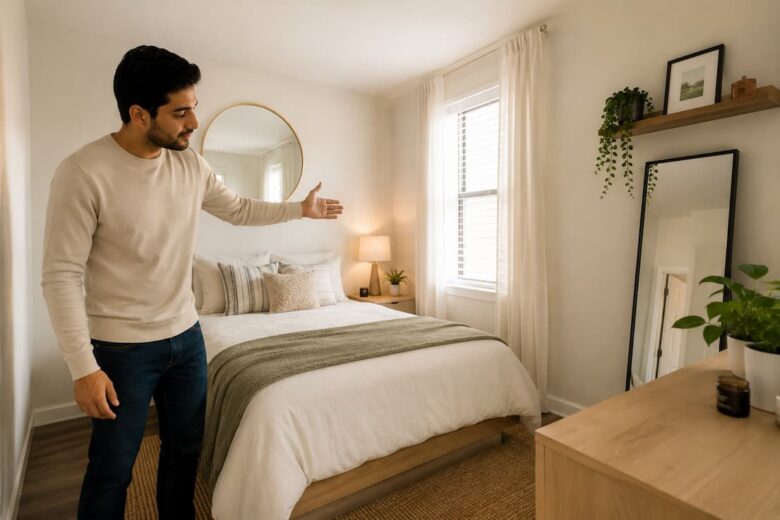
A small room does not always feel small because it lacks floor space. Sometimes the problem is the way that space is visually divided. Too much furniture, blocked windows, dark corners, bulky storage, and objects scattered across several surfaces can make an otherwise usable room feel cramped. Even when the dimensions cannot be changed, the way light moves through the room and the way the eye reads its boundaries can make a noticeable difference.
Making a room look bigger is therefore less about finding one magical decorating trick and more about removing the visual obstacles that make the space appear compressed. Furniture placement, lighting, color, storage, window treatments, mirrors, and even the size of everyday objects all influence how open a room feels. Some changes cost almost nothing, while others require replacing or rearranging a few pieces.
The best approach is to work with the room you already have rather than trying to make it behave like a much larger room. When the floor remains visible, natural light is allowed to travel through the space, and the eye can move easily from one area to another, even a compact room can feel considerably more comfortable.
1. Keep More of the Floor Visible
One of the simplest ways to make a small room appear larger is to reduce the amount of floor that is visually blocked. Furniture sitting directly across large portions of the floor can make the room feel crowded, even when there is technically enough space to walk around it. Creating clearer areas of visible flooring gives the eye a stronger sense of continuity.
This does not mean removing every piece of furniture. Instead, look for opportunities to create breathing room around the main pieces. A sofa that is pushed tightly into a corner may sometimes work better slightly away from another object, while a chair that blocks a natural walking route can be repositioned. The objective is to create a clear visual path through the room rather than filling every available area.
2. Choose Furniture That Fits the Room
Furniture that is physically too large can overwhelm a small room faster than almost anything else. A deep sofa, oversized armchair, large coffee table, or bulky cabinet can consume both floor space and visual attention. Even if the furniture is comfortable, the room may feel smaller because the proportions are working against it.
When choosing furniture, consider more than width. Depth, height, leg placement, and visual weight all matter. A piece with exposed legs can allow more floor to remain visible underneath it, while a bulky solid base can make the same footprint feel heavier. The right furniture does not have to be tiny; it simply needs to be proportionate to the room.
3. Let Natural Light Travel Through the Space
Natural light can make a compact room feel more open because bright areas tend to appear less enclosed. Heavy furniture placed directly in front of a window can interfere with that effect, as can curtains that remain drawn throughout the day.
Keep the area around the main window as open as practical. If privacy allows, let daylight enter as much of the room as possible. Light-colored curtains or shades can also help maintain brightness while providing the necessary privacy.
The goal is not to maximize sunlight at all costs. It is to avoid unnecessarily blocking one of the room’s most valuable visual assets.
4. Use Mirrors Where They Actually Help
Mirrors can make a room feel larger because they reflect light and create the impression of additional visual depth. However, simply adding a large mirror to any empty wall does not automatically improve a room.
Placement matters. A mirror positioned where it reflects a window, light source, or visually attractive part of the room can create a more convincing sense of openness. A mirror reflecting a cluttered corner may simply make the clutter appear twice.
For a small room, one well-positioned mirror can often be more effective than several decorative ones competing for attention.
5. Keep the Color Scheme Visually Connected
Strongly contrasting colors can divide a small room into separate visual sections. That is not always undesirable, but when the goal is to make the space appear larger, a more connected palette can help the eye move continuously across the room.
Light colors are often associated with spaciousness because they reflect more light, but the room does not have to be completely white. Soft neutrals, muted tones, and closely related shades can create a similar sense of continuity.
You can still introduce contrast through furniture, artwork, textiles, or accessories. The important part is avoiding so many competing visual blocks that the room begins to feel segmented.
6. Take Advantage of Vertical Space
A small room often has more usable vertical space than floor space. Drawing attention upward can make the ceiling feel higher and reduce the impression that everything is compressed into a small footprint.
Tall shelving, vertically arranged artwork, or curtains mounted closer to the ceiling can emphasize the height of the room. This does not mean every wall needs to be filled from floor to ceiling. Too much vertical storage can create the opposite effect by making the room feel enclosed.
Use height strategically to draw the eye upward while keeping the lower portion of the room relatively open.
7. Raise Curtains Higher
Curtain placement can change how large a window and wall appear. Hanging curtains immediately above the window frame may visually limit the height of the opening, while positioning the rod higher can create a longer vertical line.
Extending the curtains beyond the sides of the window can also allow more of the glass to remain visible when the curtains are open. This can make the window feel larger and help natural light reach more of the room.
The curtains themselves should not be excessively heavy or bulky if the goal is an open appearance. A simpler treatment can preserve the sense of height without adding unnecessary visual weight.
8. Reduce Small Pieces of Visible Clutter
A room can contain relatively little furniture and still feel crowded if many small objects are scattered throughout it. Books, cables, decorative items, papers, baskets, containers, and miscellaneous belongings each create another visual point for the eye to process.
This is why decluttering can have a greater effect than buying new furniture. Group similar objects, remove things that do not need to remain visible, and give frequently used belongings predictable storage locations.
You do not need an empty room. The goal is to create enough visual quiet that the furniture and architectural boundaries remain easy to see.
9. Use Furniture With More Than One Function
In a small room, every piece of furniture can be asked to perform more than one job when practical. An ottoman can provide seating and storage. A console can hold useful items while serving as a workspace. A bed with appropriate built-in storage can reduce the need for a separate cabinet.
Multifunctional furniture can reduce the total number of objects required in the room. That matters because each additional piece consumes floor space and creates another visual boundary.
The important qualification is that multifunctional furniture should still be easy to use. A storage ottoman that is difficult to open or a table that is constantly covered with unrelated objects may not deliver much practical benefit.
10. Create Clear Walking Paths
A small room feels considerably smaller when people have to navigate around furniture rather than move naturally through it. Walking paths should therefore be considered before furniture is positioned permanently.
Look at the routes you use most often. Can you reach the door without turning sideways? Can you get to a window easily? Is the path between the seating area and another room blocked by a table or chair?
Moving one piece a few inches can sometimes improve the entire arrangement. The room does not necessarily need more space; it needs fewer obstacles occupying the space that already exists.
11. Choose Leggy Furniture Where Appropriate
Furniture with visible space underneath can make more of the floor visible, which can create a lighter visual impression. Sofas, beds, chairs, and cabinets with raised bases allow the eye to see underneath them instead of encountering a solid block extending down to the floor.
This is not a requirement for every piece. A room full of furniture on tall legs can look awkward if the style does not suit it. But replacing one particularly bulky piece with a visually lighter alternative can make a noticeable difference.
The same principle applies to tables. A slim-legged table may appear less dominant than one with a thick solid base even if both occupy a similar amount of floor space.
12. Use One Larger Focal Point Instead of Many Small Ones
Small rooms can become visually busy when every wall contains several small decorations. Multiple tiny frames, shelves, signs, plants, and objects create many stopping points for the eye.
Sometimes one larger artwork, mirror, or carefully selected focal point creates a calmer appearance. The wall does not necessarily become emptier; it simply becomes easier to read.
This approach also makes decorating easier because you can concentrate attention on a few meaningful pieces rather than trying to fill every empty area.
13. Keep Storage as Visually Quiet as Possible
Open storage can be useful, but too many visible shelves can make a small room feel crowded. Every exposed object becomes part of the room’s visual composition, even when it is neatly arranged.
Where possible, use closed storage for items that do not need to remain visible. For open shelves, group objects and leave some empty space between them. A shelf that is completely packed can make the wall appear heavier than a partially filled shelf.
Storage should help control clutter rather than simply giving clutter a higher place to sit.
14. Use Lighting to Eliminate Dark Corners
A room can feel smaller when one or more corners remain noticeably dark. This is particularly common in rooms with limited natural light or furniture that blocks existing fixtures.
Instead of relying entirely on one central ceiling light, consider how different parts of the room are illuminated. A floor lamp, table lamp, wall light, or other suitable fixture can help distribute light more evenly.
The purpose is not to make the room excessively bright. It is to reduce the sharp difference between an illuminated central area and dark edges that can visually shrink the usable space.
15. Leave Some Space Intentionally Empty
Perhaps the most difficult idea for many people is also one of the most effective: an empty area does not necessarily mean something is missing.
A small room needs visual breathing space. Leaving part of a shelf empty, keeping a corner free, or resisting the urge to place another decorative item on a table can make the surrounding objects appear more intentional.
Empty space allows the eye to rest and makes boundaries easier to see. Instead of asking how to fill every available surface, ask whether the room would actually benefit from another object.
Which Changes Make the Biggest Difference?
Not every room needs all 15 ideas. In fact, trying to apply every technique at once can make the space feel overly designed. The most useful changes depend on what is currently making the room appear smaller.
| If the room feels… | Start with… | Why it helps |
|---|---|---|
| Cluttered | Remove visible excess | Reduces visual distractions |
| Dark | Improve light distribution | Makes boundaries feel less enclosed |
| Cramped | Rearrange furniture | Opens walking routes |
| Short | Use vertical lines | Draws attention upward |
| Heavy | Choose visually lighter furniture | Reveals more floor |
| Disconnected | Simplify the color palette | Creates visual continuity |
| Tight around storage | Use multifunctional furniture | Reduces the number of pieces needed |
| Flat | Add a well-placed mirror | Creates depth and reflection |
This approach is more useful than automatically purchasing small-space furniture or copying a room from a magazine. First identify what is making your own room feel compressed, then make the change that addresses that specific problem.
What Not to Do When Trying to Make a Room Look Larger
There is a tendency to believe that making a small room look larger requires using only pale colors, tiny furniture, minimal decoration, and as many mirrors as possible. These rules can sometimes help, but following them blindly can produce a room that is uncomfortable or visually empty.
Furniture should still be comfortable and appropriately sized for the people using it. A tiny sofa that nobody enjoys sitting on does not improve the room simply because it saves a little space. Likewise, covering every wall with mirrors can make the room feel visually confusing rather than spacious.
The strongest results usually come from a combination of proportion, light, organization, and clear pathways. A room does not have to look empty to look larger. It needs enough structure that the eye can understand where one area ends and another begins without encountering unnecessary obstacles.
Try Rearranging Before Buying Anything
One of the most useful experiments costs nothing. Remove small objects from the room temporarily, move the furniture into a few different arrangements, and observe how the space changes. You may discover that the largest improvement comes from changing the position of one chair or moving a table away from a walking route.
Try viewing the room from the doorway as well as from the main seating position. The first view people get when entering a room often has a strong effect on how spacious it feels. If the first thing visible is a large piece of furniture or a crowded surface, the room may feel more compressed than it does from another angle.
Taking photographs can also help because a camera often reveals visual clutter that is easy to overlook when you see the room every day.
Make the Room Feel Larger Without Making It Feel Empty
The goal of these changes is not to create a room with almost nothing in it. A useful living space still needs seating, storage, lighting, personal belongings, and objects that make it comfortable. The challenge is making those elements work together without allowing them to overwhelm the available space.
That usually means being selective. Choose furniture that fits the room, keep useful walking paths open, control visible clutter, and make sure light reaches as much of the space as possible. Use mirrors and vertical lines where they genuinely improve the room rather than adding them simply because they are associated with small-space design.
The result should feel open but lived-in, not empty.
Frequently Asked Questions
What color makes a small room look bigger?
Light and relatively soft colors can help reflect available light and create a more continuous visual appearance. However, you do not need to paint the entire room white. Closely related neutral or muted shades can also work well, especially when the walls, larger furniture pieces, and textiles do not create excessive visual contrast.
Does putting a mirror in a small room really make it look bigger?
A mirror can create the impression of additional depth by reflecting light and parts of the room. Its placement is important, though. A mirror reflecting a window or an open section of the room can be more effective than one reflecting clutter or a dark corner.
Should small rooms have small furniture?
Not necessarily. The important factor is proportion rather than simply choosing the smallest available pieces. Oversized furniture can overwhelm a compact room, but furniture that is too small can make the space uncomfortable and visually unbalanced. Choose pieces that provide the required function without unnecessarily consuming floor area.
Does decluttering make a room look bigger?
Yes, reducing unnecessary visible objects can make a significant difference because clutter creates many visual boundaries and distractions. Removing items that do not need to remain on shelves, tables, or floors allows the room’s actual dimensions and pathways to become easier to see.
How can I make a small room look bigger without spending money?
Start with furniture placement and decluttering. Clear walking routes, move oversized pieces away from important sightlines, remove unnecessary objects from visible surfaces, and rearrange existing lamps or furniture to improve light distribution. These changes can sometimes produce a noticeable improvement without purchasing anything.
Make the Space You Have Easier to See
A small room cannot always be made physically larger, but it can often be made to read differently. When furniture blocks pathways, windows are covered, storage is overflowing, and every surface is filled with objects, the boundaries of the room become harder to see. The result is a space that feels compressed even when its actual dimensions have not changed.
The most effective improvements are usually surprisingly straightforward. Keep more floor visible, choose furniture that fits the proportions of the room, allow natural light to travel, control clutter, use vertical space thoughtfully, and create clear routes through the room. A well-positioned mirror or a lighter piece of furniture can help, but those changes work best when the basic layout is already doing its job.
You also do not need to make every recommended change. Start with the feature that currently makes your room feel most cramped. If the problem is furniture, rearrange it. If it is clutter, remove what does not need to be visible. If the room is dark, improve the distribution of light. If the walls feel crowded, simplify what is displayed.
A larger-looking room is ultimately created through visual breathing space, not through tricks alone. When the eye can move freely, important furniture has room around it, and light reaches more of the space, even a compact room can feel calmer, more comfortable, and surprisingly open.

Hamza Farooq is a home improvement and organization writer who shares practical advice on cleaning, simple DIY fixes, and smart home organization. He focuses on creating easy-to-follow guides that help readers solve everyday household problems with realistic, affordable solutions. His goal is to make home maintenance simpler, more efficient, and accessible for anyone looking to improve their living space.