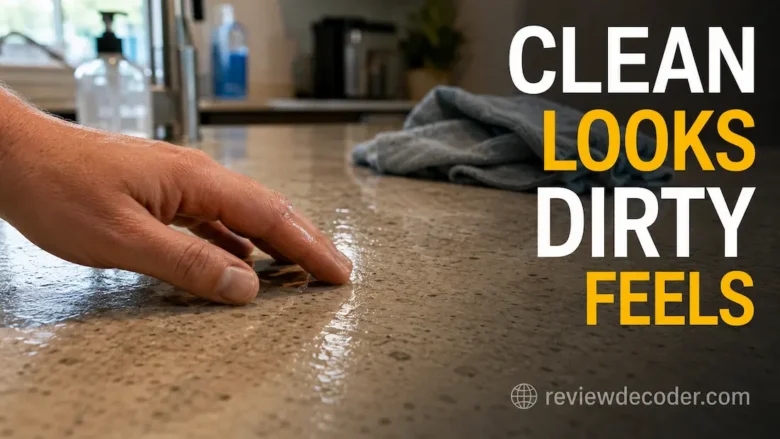
A surface may appear perfectly clean yet still prompt you to wipe it again. The countertop may have no visible crumbs, the table may look polished, and a cabinet door may appear spotless under normal lighting, yet your hand immediately notices something different. It might feel slightly greasy, tacky, dusty, rough, or simply unlike the clean surface you expected. That difference is usually not your imagination. What the eye sees and what the hand feels are two different ways of judging cleanliness.
The problem is that cleaning often removes what is easy to see without completely removing what remains on the surface. A thin layer of cooking oil, cleaning-product residue, skin oils, mineral deposits, or very fine dust can be difficult to notice visually. Some materials also make residue more noticeable to the touch than to the eye. Understanding what is left behind makes it easier to resolve the problem without repeatedly scrubbing the same surface.
Clean-looking and clean-feeling are not the same thing
Visual cleanliness is mostly about appearance. If there are no obvious crumbs, stains, fingerprints, streaks, or patches of dirt, a surface can appear clean from across the room. Touch provides different information. Your fingertips can detect tiny changes in friction, moisture, texture, and surface coating that are almost impossible to see.
This is why a countertop can look spotless but feel slightly oily when you run your hand across it. The remaining layer may be extremely thin. It doesn’t need to be thick enough to create a visible mark to change the way your skin moves over the surface. The same thing happens with cabinet doors, appliance handles, dining tables, and other areas that receive frequent contact.
A clean appearance also depends heavily on lighting. Reflections can hide very thin films, especially on darker, glossy, or patterned surfaces. A surface may look different when viewed from an angle or when sunlight hits it directly. In other cases, the residue is so evenly distributed that there is no obvious patch to identify. Your hand can still detect it even though your eyes cannot.
A thin residue can change the feel of a surface
One of the most common reasons a surface feels dirty after cleaning is that something has been left behind rather than completely removed. This doesn’t necessarily mean the cleaning product was bad. It can happen when too much product is used, when the surface isn’t wiped thoroughly, or when the product is not appropriate for that material.
Some cleaners contain ingredients designed to help loosen dirt, improve spreading, provide shine, or leave a particular finish. If too much remains on the surface, the result can be a faint film. The surface may look shiny and clean while feeling slightly slick or sticky.
This is especially noticeable on smooth surfaces where your fingers normally glide easily. A thin residue changes that movement. Instead of feeling dry and even, the surface can feel almost as though there is a very light coating between your hand and the material.
The same principle applies when a cleaner is diluted incorrectly. More product does not automatically mean more cleaning power. If the surface is left with a greater concentration of cleaning ingredients than necessary, removing the original dirt may simply be replaced by leaving another layer behind.
Grease can be present without looking greasy
Cooking areas are particularly prone to this problem. Grease does not always appear as an obvious oily patch. A very thin layer can accumulate gradually on cabinet fronts, range hoods, backsplashes, appliance controls, and nearby surfaces.
Fresh grease may be easy to recognize, but older grease can collect dust and become much less obvious. Repeated cleaning can also spread a small amount of oil over a larger area. Instead of having one clearly dirty spot, you end up with a nearly invisible film across the surface.
Touch makes this easier to notice. Your fingers may drag slightly instead of sliding normally. A cabinet door may feel different near the stove than it does farther away. The surface can look uniform while still having a noticeably different texture.
This is one reason simply wiping a greasy surface with a damp cloth may not solve the problem. If the cloth is only moving the oily material around, the surface can look better without actually becoming free of the film.
Cleaning products themselves can leave a film
Sometimes the surface feels dirty because the cleaning process has created a new problem. This is particularly possible when a product is used too heavily or isn’t fully removed afterward.
A common mistake is assuming that a stronger-smelling or more heavily applied cleaner must be doing a better job. In reality, the amount needed depends on the product and the type of soil being removed. Applying more than necessary can make the final wipe more difficult and increase the chance of residue.
The cloth matters too. A heavily loaded cloth can spread dissolved dirt and cleaner across the surface instead of picking it up efficiently. The first few passes may make the surface look dramatically better, but later passes can simply redistribute what remains.
When a surface repeatedly looks clean but feels coated afterward, it is worth considering the cleaning process itself rather than automatically reaching for a stronger product.
Hard-water deposits feel different from ordinary dirt
Mineral deposits are another reason a surface can feel wrong even when it doesn’t look particularly dirty. Water containing dissolved minerals can leave deposits behind as it evaporates. This commonly happens around faucets, sinks, shower surfaces, glass, and other areas where water repeatedly dries.
Depending on the surface and the amount of buildup, the deposit may appear as white spotting, cloudiness, or a faint haze. But early or thin deposits may be difficult to see. Your fingers may notice the problem before your eyes do because the mineral layer changes the smoothness of the surface.
A glass surface is a good example. It can look clear from a normal distance while feeling slightly rough when wiped or touched. Repeated evaporation leaves small amounts of mineral material behind, and those deposits can accumulate over time.
This is different from ordinary household dust or grease, so simply repeating the same general cleaning routine may not solve it. The cause of the residue matters because different types of buildup respond differently to cleaning methods.
Dust can become almost invisible on some surfaces
Fine dust doesn’t always look like the familiar gray layer people associate with a dirty surface. On textured, matte, patterned, or light-colored materials, tiny particles can blend into the background.
A surface can therefore look clean while still feeling slightly gritty when touched. The amount of dust may be too small to notice individually, but enough particles are present to change the feel.
Dust can also combine with other materials. Skin oils, moisture, cooking residue, and small amounts of cleaning product can make fine particles adhere more strongly to a surface. What began as loose dust can become a thin layer that requires more than a quick dry wipe.
This is one reason the order of cleaning matters. If loose dust is mixed with moisture or residue before it has been removed, the cleaning task can become harder rather than easier.
Your cleaning cloth can be part of the problem
A cloth may look clean while still carrying material from previous cleaning jobs. Over time, fibers can collect grease, dust, detergent residue, and other particles. When that cloth is reused, some of that material can be transferred back onto the next surface.
This can create a frustrating cycle. You wipe the surface, it looks better, and yet it still feels slightly dirty. You wipe again and get the same result because the tool you’re using is no longer effectively removing what you’re trying to remove.
The way a cloth is used also matters. A saturated cloth may spread moisture and dissolved residue without picking everything up. A very dry cloth may push certain materials around. Folding the cloth to expose a cleaner section can help when working across larger surfaces because one area of fabric isn’t being used to redistribute the same material repeatedly.
A useful sign is when a surface becomes cleaner-looking with every wipe but never reaches the expected clean feel. At that point, changing the cloth or cleaning method may be more useful than simply increasing the number of passes.
Some materials naturally make residue more noticeable
Not every surface should feel the same after cleaning. Material characteristics affect friction, texture, and how residue interacts with the surface.
Glossy finishes can reveal streaks and films through reflections. Matte finishes may hide visual residue while making a slight change in texture obvious to the touch. Wood finishes can feel different depending on their coating and moisture exposure. Textured plastics can trap fine particles in small recesses.
Even a perfectly maintained surface can have a particular feel because of its material and finish. The goal isn’t necessarily to make every material feel identical. Instead, it is to recognize when the surface feels different from its normal condition.
That distinction helps prevent unnecessary cleaning. If a material naturally has a slightly textured finish, repeated scrubbing won’t turn it into a smooth surface. It may actually damage the finish while trying to remove something that isn’t dirt.
Over-cleaning can make the problem worse
When a surface doesn’t feel clean, the instinct is often to scrub harder. That’s understandable, but it isn’t always the right response.
More pressure can spread some residues rather than remove them. Aggressive scrubbing can also affect finishes, especially on painted, coated, polished, or delicate materials. If the original problem is a film left by the cleaning process, adding more cleaner and more scrubbing can simply add another layer of the same problem.
A better approach is to identify what the surface is actually feeling like.
If it feels greasy, look for oils or cooking residue.
If it feels sticky, consider product residue or a concentrated layer of dissolved grime.
If it feels gritty, fine dust or mineral deposits may be involved.
If it feels rough, check for deposits, buildup, or the natural texture of the material.
If it feels slick, consider grease, polish, or cleaning-product residue.
The description of the problem can often tell you more than simply asking whether the surface looks dirty.
The cleaning sequence can matter more than the cleaner
A surface sometimes remains dirty-feeling because the steps are happening in the wrong order. Loose particles, oily residue, and moisture don’t always respond well to the same treatment.
For example, wiping a heavily dusty surface with a wet cloth can turn loose particles into a damp film. Trying to polish a greasy surface before removing the grease can spread the residue. Applying more product before removing the previous product can increase buildup.
A more deliberate process is often simpler:
Remove loose material first. Deal with the actual residue second. Remove remaining cleaning material afterward when the surface and product instructions call for it. Allow the surface to dry normally.
The exact method depends on the material and the product being used. There is no universal cleaner that should be applied to every household surface, and manufacturer’s care instructions should take priority for finished, delicate, or specialty materials.
How to figure out what is making a surface feel dirty
Instead of immediately changing cleaners, take a moment to observe the problem.
Start by identifying where the feeling occurs. Is it everywhere or only around handles, cooking areas, water sources, or frequently touched sections? A localized problem often points toward a localized source.
Next, notice what the surface feels like. Greasy, tacky, gritty, rough, waxy, and dusty are different clues. You don’t need special equipment to make this distinction. Your fingertips are already providing useful information.
Then consider what was used to clean it recently. If the surface felt normal before a new product or cleaning routine was introduced, residue from that process becomes worth considering.
Finally, compare the affected area with a nearby section of the same material that receives less use. Differences can reveal whether the problem is related to handling, cooking, water exposure, or the cleaning method itself.
This simple comparison is often more useful than repeatedly wiping the same spot and hoping it eventually feels different.
A clean surface should not require endless wiping
If a surface repeatedly looks clean but never feels clean, the answer usually isn’t to keep wiping indefinitely. The better question is what remains on the surface and why it remains there.
Grease, fine dust, mineral deposits, cleaning-product residue, and material texture can all produce a different tactile result without creating an obvious visual mess. The cleaning cloth, product amount, water quality, cleaning order, and surface type can influence the outcome as well.
Once the residue is identified, the solution becomes much more straightforward. You can choose a method appropriate for the material instead of repeatedly increasing the amount of cleaner or pressure.
The most useful cleaning habit is therefore not simply cleaning until a surface looks spotless. It is learning to recognize the difference between visible dirt, invisible residue, and the normal characteristics of the material itself. That small distinction can save time, reduce unnecessary scrubbing, and help surfaces stay in better condition over the long term.

Hamza Farooq is a home improvement and organization writer who shares practical advice on cleaning, simple DIY fixes, and smart home organization. He focuses on creating easy-to-follow guides that help readers solve everyday household problems with realistic, affordable solutions. His goal is to make home maintenance simpler, more efficient, and accessible for anyone looking to improve their living space.