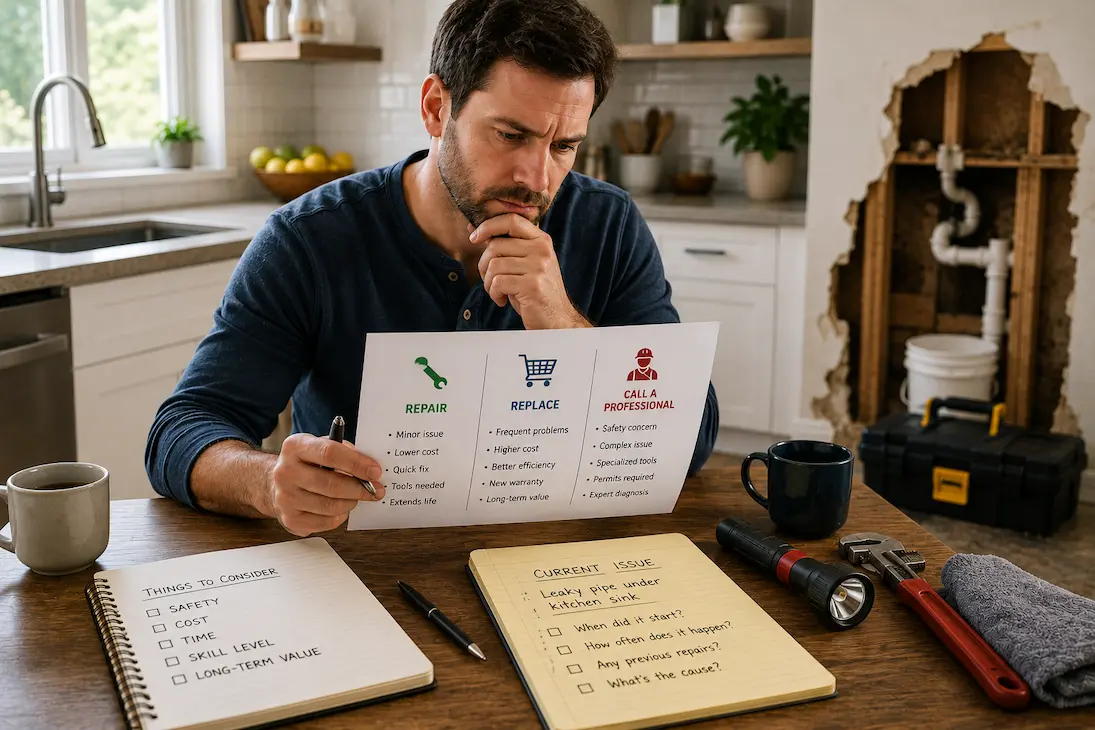
Owning a home means making decisions that rarely have perfect answers. A dripping tap, a damaged cabinet, a noisy appliance, or a cracked tile can all raise the same question: should you repair it yourself, replace it entirely, or ask a professional to handle the job? The answer isn’t always obvious, and choosing the wrong approach can cost both time and money.
Many homeowners assume the cheapest option is automatically the best one. Others replace items that could have been repaired with minimal effort, while some continue to repair the same problem long after replacement would have been the more practical choice. Good home maintenance isn’t simply about fixing things—it’s about knowing which solution makes the most sense for your situation.
This guide offers a practical way to think through those decisions. Rather than focusing on specific repairs, it explains the questions experienced homeowners often ask before deciding whether to repair, replace, or seek professional help.
Start by Looking at the Bigger Picture
When something stops working properly, it’s easy to focus only on the immediate problem. A drawer won’t close, a tap drips, or a fence panel has become loose. While these issues deserve attention, the visible problem is only one part of the decision.
Consider how the item has performed over the past few years. Has it been reliable until now, or has it required repeated attention? Is the problem an isolated issue or another sign of gradual wear? Looking at the overall condition rather than one single fault often leads to a better long-term decision.
An older item with one small problem may still have many years of useful life ahead. On the other hand, several minor faults appearing within a short period can suggest that larger maintenance expenses are approaching.
Ask Whether the Problem Affects Safety
Some household issues are inconvenient. Others have the potential to become dangerous if ignored.
A cabinet hinge that has loosened slightly may simply need adjustment. By contrast, electrical burning smells, gas odors, significant water leaks, damaged structural components, or signs of overheating should never be treated as ordinary DIY projects without careful assessment.
Safety should always influence the decision before cost does. Saving money is worthwhile only when the repair can be completed without creating unnecessary risk.
Consider the Remaining Life of the Item
Every household item eventually reaches a point where continued repairs become less practical than replacement. The challenge is recognizing when that point has arrived.
Think about how long the item has already been in service, how heavily it is used, and whether replacement parts remain readily available. If a repair is likely to provide many additional years of reliable use, it often makes good sense to repair. If failures are becoming more frequent, replacing the item may prove more economical over time.
Age alone doesn’t determine the answer, but it provides valuable context for the decision.
Questions Worth Asking Before You Decide
| Question | Why It Matters |
|---|---|
| Is the problem affecting safety? | Safety concerns often require immediate action. |
| Has this issue happened before? | Repeated failures may indicate a larger problem. |
| Can the repair reasonably extend the item’s life? | Helps compare repair value against replacement. |
| Are replacement parts readily available? | Difficult-to-obtain parts may influence the decision. |
| Would replacement improve efficiency or reliability? | Newer products sometimes offer meaningful long-term benefits. |
These questions don’t provide automatic answers, but they encourage thoughtful decisions instead of rushed ones.
Sometimes the Smallest Repair Has the Greatest Value
Not every repair needs to be dramatic to make a difference. Tightening loose hardware, replacing worn weather stripping, resealing small gaps, adjusting doors, or replacing inexpensive fittings can often restore normal function with very little cost.
These types of repairs usually make sense because the effort is relatively low while the improvement can be significant. They also help prevent minor issues from developing into more expensive problems later.
Routine maintenance often extends the life of household items more effectively than waiting until something fails completely.
Repeated Repairs Can Become More Expensive Than Replacement
One repair rarely tells the whole story. If the same appliance, fixture, or piece of furniture has required attention several times within a short period, it’s worth stepping back and looking at the pattern rather than the latest fault.
Frequent repairs involve more than replacement parts. They also require time, effort, temporary inconvenience, and the possibility that another failure will appear soon afterward.
In these situations, replacing the item may provide greater value than continuing to repair individual problems one at a time.
Think About Tomorrow, Not Just Today
A repair that solves today’s problem isn’t always the most practical long-term solution. Imagine repairing an aging appliance that already consumes more electricity than modern alternatives or fixing furniture that has become unstable in several different places.
Sometimes replacement offers benefits beyond restoring normal operation. Improved efficiency, better reliability, lower maintenance requirements, or updated safety features may justify replacing an older item even if it can technically still be repaired.
Thinking beyond the immediate repair helps homeowners make decisions that continue providing value well into the future.
Professional Help Isn’t Always the Most Expensive Option
Many people hesitate to contact a professional because they assume doing everything themselves will automatically cost less.
In reality, an unsuccessful DIY repair can sometimes increase expenses if damaged components need replacing or if the original problem becomes more complicated. A professional assessment may identify the real cause quickly, reducing unnecessary work and preventing repeated repairs.
Knowing when expert advice is worthwhile is itself an important homeownership skill.
Good Decisions Usually Come From Careful Evaluation
Home maintenance isn’t simply about repairing whatever appears broken. It involves weighing safety, cost, remaining lifespan, reliability, and future maintenance before deciding on the most sensible course of action.
By slowing down and considering these factors together, homeowners often discover that the best decision isn’t always the most obvious one.
Think Beyond the Price Tag
When homeowners compare repairing and replacing something, the first number they usually look at is the immediate cost. While that figure is important, it often doesn’t provide a complete picture. A repair may cost very little today but require another repair in a few months, while a replacement could continue working reliably for many years with minimal maintenance.
It’s also worth considering the hidden costs that don’t appear on a receipt. Time spent troubleshooting, repeated trips to buy replacement parts, and the inconvenience of dealing with the same issue again all have value. Looking at the complete picture often leads to a different decision than focusing only on the lowest upfront expense.
A practical homeowner tries to balance today’s budget with tomorrow’s reliability rather than treating every repair as an isolated event.
Some Problems Become More Expensive When Ignored
Not every issue requires immediate action, but some become significantly more difficult to resolve when you leave them unattended. A small plumbing leak may eventually damage surrounding materials, a loose exterior board can allow moisture to enter, and worn weather seals may gradually reduce energy efficiency.
This doesn’t mean every minor imperfection deserves urgent attention. Instead, it highlights the importance of understanding which problems are likely to remain stable and which are likely to worsen over time.
Addressing developing issues early often costs less than repairing the additional damage they create later.
Practical Decision Examples
| Situation | Repair | Replace | Professional Assessment |
|---|---|---|---|
| Loose cabinet hinge | ✔ Usually practical | Rarely necessary | Not normally required |
| Worn weather stripping | ✔ Good option | Only if badly damaged | Usually unnecessary |
| Old appliance with repeated faults | Temporary solution | ✔ Often worth considering | Helpful if the cause is unclear |
| Persistent roof leak | Temporary protection only | It depends on the condition. | ✔ Recommended |
| Electrical outlet showing signs of overheating | ✘ Avoid DIY unless qualified | Depends on diagnosis | ✔ Strongly recommended |
| Cracked decorative trim | ✔ Often suitable | If beyond repair | Optional |
Every home is different, so these examples should be viewed as general guidance rather than fixed rules.
Consider How Often You Use the Item
The importance of a repair often depends on how much the item contributes to everyday life. A drawer in a rarely used guest room may not require the same urgency as a kitchen tap or the front door that everyone uses several times each day.
Items that receive constant use deserve solutions that provide dependable long-term performance. Investing a little more in these areas often delivers better value because the repair or replacement benefits daily routines rather than occasional use.
Thinking about frequency of use helps prioritize both your budget and your maintenance schedule.
Warranties and Product Support Can Influence the Decision
Before replacing or attempting a major repair, it’s worth checking whether the item is still covered by a manufacturer’s warranty or service agreement.
Some repairs performed without authorization may affect warranty coverage, while approved service options could reduce or eliminate repair costs altogether. Replacement parts may also be easier to obtain for newer products that continue receiving manufacturer support.
Taking a few minutes to review available documentation can sometimes save both money and unnecessary work.
Don’t Let Temporary Success Hide a Larger Problem
Occasionally, a repair appears successful because the immediate symptom disappears. Days or weeks later, the same issue returns because the underlying cause was never addressed.
For example, repeatedly repainting a stained wall won’t solve an active moisture problem. Tightening a loose screw may provide only temporary improvement if the surrounding material has weakened over time.
After completing any repair, continue observing the area for a while. A lasting solution should remain stable rather than requiring repeated attention.
A Simple Decision Framework
| Ask Yourself… | If the answer is yes, then… |
|---|---|
| Is anyone’s safety at risk? | Stop and seek qualified help if necessary. |
| Has the same issue returned multiple times? | Compare long-term repair costs with replacement. |
| Can the repair realistically extend the item’s useful life? | Repair may be worthwhile. |
| Is the item becoming unreliable despite previous repairs? | Replacement may provide better value. |
| Am I uncertain about the cause or the repair process? | Consider professional advice before proceeding. |
These questions encourage careful thinking without making the decision unnecessarily complicated.
Sometimes Waiting Is the Right Choice
Homeowners often feel pressure to act immediately whenever something appears wrong. While you should never ignore urgent issues, you can often benefit from careful observation of certain cosmetic or non-critical problems before taking any action.
A small crack that remains unchanged for months, a door that sticks only during humid weather, or minor settling marks may simply need monitoring rather than immediate repair. Giving yourself time to understand the situation often leads to better decisions than reacting too quickly.
Patience can be just as valuable as practical skill when maintaining a home.
Confidence Comes From Good Judgment
Many people think experienced homeowners always know the correct answer immediately. In reality, their confidence usually comes from following a consistent decision-making process rather than relying on instinct alone.
They ask questions, compare options, consider future costs, assess safety, and choose the solution that offers the best balance of reliability and practicality. This habit develops gradually and becomes one of the most valuable home maintenance skills over time.
The goal isn’t to avoid every mistake. It’s to make thoughtful decisions that protect both your home and your budget.
Frequently Asked Questions
Is repairing always cheaper than replacing?
Not necessarily. A single repair may cost less initially, but repeated repairs over time can eventually exceed the cost of replacing the item.
When should I call a professional instead of attempting DIY?
Professional assistance is generally the safer choice whenever the repair involves electrical systems, gas, structural components, significant plumbing issues, or whenever you’re uncertain about the cause of the problem.
Should older household items always be replaced?
No. Many older items continue to perform well and only require occasional maintenance. The decision should depend on their overall condition, reliability, repair history, and expected remaining lifespan.
How can I tell if a repair is only temporary?
If the same issue repeatedly returns despite previous repairs, it’s worth reassessing the underlying cause rather than continuing with the same solution.
What’s the most significant factor when choosing between repair and replacement?
There isn’t a single factor. The best decision usually considers safety, long-term reliability, total cost, frequency of use, and whether the repair is likely to provide lasting value.
Final Thoughts
Every home eventually presents situations where the best choice isn’t immediately obvious. Some problems can be solved with a simple repair, others justify replacement, and certain situations are better handled by a qualified professional. Rather than making decisions based only on cost or convenience, it’s helpful to consider the condition of the item, its remaining lifespan, how often it’s used, and whether safety is involved.
Developing this habit of thoughtful evaluation makes homeownership less stressful over time. Instead of reacting to every problem the same way, you’ll begin making decisions that are practical, cost-effective, and better suited to the long-term care of your home. That balanced approach often leads to fewer repeated repairs, better maintenance outcomes, and greater confidence whenever the next household issue appears.

Hamza Farooq is a home improvement and organization writer who shares practical advice on cleaning, simple DIY fixes, and smart home organization. He focuses on creating easy-to-follow guides that help readers solve everyday household problems with realistic, affordable solutions. His goal is to make home maintenance simpler, more efficient, and accessible for anyone looking to improve their living space.