
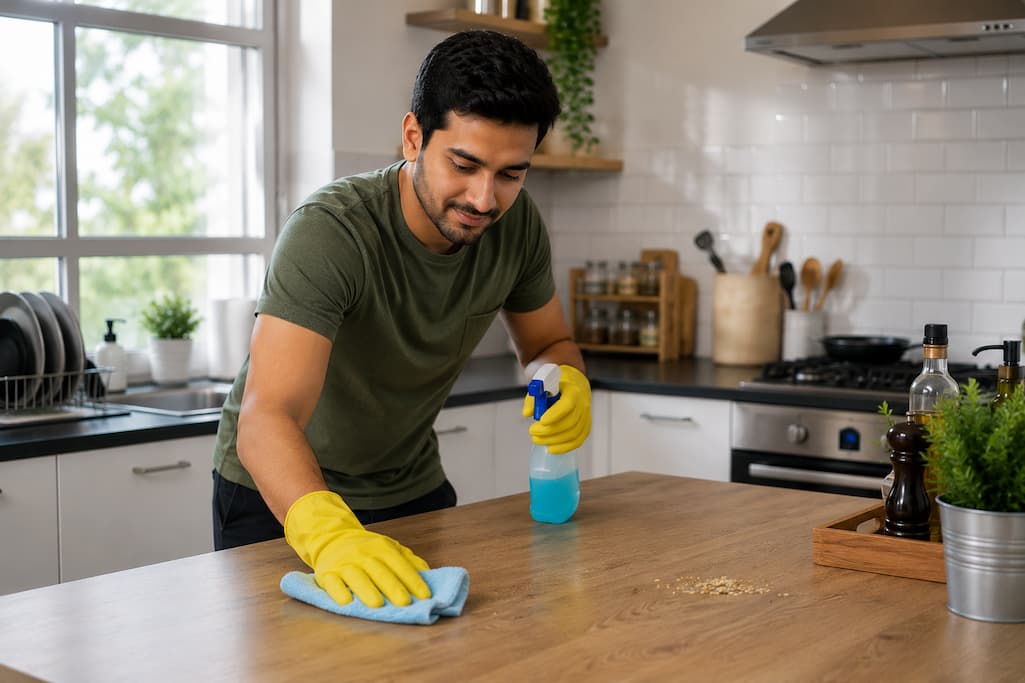
There is a moment in every kitchen cleaning session that makes me want to quit. It happens right after I finish the counters. The sink is full of dishes. The stove has three days of grease buildup. And I remember the floor. The sticky spot near the fridge where juice spilled on Tuesday. The crumbs under the toaster I keep meaning to move. The whole thing feels like a mountain that grew while I was looking at the first hill.
I used to handle this by not handling it. I would clean the counters, declare victory, and walk away. The dishes stayed in the sink. The stove stayed greasy. The floor stayed sticky. And every morning I woke up to a kitchen that felt like a punishment. Not anymore. I developed a step-by-step routine that takes me from disaster to done without the overwhelm. It is not fast. But it is thorough. And I never quit halfway through anymore.
What I Was Working With
My kitchen is 8 feet by 10 feet. That is 80 square feet of total space, including the walking area. The counter space is roughly 12 linear feet, split between two walls in an L-shape. The stove is a four-burner gas model from 2018. The sink is a standard double-basin stainless steel. The refrigerator is the 30-inch top-freezer I wrote about in my refrigerator cleaning guide. There is one window above the sink, 2 feet wide, facing east. It gets good morning light and shows every water spot on the faucet.
I cook dinner four to five nights a week. Breakfast is usually toast or eggs. Lunch is leftovers or sandwiches. By Sunday evening, the kitchen looks like a crime scene. Grease on the backsplash. Crumbs in every corner. A sink full of plates. And that smell. The smell of cooking that has settled into every porous surface. That is my starting point every week.
What I Tried First (And Why It Failed)
My original approach was chaos. I would start wherever my eyes landed. Maybe the dishes. Then I would notice the stove and switch. Then I would wipe a counter and find a spill that needed scrubbing. Two hours later, I had half-finished everything and fully finished nothing. The kitchen looked slightly better but felt no cleaner. And I was exhausted.
I also tried the “clean as you go” method that cooking shows preach. Chop vegetables, wash the cutting board. Finish the pan, scrub it immediately. In theory, this prevents buildup. In practice, it turns cooking into a multitasking nightmare. I would burn the garlic while rinsing a spoon. I would overcook the pasta while wiping the counter. My food got worse. My stress got higher. And the kitchen still needed a real clean at the end of the week.
My third failure was all-purpose cleaner on everything. One bottle. One rag. One approach. It worked on the counters. It streaked on the stainless steel sink. It left a film on the glass cooktop. And it did nothing for the baked-on grease around the burner grates. I was using the wrong tool for most of the jobs and wondering why nothing looked clean.
My Step-by-Step Routine
Now I clean in a specific order. Top to bottom. Dry to wet. Back to front. Every step has a purpose. Every step builds on the last. Here is exactly what I do.
Step 1: Clear the Counters (10 Minutes)
Everything that does not belong on the counter goes away. Mail to the desk. Keys to the hook. That bowl of fruit that has been there since Monday — I check for bad apples, toss them, and move the bowl to the dining table. The toaster gets unplugged and moved to the table too. The coffee maker stays because it lives on the counter, but I remove the filter basket and dump the grounds.
This step is not cleaning. It is creating space. You cannot clean a counter that is covered in objects. I learned this the hard way when I tried to wipe around a pile of mail and ended up with damp, wrinkled envelopes. Now everything moves first. Wipe later.
Step 2: Empty the Sink (15 Minutes)
All dishes get washed, dried, and put away. I do not have a dishwasher. Never have. So this is manual labor. I fill the left basin with hot water and a squirt of dish soap. The right basin gets warm rinse water. I wash in order: glasses first, then plates, then bowls, then silverware, then pots and pans last. This keeps the water cleaner longer and prevents grease from coating everything.
For stubborn pots, I fill them with hot soapy water and let them soak while I wash everything else. By the time I get to them, the grime slides off. I dry everything with a microfiber towel and put it away immediately. No dish rack full of wet plates sitting on the counter. The dish rack itself gets wiped down and stored under the sink.
Step 3: Clean the Stove (20 Minutes)
The stove is always the dirtiest surface. I start with the burner grates. I remove all four and place them in the sink. I sprinkle baking soda on the cooktop surface, spray it with a 50-50 vinegar-water mix, and let it fizz for five minutes. While it fizzes, I scrub the grates with a stainless steel scrubber and hot soapy water. The baked-on grease takes elbow grease, not magic. I scrub until the metal shines, rinse, and dry.
Then I wipe the cooktop. The baking soda-vinegar paste lifts most of the grease. For stubborn spots, I use a plastic scraper — the kind for sticker removal. It lifts charred food without scratching the glass. I wipe everything with a damp cloth, then dry with a separate cloth to prevent water spots.
The control knobs pop off and get washed in soapy water. The area behind them, where grease collects in the crevices, gets a cotton swab dipped in my vinegar mix. This is the detail work that makes the difference between “wiped” and “clean.”
Step 4: Wipe the Counters and Backsplash (10 Minutes)
With the stove done, I move to the counters. I use the same vinegar-water spray I use for my frequently touched areas. Two cups water, half a cup white vinegar, one tablespoon rubbing alcohol. I spray it on a microfiber cloth, not the counter, to control the moisture. I wipe in sections, left to right, pushing crumbs and debris toward the sink.
The backsplash gets the same treatment. It is painted drywall, not tile, so I am careful not to oversaturate. A damp cloth is enough. The area behind the stove gets extra attention because grease splatters travel farther than you think. I can always tell when I have skipped this spot because the paint looks slightly darker from accumulated oil.
Step 5: Clean the Sink (5 Minutes)
After washing dishes, the sink itself is grimy. Food particles. Soap scum. Water spots. I sprinkle baking soda around the basin, scrub with a sponge, and rinse with hot water. The drain gets a cup of boiling water poured down it to clear any buildup. Then I wipe the faucet and handles with my vinegar cloth. Stainless steel shows every fingerprint, so this final wipe makes the whole sink look finished.
I also check the garbage disposal if I had one. I do not. But if you do, run it with ice cubes and lemon peels once a week to clean the blades and freshen the smell.
Step 6: Wipe the Exterior Appliances (10 Minutes)
The refrigerator door, the oven handle, the microwave front, the dishwasher panel. These get touched constantly and collect oils from hands. I use my damp microfiber cloth for all of them. For the stainless steel refrigerator, I follow up with a dry cloth to prevent streaks. The microwave interior gets a quick wipe if there are splatters. If it is bad, I heat a bowl of water with lemon slices for three minutes, let it steam, then wipe. The steam loosens everything.
Step 7: Sweep and Mop the Floor (15 Minutes)
Last. Always last. Because every step above drops something on the floor. Crumbs from the counters. Grease from the stove. Water from the sink. If I mop before I clean the counters, I am mopping twice.
I sweep first, pushing everything toward the center, then into a dustpan. I use a broom, not a vacuum, because my kitchen has corners where a vacuum head cannot reach. Then I mop with warm water and a capful of white vinegar in a bucket. I use a microfiber mop pad, not a string mop, because it picks up grime instead of pushing it around. I work from the far corner toward the door, so I am not walking on wet floor.
The sticky spot near the fridge gets extra attention. I let the vinegar water sit for a minute, then scrub with the mop pad. If it is really bad, I get on my hands and knees with a scrub brush. There is no shame in doing what works.
💡 What I Learned the Hard Way
Do not mix bleach and vinegar. I knew this in theory. Everyone knows this in theory. But one Sunday, I had a particularly stained sink and thought, “A little bleach will whiten it, then I will rinse and use vinegar.” I did not rinse enough. The fumes hit me like a wall. My eyes burned. My throat closed. I ran out of the kitchen gasping and stood in the living room for ten minutes waiting for the air to clear. The chemical reaction creates chlorine gas, which is toxic. I was lucky I only used a small amount and had the window open. Now I pick one cleaner per session. Bleach OR vinegar. Never both. Not even “just a little.” Not even “I will rinse first.” One or the other. Period.
When This Routine Won’t Work
⚠️ When This Won’t Work
This routine is designed for a standard residential kitchen with moderate use. If you run a commercial kitchen, a catering business from home, or cook for a large family every single day, you need a more aggressive schedule. Professional kitchens clean as they go because they have to — health codes demand it. Home kitchens have more flexibility. Also, if your kitchen has granite, marble, or other natural stone countertops, skip the vinegar entirely. The acid can etch stone over time. Use a pH-neutral cleaner instead. I have laminate counters, so vinegar is safe. But my neighbor learned the hard way when her granite lost its shine after a year of vinegar wipes. Know your surfaces before you choose your cleaner.
What Others Told Me
I asked my mother how she cleans her kitchen. She has been doing it for forty years. Her answer: “I just do it.” Not helpful, Mom. But she did say one thing that stuck. “Start with what bothers you most. If the sink full of dishes makes you crazy, wash them first. You will feel better and the rest is easier.”
I tried that. It worked for a while. But I found that if I started with dishes, I would run out of energy before the stove. The stove is the hardest job. It needs the most attention. So I moved it earlier in my routine, right after the sink. Now I tackle the worst while I still have momentum. The counters and floor are easy by comparison. They feel like coasting.
A coworker told me she uses a steam cleaner for everything. “No chemicals,” she said. “Just water.” I borrowed hers once. It worked well on the floor and the grout between my backsplash and counter. But on the stove, the steam just spread the grease around. It needed a surfactant — soap or baking soda — to break down the oil. Steam alone was not enough. I returned the steam cleaner and stuck with my vinegar mix.
My Weekly vs. Daily Breakdown
I do not deep clean every day. That would be insane. Here is how I split the work:
| Task | Daily | Weekly (Sunday) |
|---|---|---|
| Wash dishes | Yes — after every meal | Deep clean pots and pans |
| Wipe counters | Yes — after cooking | Remove everything, wipe underneath |
| Clean stove | Wipe spills immediately | Full grate removal and scrub |
| Clean sink | Quick rinse after dishes | Baking soda scrub and drain flush |
| Wipe appliances | Handle and touchpoints only | Full exterior wipe, microwave interior |
| Sweep floor | Quick sweep after dinner | Full sweep and vinegar mop |
The daily tasks take maybe fifteen minutes total. The weekly deep clean takes about an hour and a half. I do it Sunday evening, after dinner, while a podcast plays. It is not fun. But it is satisfying. And Monday morning, my kitchen feels like a gift to myself.
How This Connects to My Other Kitchen Systems
A clean kitchen does not exist in isolation. It depends on organization. I wrote about how I organized my small kitchen space — the layout that makes cleaning possible because everything has a home. I also wrote about removing grease from surfaces, which is the technique I use on my stove and backsplash every week. And my cleaning supply arrangement guide explains why my vinegar spray and baking soda live under the sink, not in a closet across the apartment.
FAQ
How long does the full weekly clean take?
For my 80-square-foot kitchen, about 90 minutes. If you have a larger kitchen or more appliances, budget two hours. The first few times you do it, it will take longer because you are figuring out the order and locating your supplies. After a month, it becomes automatic. I can now do my full routine in 75 minutes if I do not get distracted.
What if I do not have time for the full routine?
Do the daily minimum: dishes, counters, quick sweep. The weekly deep clean can slide by a day or two if life gets busy. But do not let it slide more than that. The grease builds up. The crumbs accumulate. And the mental weight of a dirty kitchen starts affecting your mood. I have skipped a week before. The next week was twice as hard. Not worth it.
Can I use a dishwasher instead of hand-washing?
Absolutely. I do not have one, but if you do, load it after dinner and run it overnight. Empty it in the morning. The key is not letting dishes pile up in the sink. Whether you wash by hand or machine, the sink should be empty before bed. That one habit changes everything.
What is the best order if I have a different kitchen layout?
The principle is the same: top to bottom, back to front, dry to wet. Start with anything above counter level — cabinets, microwave, upper shelves. Then counters and appliances. Then sink. Then floor. The exact order of counters vs. stove vs. sink matters less than the principle of not cleaning the floor before you clean everything above it.
How do I clean a glass cooktop without scratching it?
Use a plastic scraper for burned-on food, not metal. Apply baking soda paste, let it sit, then wipe with a soft cloth. Never use abrasive scrubbers like steel wool or powdered cleansers on glass. They will scratch permanently. I learned this from the manufacturer manual that came with my stove. Read your manual. It matters.
Related Articles
- How I Organized My Small Kitchen Space — The layout system that makes cleaning faster because everything has a designated home
- Simple Way to Remove Grease from Surfaces — The baking soda and vinegar method I use on my stove and backsplash every week
- How I Arrange Cleaning Supplies for Easy Use — Why my spray bottle and scrubbers live under the sink, not in a distant closet
Conclusion
I still have that moment where I want to quit. Every single week. It comes when I look at the stove after finishing the counters. The grease is always worse than I remember. But now I know the routine. I know the order. I know that if I just keep going, I will hit the floor last, and the floor is easy. The floor is the finish line.
The kitchen is the most-used room in my home. It deserves more than a quick wipe. It deserves a system. My system takes 90 minutes on Sunday. It takes 15 minutes daily. And it gives me a kitchen that feels like a room I want to cook in, not a room I want to avoid.
If your kitchen feels overwhelming right now, start with one thing. Not the whole routine. One thing. Wash the dishes. Wipe the counters. Sweep the floor. Do that for a week. Then add the next step. The routine builds itself if you let it. And one Sunday, you will stand in your kitchen with a podcast playing and a clean floor under your feet, and you will realize you did not want to quit at all.
Sources and References
- FDA — Cleaning the Kitchen — Guidelines on safe kitchen cleaning practices, including proper sanitization of food-contact surfaces and separation of raw and cooked food areas. Informed my sink-first approach and counter-wiping technique.
- EPA Safer Choice Program — Information on selecting safer cleaning products for household use. Validated my use of vinegar and baking soda as effective, low-toxicity alternatives to harsh chemical cleaners in food preparation areas.
- CDC — Food Safety — Recommendations for preventing cross-contamination and maintaining a hygienic kitchen environment. Reinforced my practice of washing dishes in order from least to most soiled and cleaning the sink after handling raw meat.

Hamza Farooq is a home improvement and organization writer who shares practical advice on cleaning, simple DIY fixes, and smart home organization. He focuses on creating easy-to-follow guides that help readers solve everyday household problems with realistic, affordable solutions. His goal is to make home maintenance simpler, more efficient, and accessible for anyone looking to improve their living space.