
I have too many clothes. There. I said it. Not a shocking amount. Not reality-TV amount. But enough that my closet, which is four feet wide and legally obligated to call itself a closet, gave up on me around March.
The floor became my second closet. Then the chair. Then the desk. I was living in a textile avalanche and pretending it was temporary.
The space under my bed was not empty. It was worse. It was a graveyard. Single socks. A yoga mat I used twice. Dust bunnies that had evolved into dust wolves. I could not see them but I knew they were there. Watching.
So I pulled everything out. Measured the gap. Eleven and a half inches. Not much. But enough. And I decided that if I was going to own this much stuff, I was at least going to hide it properly.
What I Tried First (And Why It Failed)
Cardboard boxes. Free. Available. I flattened three Amazon boxes and slid them under. Labeled them with a Sharpie. “Winter.” “Summer.” “Extra.”
By June the boxes were sagging. The corners had softened from humidity. One box, the one closest to the bathroom wall, developed a faint smell. Not mold. Just… old cardboard and regret. I pulled out a sweater and it smelled like a shipping warehouse. Not wearable. Not donate-able. Just sad.
I tried fabric bins next. The collapsible kind with the wire frames. They fit. They looked nice. But they did not roll. To get to the back bin, I had to pull out the front bin. Which meant kneeling. Which meant I never did it. The back bin became a time capsule. I found a bathing suit from 2019 in there. I do not swim.
The lesson: if it does not roll, it does not exist. I learned this the hard way while organizing the rest of the bedroom. Accessibility is not a feature. It is the entire point.
What Actually Works
Hard plastic bins. With wheels. Clear. Not decorative. Not cute. Functional.
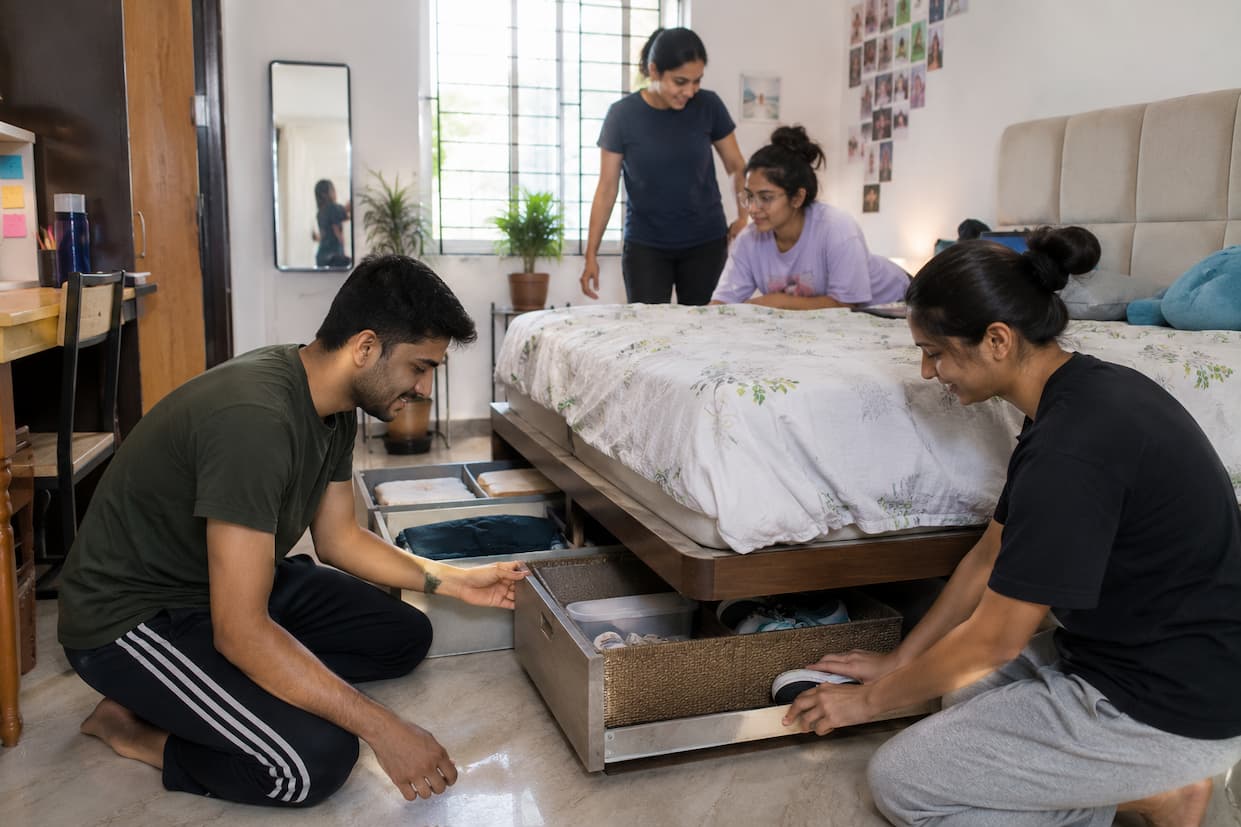
I bought two. Twenty-six inches long, sixteen inches wide, six inches tall. They fit side by side under my bed with an inch of clearance to spare. The wheels are soft rubber, not hard plastic. Hard plastic wheels catch on carpet. These glide. I can pull them out with one finger while holding a coffee in the other hand.
Inside, I use vacuum-seal bags for seasonal clothes. Not the electric pump kind. The kind you roll by hand. They cost less and you do not need to store a pump. I fit three winter coats, two sweaters, and a heavy scarf into one bag the size of a pillow. The air hisses out like a snake. Satisfying.
For shoes, I use a separate bin. No vacuum bags. Shoes need to breathe. I learned that after storing leather boots in a sealed bag and finding them wrinkled and musty three months later. Now they sit loose in the bin, toe-to-heel, like they are in a shoebox. Cedar blocks in the corners. Cheap. Effective. My seasonal storage guide covers the cedar trick in more detail.
The third bin, smaller, holds linens. Extra sheets. A backup blanket. Things I need maybe twice a year. I labeled the outside with masking tape and a marker. The tape peels eventually. I replace it. Labels are not permanent. They are just reminders to my future self, who has the memory of a goldfish.
The System I Actually Maintain
Every change of season, I swap. October: summer clothes go under, winter comes out. April: reverse. It takes twenty minutes. The key is the rolling. If I had to lift, drag, or unstack, I would skip it. I know myself. I am lazy. The system works because it accommodates my laziness.
I also keep a small desiccant pack in each bin. The kind that comes with electronics. I save them. Hoard them, honestly. They live in the bins and absorb moisture. I replace them when they feel saturated. Which is never, because I check by squeezing them like a weirdo every six months.
The wardrobe organization feeds directly into this system. If the closet is full, the under-bed is the overflow. If the under-bed is full, I have too much. That is my warning light.
What About the Dust?
It is there. It is always there. I vacuum the bare floor under the bed every time I swap the bins. Which means twice a year. The rest of the time, the bins sit on the dust. They protect the clothes from it. The bins have lids. Tight enough. Not airtight, but tight enough that dust does not drift in.
I also vacuum the wheels. Sounds obsessive. But hair wraps around them. Cat hair. My hair. Mystery hair. If the wheels get clogged, the bins do not roll. Then I stop using them. Then the system dies. So I vacuum the wheels when I vacuum the room. Thirty seconds. Prevention.
💡 What I Learned the Hard Way
I stored a gym bag under there. Leather. Nice one. A gift. I forgot about it for eight months. When I pulled it out, the leather had cracked along the fold lines. The dry air under the bed, combined with the weight of the bed pressing down, destroyed it. Under-bed is not for structured items. It is for soft things. Clothes, linens, textiles. Nothing with a shape it needs to keep. That bag cost me a friendship. Not really. But I felt guilty every time I looked at the cracks. Now I only store things that can be squashed without trauma.
Quick Comparison: Storage Methods I Tested
| Method | Why I Tried It | Why It Failed |
|---|---|---|
| Cardboard boxes | Free, already had them | Sagged, smelled, attracted dust |
| Fabric collapsible bins | Looked nice, fit the aesthetic | No wheels, back bins became unreachable |
| Vacuum bags directly on floor | Maximized space | Bags punctured on carpet tack strip, lost seal |
| Hard plastic rolling bins | Saw them recommended online | Nothing. They work. I won. |
⚠️ When This Won’t Work
If your bed frame sits lower than seven inches off the floor, you cannot fit standard rolling bins. You might squeeze flat under-bed bags, but they are a pain to slide in and out. Measure first. Also, if you live in a humid climate without air conditioning, under-bed storage becomes a mold risk. I live in a dry climate. If you are in Florida or Louisiana, use cedar blocks, desiccant, and check monthly. Finally, if you have dust mite allergies, storing bedding under the bed might trigger symptoms. Wash everything before it goes in, and use allergen-proof bags. I do not have this issue. But I have read about it. It sounds miserable.
Frequently Asked Questions
How much clearance do I actually need?
Seven inches minimum for rolling bins. Nine or more is comfortable. My eleven and a half inches is luxury. I could fit taller bins but I do not need to. The extra clearance means I can vacuum without moving the bed. That matters more than storage capacity.
Can I store food under the bed?
No. Why would you? But people ask. The answer is no. Pests. Temperature fluctuations. The possibility of forgetting a granola bar until it becomes a science experiment. Just no.
How do I keep the bins from sliding around?
They do not slide much because the wheels have slight friction. But if your floor is slick hardwood, the bins might drift when you vacuum. Put a small rubber mat under each bin. The cheap ones for kitchen drawers. Cut to size. Problem solved.
What about bed risers?
I considered them. They would give me another four inches. But my bed frame is wood. Risers on wood can slip. I did not want to wake up at 3 AM to a collapsing bed. If you have a metal frame, risers are safer. Check the weight rating. Your bed, plus you, plus a partner, plus a cat. Do the math. Do not exceed it.
Should I store sentimental items under there?
Absolutely not. Under-bed is for utilitarian things. Clothes. Sheets. Shoes. Sentimental items belong where you can see them. Or in a proper keepsake box on a shelf. Under-bed is the limbo of storage. Things go there to be useful, not remembered.
Closing Thought
My closet is still small. I still own too many clothes. The chair is no longer a closet. The floor is visible. The dust wolves are gone, replaced by two plastic bins that roll smoothly and judge me silently.
It is not a perfect system. It is a lazy system. But lazy systems are the only ones that survive. If it requires effort, I will abandon it by February. This one requires one finger and twenty minutes twice a year.
Even I can manage that.
Measure your gap. Buy the bins. Hide your shame. It feels better than you think.
Sources and References
- Centers for Disease Control and Prevention (CDC) — Mold prevention and moisture control guidelines for residential storage areas.
- U.S. Environmental Protection Agency (EPA) — Indoor air quality recommendations, including dust management and allergen reduction in sleeping areas.
- Asthma and Allergy Foundation of America (AAFA) — Information on dust mite allergens and best practices for textile storage in bedroom environments.

Hamza Farooq is a home improvement and organization writer who shares practical advice on cleaning, simple DIY fixes, and smart home organization. He focuses on creating easy-to-follow guides that help readers solve everyday household problems with realistic, affordable solutions. His goal is to make home maintenance simpler, more efficient, and accessible for anyone looking to improve their living space.