I turned on the ceiling fan in April. First warm day. The blade spun twice before my nose started itching. By the third rotation I was sneezing into my elbow. My eyes watered. The room smelled like a forgotten attic.
That is how I learned that “out of sight” does not mean “clean.”
It means “waiting.”
What I Was Working With
Two ceiling fans. One in the bedroom, one in the living room. Three floor vents. One bathroom exhaust fan. I am five-foot-nine. The bedroom fan is eight feet up. The living room fan sits on a sloped ceiling that might as well be nine feet. I do not do heights gracefully.
I also have a standard step stool. Not a ladder. A step stool with two steps and a wobble I keep meaning to fix. That is my equipment list. No fancy extendable dusters. No vacuum attachments that cost more than the fan itself.
The Tools That Actually Matter
You do not need much. But you need the right much.
- An old pillowcase: Not the good ones. The thin, worn ones you were going to toss. You will see why.
- A microfiber cloth: The cheap kind. Because this job ruins cloths.
- Vacuum with a hose: The brush attachment helps, but the hose alone is enough.
- A butter knife wrapped in a damp cloth: For vent slats. Trust me on this.
- Dish soap and warm water: For the vent covers.
- A screwdriver: Only if your vent covers are screwed in. Mine are.
I keep these in a bucket under the kitchen sink. Labeled “gross jobs.” So I cannot pretend I forgot where they are.
Ceiling Fans: The Pillowcase Mistake
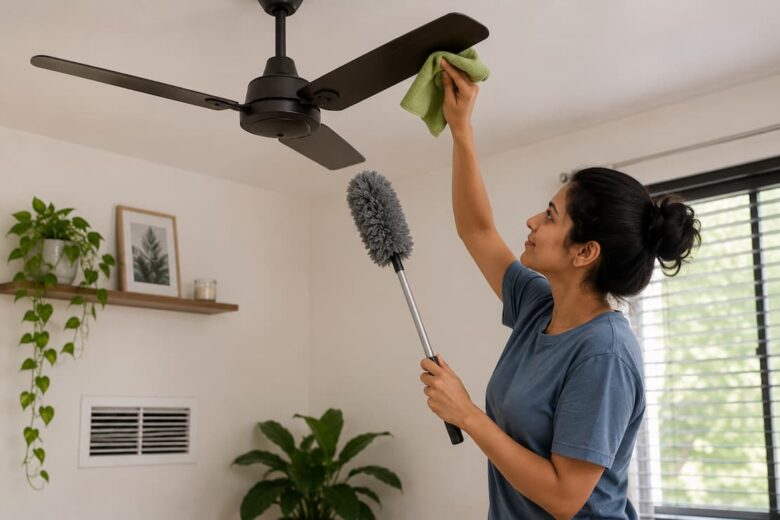
You have probably seen the pillowcase trick. Slide the blade inside. Pull. The dust stays trapped. It works. It really does.
But the first time I tried it, the pillowcase ripped along the seam. Cheap cotton. Dust cloud. The blade clunked against the glass light fixture. I flinched. Stepped off the stool wrong. Twisted my ankle slightly. All because I used a pillowcase from a discount hotel I stayed at in 2019.
Now I check the seams first. Double-stitched only. Or I skip the pillowcase entirely and drape a microfiber cloth over the blade, pinching it around the edges like a taco. Slower. But no explosions.
Order matters. I clean the ceiling fan before I clean the floor. Always. Dust falls down. Obvious. But I forgot once. Mopped first. Then fan. Then mopped again. Never again.
If your fan has a light fixture, be careful. A wobbling blade against glass is expensive. Turn the fan off at the wall switch, not just the remote. Remotes have batteries. Batteries fail. The wall switch does not.
Floor Vents: Where the Real Dirt Lives
My floor vents are the drop-in metal kind. I used to vacuum over them. The vacuum just rattles the slats. Useless. It is like brushing your teeth with your mouth closed.
Now I pop them out. Two screws. I carry them to the kitchen sink. Warm water. A squirt of dish soap. A brush I stole from a discarded grill set. The water turns gray immediately. Embarrassing gray. Like washing a car tire that has never been washed.
While the cover dries on a towel, I vacuum the duct opening. The hose fits about six inches inside. Not far enough to reach the main ductwork. But far enough to grab the hair and dust bunnies that collect at the entrance. I do this more often than I clean the fans because the floor is where life actually happens.
For the slats themselves, I wrap a damp microfiber around a butter knife. The knife slides between the slats. The cloth grabs the dust. Dry the cover completely before reinstalling. I learned that after putting a wet cover back and smelling mildew for a week. The vent became a humidifier. A bad one.
Bathroom Exhaust: The Surprise I Wasn’t Ready For
I ignored this fan for two years. It is high, small, and loud. I assumed loud meant working. It does not. Loud means struggling.
I finally stood on the toilet tank lid. Bad idea. Unstable. Wobbled. But I got the cover off. The fan blades were furry. Not dusty. Furry. Like a small animal. And dead gnats. Six of them. I gagged.
I used a damp cloth and cotton swabs. No spray. No liquid near the motor. The motor is not sealed. I wiped the blades gently. The housing. The cover. Put it back. The fan got quieter immediately. It had been working twice as hard to move half the air.
The bathroom deep clean is a separate job. But the exhaust fan is the part everyone skips. Do not skip it. It is the lungs of the room.
How Often I Actually Do This
I will not pretend I clean these monthly. I do not. Nobody I know does.
| Location | How Often I Clean It | Why That Timing |
|---|---|---|
| Ceiling fans | Twice a year (April and October) | Before heavy cooling and heating seasons |
| Floor vents | Quarterly | Season changes bring different dust and debris |
| Bathroom exhaust | Once a year | It is a pain. But once is enough if you run it during showers. |
If you have allergies, double the frequency. I do not. So twice a year is my honest number.
⚠️ When This Method Won’t Work
If you see mold inside your vent or around the exhaust fan, stop. Do not clean it yourself. Household cleaners will not kill mold inside ductwork. They will disturb the spores and make them airborne. Call a professional. Also, if your ceiling fan is mounted on a vaulted ceiling over sixteen feet high, a step stool is not enough. Rent a proper ladder. I am serious. Finally, if your vent cover is painted shut or rusted in place, do not force it. You will crack the duct or the floor trim. Spray a small amount of penetrating oil and wait a day. Or call maintenance if you rent.
💡 What I Learned the Hard Way
I once sprayed a multi-purpose cleaner directly onto a ceiling fan blade. It dripped. Into my eye. Also into the motor housing. The fan buzzed for a week like an angry bee before dying completely. Replacement cost: forty-seven dollars. Lesson: spray the cloth, not the blade. And wear glasses. I now use cheap safety glasses from the dollar store. They look ridiculous. They have saved my eyes twice.
Frequently Asked Questions
Can I use one of those extendable dusters instead?
You can. But they do not trap dust. They just relocate it. The dust falls onto your bed, your couch, your floor. Then you clean those. The pillowcase or microfiber cloth actually holds the dust. Use the duster for blinds. Not fans.
Do I need to turn off the breaker?
For a ceiling fan, the wall switch is enough. Just make sure the remote is not nearby where a cat or a child might press it. For a bathroom exhaust, the wall switch is usually enough too. But if you are removing the cover and the wiring is exposed, turn the breaker off. I did not. I was lucky. Do not be me.
Why does my fan wobble after I clean it?
You probably bumped a blade out of alignment. Or the dust was actually balancing an already uneven blade. Check that all blades are at the same angle. Tighten the screws where the blades meet the motor. If it still wobbles, a blade may be warped. Fans are cheap. Replace it before it shakes itself off the mount.
Can I put metal vent covers in the dishwasher?
Yes. I have. But run it without other dishes. The vent covers are gross. You do not want them touching your plates. Also, if your dishwasher runs hot, the paint on older vent covers might chip. Hand washing is safer. Slower. But safer.
What if my vents have filters?
Replace or wash the filters according to the manufacturer. Do not vacuum them and put them back. Vacuuming damages the filter material. If you cannot find the manual, check the filter frame for a model number. Google it. Most HVAC filters need replacing every three months. I write the date on the filter edge in Sharpie so I do not forget.
Closing Thought
Clean air is invisible. Dirty air is not. It is sneezes. It is dust motes in sunbeams. It is a fan that sounds like a helicopter because it is fighting its own filth.
The cleaning is not satisfying. There is no dramatic before-and-after photo that gets likes. But the sneezing stopped. The fan spins quietly. The vent does not smell like a basement.
That is enough.
Start with the pillowcase. And the glasses. Your eyes will thank you.
Sources and References
- U.S. Environmental Protection Agency (EPA) — Introduction to Indoor Air Quality (IAQ), including the importance of ventilation and regular cleaning of HVAC components and fans.
- Centers for Disease Control and Prevention (CDC) — Mold prevention and health guidelines, including warnings against disturbing mold without proper containment.
- University of Georgia Cooperative Extension — Composition of household dust and recommendations for managing dust accumulation in residential environments.

Hamza Farooq is a home improvement and organization writer who shares practical advice on cleaning, simple DIY fixes, and smart home organization. He focuses on creating easy-to-follow guides that help readers solve everyday household problems with realistic, affordable solutions. His goal is to make home maintenance simpler, more efficient, and accessible for anyone looking to improve their living space.