
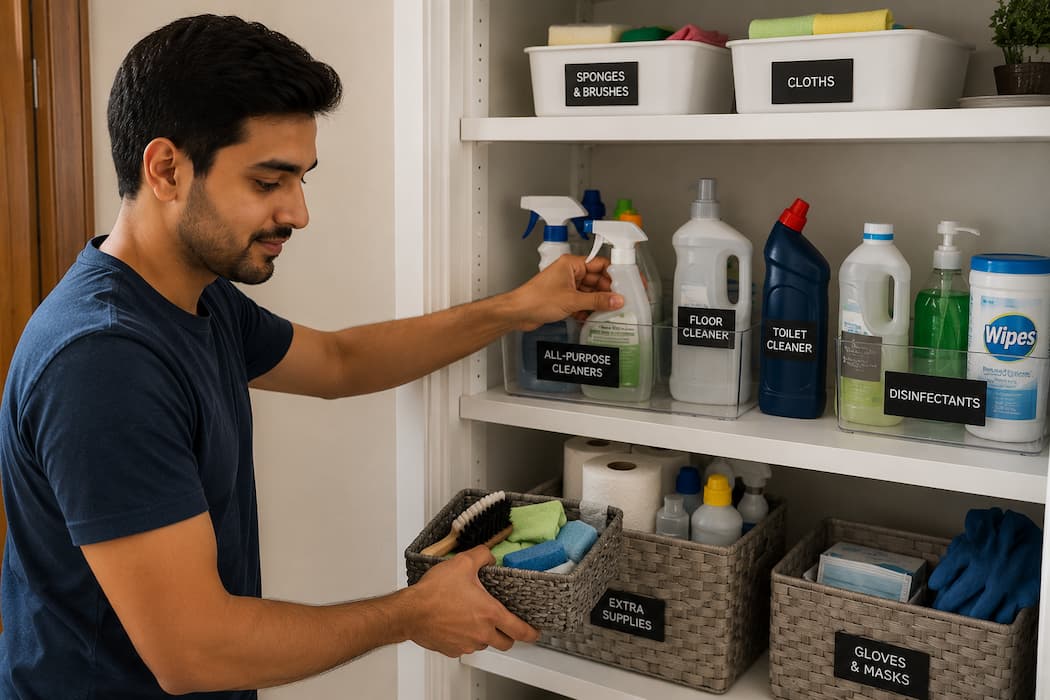
I used to keep my cleaning supplies under the kitchen sink. All of them. The spray bottle, the sponges, the rubber gloves, the extra trash bags, the box of baking soda, the bottle of vinegar, the microfiber cloths, the old toothbrush I used for grout, the steel wool I never used but kept “just in case.” It was a black hole. I would open the cabinet, stare into the darkness, and grab whatever my hand touched first. Usually the wrong thing.
Then one Tuesday, I needed the spray bottle for a quick counter wipe. I opened the cabinet, reached in, and knocked over the vinegar bottle. It did not have the cap on tight. Vinegar flooded the cabinet, soaked a roll of paper towels, and dripped onto the floor. I spent twenty minutes mopping vinegar off linoleum that already smelled like a salad bar. The spray bottle? Still buried in the back. I never found it that day.
That was the day I decided my cleaning supplies needed a system. Not a Pinterest board. A system. One that made sense for a person who cleans in bursts, not marathons. One that meant I could grab what I needed without a headlamp and a search party.
What I Was Working With
My kitchen has one under-sink cabinet. It is 24 inches wide, 20 inches deep, 30 inches tall. The back half is unusable because of the plumbing pipes that run down the center. The front half is where everything lived, piled on top of each other like a game of cleaning-supply Jenga.
I also have a hall closet, 18 inches wide, with one shelf at eye level. That shelf held a random assortment of things: a half-empty bottle of window cleaner, a box of dryer sheets, a flashlight with dead batteries. The closet floor was where I tossed the vacuum cleaner and a broom that shed straw every time I moved it.
My bathroom has a small cabinet above the toilet. One shelf. It held toothpaste, extra soap, and somehow a bottle of toilet bowl cleaner that leaked once and left a blue stain I never fully removed.
Three spaces. All of them dysfunctional. I needed to rethink the whole thing.
What I Tried First (And Why It Failed)
My first idea was buying an organizer. A plastic caddy with compartments. I got one for $8 at Walmart, brought it home, and loaded it with my most-used items. Spray bottle. Sponge. Gloves. Cloth. Perfect.
Except the caddy was too tall for the under-sink cabinet. It fit, but only if I angled it, which meant everything inside slid to one side. And when I pulled it out, the handle caught on the plumbing pipe. Every single time. I used it for two weeks, cursing quietly each time, then moved it to the hall closet where it collected dust.
My second attempt was a tension rod under the sink. I saw this online: hang spray bottles from the rod by their triggers, freeing up shelf space below. Clever. I bought a rod for $5. Installed it. Hung three bottles. Closed the cabinet. Opened it the next day to find the rod had slipped and all three bottles were on the floor. One cracked. The rod went in the trash.
I also tried color-coding my cloths. Blue for kitchen. Yellow for bathroom. Green for general. It lasted a week. Then I grabbed the nearest cloth without looking and wiped the toilet with the “kitchen” blue one. The system collapsed because I am human and humans do not always follow color codes at 7 AM.
What Actually Works: My Three-Zone System
After those failures, I stopped trying to be clever. I started trying to be practical. I divided my supplies into three zones based on where I use them, not where I think they should live. Kitchen tasks happen in the kitchen. Bathroom tasks happen in the bathroom. Whole-house tasks happen where they are most accessible.
Zone 1: The Kitchen Caddy
I bought a flat, shallow plastic bin for $4. Not a caddy with a handle. A bin. It slides in and out of the under-sink cabinet without catching on pipes. Inside it:
- My spray bottle with the vinegar-alcohol solution
- Two microfiber cloths (not color-coded, just “clean” and “needs washing”)
- A small scrub brush for the sink
- A box of baking soda
- A roll of paper towels (standing upright, not lying down)
That is it. Six items. The bin lives on the right side of the under-sink cabinet, where the plumbing does not block it. I can slide it out with one hand while holding a dirty plate in the other. No searching. No reaching. No vinegar floods.
Behind the bin, in the narrow space the plumbing creates, I store backup supplies. Extra sponges. A spare spray bottle. The box of trash bags. Things I do not need daily but need to know where they are.
Zone 2: The Bathroom Basket
I bought a second shallow bin, same size, for $4. This one lives on the floor of the bathroom cabinet, not the shelf above the toilet. The shelf is too high for quick access. The floor bin is right there when I open the door.
Inside:
- A small spray bottle with a diluted vinegar solution (weaker than the kitchen one, for mirrors and counters)
- One microfiber cloth
- Toilet bowl cleaner (in a sealed plastic bag after the blue-stain incident)
- A toilet brush in a holder that fits in the corner of the cabinet
- A box of disposable gloves
I clean the bathroom twice a week. Having everything in one bin means I grab the bin, set it on the counter, and work. No running to the kitchen for spray. No forgetting the toilet brush because it lives somewhere else. One bin. One bathroom. Done.
Zone 3: The Whole-House Station
The hall closet became my whole-house station. I cleared the shelf completely and started over. Now it holds:
- The vacuum cleaner (upright, not tossed on the floor)
- A broom and dustpan (hanging on hooks I screwed into the door)
- A mop with a washable microfiber pad
- A small bucket that nests inside the mop bucket
- A caddy with floor cleaner, glass cleaner, and furniture polish
- Extra supplies: backup sponges, cloths, trash bags, baking soda
The key was the hooks. The broom used to lean in the corner and fall over every time I opened the closet. Now it hangs. The dustpan clips to the broom handle. Everything is visible. Everything is reachable. I open the closet and see everything I own. No black hole. No Jenga tower.
💡 What I Learned the Hard Way
Do not store cleaning chemicals above eye level. I learned this when a bottle of toilet bowl cleaner leaked from the shelf above my toilet and dripped onto my head while I was sitting there. Yes, on my head. Blue-stained toilet bowl cleaner. In my hair. At 6 AM. I had to shower, wash my hair twice, and still smelled faintly of chemicals all day. Now every liquid cleaner lives below waist height or in a sealed bag if it must go higher. Gravity is not your friend when it comes to leaking bottles. Also, check the caps. Every time. I now tighten every bottle cap before storing it, even if I just bought it. The extra two seconds save hours of cleanup and one very memorable bad morning.
When This System Won’t Work
⚠️ When This System Won’t Work
This three-zone system assumes you have at least two storage spaces: one in or near the kitchen and one in or near the bathroom. If you live in a studio apartment with one closet and no under-sink cabinet, you will need to adapt. I lived in a studio for two years. My entire cleaning supply collection fit in a single milk crate under the sink. The key then was ruthless minimalism: one spray bottle, two cloths, one scrub brush, one all-purpose cleaner. That was it. Anything more was clutter. Also, if you have young children or pets who get into cabinets, you need child locks or high storage regardless of convenience. My nephew visits, so I installed a simple magnetic lock on the under-sink cabinet. It adds two seconds to opening it. Worth it. Finally, if you use heavy-duty or professional-grade cleaning chemicals, store them separately from everyday supplies and follow the manufacturer’s safety guidelines. I only use vinegar, baking soda, and mild dish soap, so my safety concerns are minimal. But bleach, ammonia, and strong solvents need dedicated, ventilated storage away from food prep areas.
What Others Told Me
I asked about cleaning supply organization in a Facebook group for apartment dwellers. The advice was surprisingly divided.
One woman said she keeps everything in one rolling cart that moves from room to room. “One supply set for the whole house,” she wrote. I tried that mentally and immediately pictured myself wheeling a cart into the bathroom while my partner was showering. No. Some supplies need to stay where they are used.
A guy said he uses a pegboard in his laundry room. “Everything visible,” he claimed. “Like a workshop.” That sounds great if you have a laundry room. I have a closet. A pegboard in a closet is just a wall of things that fall off when you reach for the vacuum.
The best comment came from a professional cleaner who said: “I carry a caddy, but I also leave a microfiber cloth and a spray bottle in every bathroom. The thirty seconds I save not walking to the kitchen adds up to an hour per week.” That validated my zone system. Convenience is cumulative. Small savings add up to real time.
My Supply List: What I Actually Own
I used to buy every cleaner the store sold. Now I own exactly this:
| Item | Where It Lives | What It Cleans |
|---|---|---|
| Vinegar-alcohol spray | Kitchen caddy | Counters, handles, appliances |
| Diluted vinegar spray | Bathroom basket | Mirrors, bathroom counters, toilet exterior |
| Baking soda | Kitchen caddy + backup in closet | Sink scrub, oven paste, deodorizer |
| Dish soap | By the sink (not in caddy) | Dishes, hand wash, pre-treating stains |
| Microfiber cloths | Kitchen caddy (2), bathroom basket (1), closet (3 spare) | Everything — washed separately weekly |
| Toilet bowl cleaner | Bathroom basket, sealed bag | Toilet bowl only |
| Floor cleaner | Hall closet caddy | Mopping solution for tile and linoleum |
| Glass cleaner | Hall closet caddy | Windows, mirrors, glass tabletops |
| Furniture polish | Hall closet caddy | Wooden table, nightstand, bookshelf |
| Rubber gloves | Bathroom basket | Toilet cleaning, deep scrubbing |
Ten items. Three zones. That is my entire cleaning arsenal. I used to own twenty-plus products. Now I use ten. The difference in mental load is enormous. I never stand in front of the cabinet wondering which cleaner to grab. I know what I have. I know where it is. I know what it does.
How I Maintain the System
Every Sunday, during my weekly home reset, I check each zone. I replace any cloth that looks worn. I refill spray bottles if they are low. I toss empty containers immediately, not “later.” And I wipe down the bins themselves — they get dusty and grimy too.
Once a month, I do a full inventory. Do I actually use the furniture polish? (Yes, once a month on the table.) Do I need three spare microfiber cloths? (Yes, because I wash them weekly and sometimes run out.) Is the toilet bowl cleaner still sealed? (Always check. Always.)
This monthly check takes five minutes. It prevents the slow creep of clutter that turns an organized system back into a black hole.
How This Connects to My Cleaning Routines
An organized supply system is useless without routines to use it. I wrote about how I clean my kitchen step by step — the routine that depends on my kitchen caddy being exactly where I expect it. I also wrote about how to deep clean a bathroom, which starts with grabbing the bathroom basket and knowing everything is inside. And my weekly home organization routine is when I restock, replace, and reset all three zones at once.
FAQ
Do I need to buy new bins and organizers?
No. I bought two $4 bins. You can use shoeboxes, old baskets, or even sturdy grocery bags. The container matters less than the boundary. The key is having a designated space for each zone, not fancy matching labels. I used a Sharpie to write “KITCHEN” and “BATHROOM” on my bins. That is my labeling system. It works.
What if I have more cleaners than fit in three zones?
You probably have too many cleaners. I did. Go through them. Toss anything you have not used in six months. Combine duplicates. Do you really need three different glass cleaners? Probably not. I had a cabinet full of “specialized” products that all did the same thing. Vinegar and water handles 80 percent of household cleaning. The other 20 percent needs specific products, but not twenty different ones.
How do I keep cloths from getting mixed up?
I do not color-code anymore. Instead, I have a simple rule: kitchen cloths stay in the kitchen, bathroom cloths stay in the bathroom. They never cross zones. When I wash them, kitchen cloths go in one load, bathroom cloths in another. If a cloth gets too stained or worn, it gets demoted to “floor rag” status and lives in the closet. No confusion. No cross-contamination.
What about storing cleaning supplies safely with kids?
Install child locks on any cabinet that holds chemicals, even mild ones like vinegar. My nephew is eight now and knows not to touch, but when he was younger, the magnetic lock was essential. Also, store sprays and liquids below waist height when possible. If they leak, they leak down, not down onto someone. The toilet bowl cleaner incident taught me that lesson permanently.
Should I keep a caddy for moving between rooms?
I do not. I tried it and found myself carrying unnecessary items from room to room. The zone system means each room has what it needs. The only exception is my whole-house cleaning day, when I grab the mop, the vacuum, and the floor cleaner from the closet and work through every room systematically. Even then, I return each item to the closet when I am done. No wandering caddies.
Related Articles
- How I Clean My Kitchen Step by Step — The routine that depends on my kitchen caddy being organized and accessible
- How to Deep Clean a Bathroom at Home — Starts with grabbing the bathroom basket and knowing every tool is inside
- My Weekly Routine for Home Organization — When I restock, replace, and reset all three cleaning zones at once
Conclusion
My cleaning supplies no longer live in chaos. The kitchen caddy slides out smoothly. The bathroom basket sits ready. The hall closet opens to a wall of hanging tools instead of a pile of fallen brooms. I know what I own. I know where it lives. I know what it does.
The vinegar flood was my wake-up call. Not because it was a disaster — it was just vinegar. But because it revealed a deeper problem. I was fighting my own system every time I cleaned. The supplies were supposed to help me. Instead, they were another obstacle.
Now they help. The right spray bottle is always within reach. The right cloth is always clean. The right tool is always where I expect it. Cleaning is still not fun. But it is faster. It is easier. And it is no longer preceded by twenty minutes of searching, cursing, and mopping up spills.
If your cleaning supplies are a mess right now, start with one zone. The one you use most. Empty it completely. Toss what you do not use. Keep what you do. Put it in a bin, a box, or a bag. Label it with a Sharpie. And stop buying new cleaners until you finish the ones you have. The best cleaning supply is the one you can find when you need it.
Sources and References
- U.S. Consumer Product Safety Commission — Cleaning Substances Safety — Guidelines on safe storage of cleaning products, especially in homes with children. Informed my decision to install magnetic locks and store liquids below waist height.
- EPA Safer Choice Program — Information on selecting safer cleaning products and reducing chemical exposure in the home. Supported my shift to vinegar, baking soda, and minimal product use.
- NSF — Home Cleaning Safety — Recommendations for safe handling, storage, and disposal of household cleaning products. Validated my practice of checking bottle caps and storing chemicals in sealed containers.

Hamza Farooq is a home improvement and organization writer who shares practical advice on cleaning, simple DIY fixes, and smart home organization. He focuses on creating easy-to-follow guides that help readers solve everyday household problems with realistic, affordable solutions. His goal is to make home maintenance simpler, more efficient, and accessible for anyone looking to improve their living space.