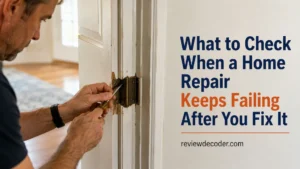
The bathroom door handle came off in my hand on a Tuesday morning. Not the whole handle. Just the half I was holding. The other half stayed on the door, dangling, mocking me. I was already late. The handle knew.
I had fixed a loose handle before. Tightened a screw. Felt competent. This was different. This was structural. The screws had stripped the wood. The handle spun freely. The latch did not latch. The door was essentially a wall with a knob-shaped decoration.
I closed the door by pulling the edge. Like an animal. Then I went to work and thought about it all day.
What I Was Working With
The door is interior. Hollow core. Lightweight. The kind that sounds like a drum when you knock. The handle is a standard passage set. Not a lock. Just a lever that turns a latch. The screws that hold the handle to the door go through the handle plate and into the door itself. The wood there is thin. Maybe three-quarters of an inch. Not much to grip.
The previous fix, six months earlier, was tightening the screws. That worked temporarily. But each tightening stripped the holes slightly. Now the screws turned freely. No resistance. No purchase. The wood was worn away inside the hole like a cavity.
I needed a fix that did not involve replacing the door. Or calling a locksmith. Or explaining to my partner why the bathroom had no handle for three days.
The Toothpick Method (That I Almost Skipped)
I found it online. Filled with skepticism. Toothpicks and wood glue in the screw hole. Sounded like a hack. A temporary patch. Something that would fail in a week and leave me with a door full of toothpicks.
But it was Tuesday night. Hardware stores closed. I had toothpicks. I had wood glue. I had nothing to lose except dignity.
I removed the handle completely. Both halves. The latch mechanism. Everything. I looked at the stripped holes. Two of them. Cylindrical voids where wood should be.
I dipped toothpicks in wood glue. Not Elmer’s. Actual wood glue. Titebond II. The yellow kind. I stuffed them into the holes. Not one. Four or five per hole. Packed tight. Broke off the excess with pliers. Let it dry overnight. The bottle said thirty minutes. I gave it eight hours. I was not trusting a bathroom door to a half-hour cure.
Next morning, I drilled pilot holes into the toothpicks. Small bit. Careful. Not too deep. The toothpicks were now solid wood filler. The screws bit in like new. Tight. Resistance. The handle went on flush. The latch turned. The door closed with a satisfying click.
That was fourteen months ago. Still solid. Still tight. The toothpicks outlasted my confidence.
I wrote about basic repairs after this experience. Because if toothpicks can fix a door, what else have I been overthinking?
When Toothpicks Are Not Enough
The toothpick method works for stripped screw holes in soft wood. Hollow core doors. Cabinet hinges. Drawer pulls. Light-duty handles.
It does not work for:
- Metal doors. No wood to grip. Toothpicks need wood.
- Heavy exterior handles with deadbolts. The torque is too high.
- Holes that are stripped completely through the door. If you can see daylight, you need a longer screw or a different mounting point.
- Situations where the handle itself is broken. Toothpicks fix the hole. Not the hardware.
For those, I use a different method. A wooden dowel. Same principle, larger scale. Drill out the stripped hole to a quarter-inch. Cut a dowel to length. Glue it in. Drill a new pilot hole. The dowel is stronger than toothpicks. More surface area. Better for exterior doors or handles that get heavy use.
I keep a bag of quarter-inch dowels in my toolbox now. Along with toothpicks. I am prepared for multiple scales of failure.
The Screwdriver Mistake Everyone Makes
Using the wrong screwdriver strips screws. I know this. I have done this. The Phillips head that is slightly too small. The flathead that does not seat fully. You turn. The screw resists. You push harder. The head rounds. Now you have a stripped screw in a stripped hole. Double failure.
I bought a screwdriver set with proper sizing. Not a multi-bit. Individual drivers. Size 1 Phillips. Size 2. Size 3. I match the driver to the screw before I start. It takes five seconds. It saves twenty minutes of extraction later.
Also, I pre-drill pilot holes now. Even for small screws. Especially in soft wood. The pilot hole removes material so the screw threads grip without splitting the wood. It feels like extra work. It is extra work. But it prevents the Tuesday morning handle-in-hand situation.
Pilot holes are like patching cracks. Do it right the first time or do it again later.
The Lubrication I Forgot About
The latch mechanism itself can cause handle looseness. Not the screws. The internal parts. The spindle that connects the two halves. The spring that returns the lever. If these are sticky, you push harder. The harder push loosens the screws over time.
I spray graphite powder into the mechanism once a year. Not WD-40. WD-40 attracts dust and becomes gummy. Graphite is dry. It lubricates without residue. A quick puff into the keyhole and the latch slot. Work the handle a few times. Smooth. Silent. Less force required. Less force means less loosening.
I learned this after replacing a handle that was not actually broken. Just sticky. The new handle loosened in three months because I was still pushing too hard. The problem was lubrication, not hardware.
💡 What I Learned the Hard Way
I once tightened a loose handle so aggressively that I cracked the door. Hollow core doors are not solid wood. They are cardboard honeycomb inside. The screw went in, found no resistance, and kept going. The handle plate compressed the thin veneer. A hairline crack radiated from the screw hole. Visible. Permanent. I filled it with wood filler and painted over it. But I know it is there. The lesson: tight is good. Too tight is broken. Stop when you feel resistance. Do not keep turning because you want to feel competent.
Method Comparison: What Works for What
| Problem | Quick Fix | Proper Fix | When to Call a Pro |
|---|---|---|---|
| Loose screws, soft wood | Tighten with correct driver | Toothpicks + wood glue | Never, if you have toothpicks |
| Stripped hole, heavy use | Longer screw | Dowel + glue + new pilot hole | If door is cracked or split |
| Sticky latch | WD-40 (temporary) | Graphite powder lubrication | If mechanism is broken internally |
| Handle spins freely | Check set screw on spindle | Replace spindle or handle set | If spindle is welded or seized |
| Door itself is damaged | Wood filler + paint | Replace door | Always, for exterior or fire doors |
⚠️ When This Won’t Work
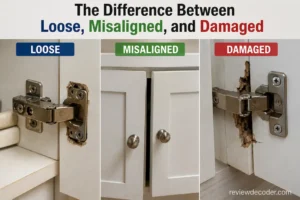
If your door handle is part of a smart lock system, stop. Do not drill. Do not glue toothpicks into anything with a circuit board. Call the manufacturer. Smart locks have warranty requirements and calibration needs that mechanical handles do not. Also, if the door is fire-rated, any modification — even replacing a handle — must meet code. Check your local regulations. A loose handle on a fire door is not a DIY fix. It is a safety violation. Finally, if the door frame itself is loose, not the handle, you are fixing the wrong thing. A tight handle on a shifting frame will loosen again within days. The frame needs shimming or re-anchoring. That is beyond toothpicks. That is structural.
Frequently Asked Questions
How long does the toothpick fix last?
Mine is fourteen months and counting. The wood glue creates a bond stronger than the original wood. The toothpicks become part of the door. Eventually, if the door itself degrades, you may need to re-drill. But that is a door problem, not a toothpick problem. I expect several years. Maybe the life of the door.
Can I use matchsticks instead of toothpicks?
Yes. Matchsticks are slightly thicker. Better for larger holes. But remove the match head first. The sulfur in match heads can interfere with wood glue curing. Also, they smell weird when cut. Use wooden matches, not cardboard. Soak the head in water for ten minutes. It pops off easily. Then proceed as with toothpicks.
What if the screws are stripped, not the holes?
New screws. Cheap. Easy. Match the thread pattern and length. Take the old screw to the hardware store. They have sizing boards. Or just buy a multi-pack of common interior door screws. Keep them in your toolbox. Stripped screws are not worth saving. They cost fifteen cents. Your time is worth more.
Why not just use wall anchors?
Wall anchors are for drywall. They spread behind the surface to create grip. In a door, there is no hollow space to spread into. The anchor would just spin in the wood, creating a larger hole. Anchors work for walls. Dowels work for doors. Different physics. Different fix.
Should I replace the handle entirely?
If the handle is more than ten years old, maybe. The internal springs wear out. The finish degrades. But if the handle looks fine and just wobbles, fix the mounting first. A new handle on stripped holes will wobble just as fast. Fix the door. Then decide if the handle is worth keeping.
Closing Thought
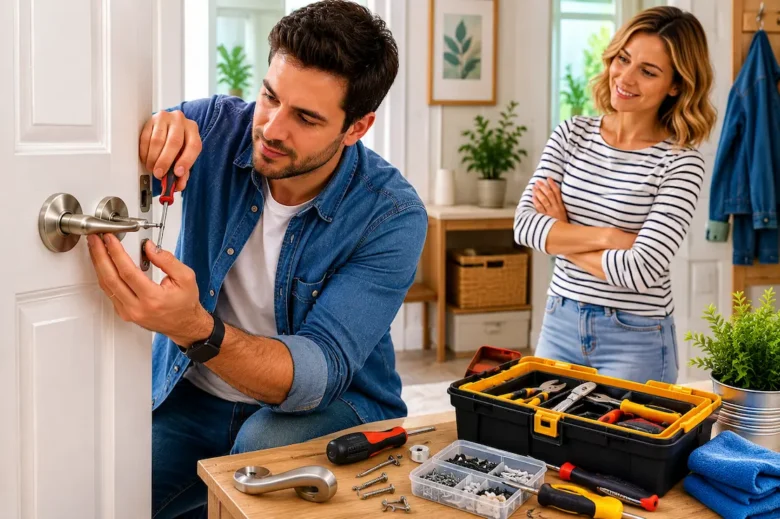
I now own toothpicks specifically for home repair. Not for teeth. For doors. I have a small box in my toolbox labeled “toothpicks (wood glue only).” My partner thinks I am eccentric. She is not wrong.
But the bathroom door closes. The handle stays on. The latch clicks. Every morning, I turn that handle and feel a small, stupid pride.
Competence is not knowing everything. It is knowing that a box of toothpicks and a bottle of glue can save you a service call. It is knowing when to stop tightening. It is knowing that the quick fix, done right, outlasts the expensive replacement, done wrong.
Fix your door. Use toothpicks if you need to. No one will know. And if they do, they will be impressed.
Sources and References
- U.S. Consumer Product Safety Commission (CPSC) — Home safety guidelines, including door hardware installation standards and fire door safety requirements for residential properties.
- National Fire Protection Association (NFPA) — Standards for fire doors and windows, including requirements for hardware modifications and maintenance in residential and commercial buildings.
- Penn State Extension — General home repair guidance, including wood filler techniques, pilot hole drilling, and proper tool selection for DIY maintenance projects.

Hamza Farooq is a home improvement and organization writer who shares practical advice on cleaning, simple DIY fixes, and smart home organization. He focuses on creating easy-to-follow guides that help readers solve everyday household problems with realistic, affordable solutions. His goal is to make home maintenance simpler, more efficient, and accessible for anyone looking to improve their living space.