
I found a coat in my closet last March. A winter coat. Heavy. Wool. The kind that makes you sweat in anything above forty degrees. I had not worn it in two years. I knew this because the receipt was still in the pocket. December 2021. A sale. Final purchase. I remembered feeling clever at the time.
The coat was not alone. It had neighbors. A sweater with tags still on. Three scarves I received as gifts and never liked. A hat that made my head look like a mushroom. I had been storing these items for years. Rotating them seasonally. Pretending they were part of my wardrobe.
They were not. They were clutter with a calendar.
What I Was Working With
My closet is four feet wide. One rod. One shelf above. The shelf holds a plastic bin labeled “Winter” in Sharpie. The bin was full. Overflowing. I had added a second bin. Then a third. They stacked precariously. The top bin slid forward when I opened the closet door. I caught it with my forehead once. Not a proud moment.
Under the bed: two more bins. Rolling. Clear. Those held the overflow. The items I could not fit in the closet but could not admit I did not want.
The dresser had three drawers dedicated to off-season items. T-shirts in January. Sweaters in July. I never accessed these drawers. I just knew they were there. Like a security blanket made of cotton and denial.
I owned maybe sixty pieces of clothing total. Twenty of them were in active rotation. Forty were in storage. The math was not working.
The Lie I Told Myself
“I will wear it next season.”
I said this for three years about a corduroy jacket. It was brown. It fit. It was fine. I never chose it. Every fall I looked at it. Every fall I picked something else. But I stored it. Because storing felt less wasteful than donating.
This is the trap. Storage becomes a holding pattern for decisions you are afraid to make. The coat is not being used. It is being delayed. And delay feels like responsibility. It is not.
I made a new rule. Brutal. Simple. If I did not wear it last season, it does not get stored. It gets donated. No exceptions. No “but what if.” Last season is the evidence. The closet is not a court of appeals.
The corduroy jacket went to Goodwill. I felt nothing. Not guilt. Not relief. Just the absence of a decision I had been delaying for thirty-six months. Decluttering is not about the items. It is about the mental load of unmade decisions.
The System I Built After the Purge
I kept thirty-two items. Total. Year-round wardrobe. Everything else left.
The thirty-two items fit in the closet. No bins. No under-bed storage. No dresser overflow. The closet has space between hangers. I can see everything. I can touch everything. I know what I own because I can see it all at once.
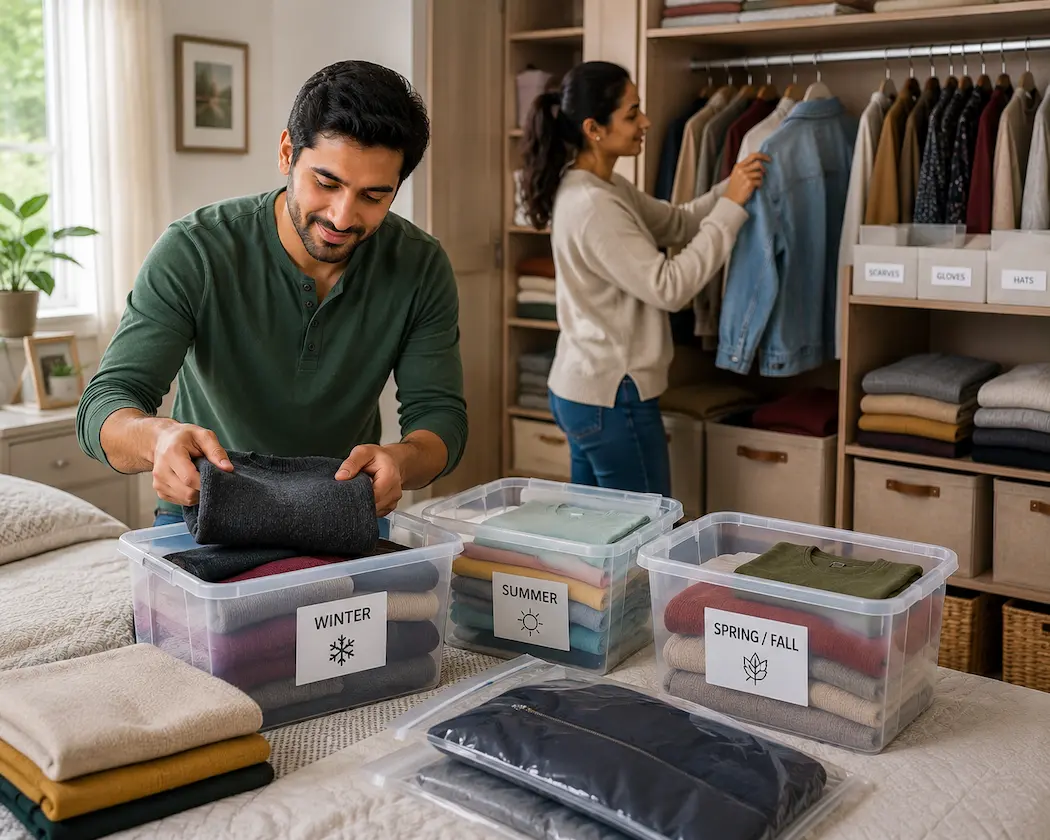
For seasonal transition, I use one bin. One. Not three. It sits on the shelf. In April, the two heavy sweaters and one winter coat go in. In October, they come out. The summer items — two pairs of shorts, three light shirts — go in. The rotation takes ten minutes.
The bin is clear. I can see inside without opening it. I labeled it with a piece of masking tape. “Off-season.” Not “Winter.” Not “Summer.” Just “Off-season.” Because the label does not matter. The contents change. The label stays. I replace the tape when it peels.
The wardrobe organization supports this system. Everything visible. Everything chosen. Nothing hidden in bins to avoid decisions.
How I Store What Actually Gets Stored
The bin is hard plastic. Not fabric. Not cardboard. Plastic with a tight lid. I add one cedar block. Small. The size of a bar of soap. It lives in the corner of the bin. Replaced annually. Costs two dollars.
I do not use mothballs. They smell like a chemical factory. They are toxic. The cedar works. I have never had moth damage. I have never had mildew. The plastic keeps moisture out. The cedar handles anything that sneaks in.
I fold items loosely. Not vacuum-sealed. Not compressed. Wool needs to breathe. Compression creates permanent creases. I fold along natural seams. Stack vertically, not horizontally. Like books on a shelf. I can see each item without disturbing the others.
No tissue paper. No garment bags. No sachets. Those are for museums. I am storing clothes, not archiving them. The under-bed space is empty now. I use it for nothing. The emptiness is the point.
The One-Year Test I Actually Follow
Every April and October, during the swap, I try on each stored item. Not a quick glance. I put it on. I look in the mirror. I ask: “Would I wear this tomorrow?”
If the answer is hesitation, it goes. Not next season. Now. Hesitation is the body recognizing what the mind denies. The item does not fit right. The color is wrong. The memory attached is not positive. Whatever the reason, hesitation is the signal.
I donated a sweater last October this way. Perfectly good. Cashmere. A gift from someone I no longer speak to. I put it on. Felt heavy. Not the fabric. The association. Off it went. Someone else will wear it without the weight.
The test takes twenty minutes. Twice a year. Forty minutes total. Less time than I used to spend searching for the bin I wanted under the bed.
💡 What I Learned the Hard Way
I once stored a leather jacket in a plastic bin with a tight lid. Cedar block included. Checked it six months later. White mold spots on the collar. The leather had retained moisture from a humid day. The plastic trapped it. The cedar could not absorb that much. I cleaned the mold with vinegar. Conditioned the leather. Saved the jacket. But now I air-dry leather for forty-eight hours before storing. No exceptions. No shortcuts. The bin is for dry items only. Slightly damp is not dry. Dry is dry.
Before and After: The Numbers
| Category | Before | After |
|---|---|---|
| Total clothing items | 60+ | 32 |
| Storage bins | 5 (closet + under-bed + dresser) | 1 (closet shelf) |
| Seasonal swap time | 2+ hours (finding, sorting, refolding) | 10 minutes |
| Items donated | None (I stored everything) | 28+ over two years |
| Decision fatigue | High (what to wear, what to store, what to keep) | Low (everything is visible and chosen) |
⚠️ When This Won’t Work
If you live in a climate with no real seasons — Florida, Southern California — seasonal storage is barely necessary. You might rotate a few items, but the bin system is overkill. Just keep everything accessible. Also, if you have a job requiring specialized clothing — uniforms, protective gear, formal wear — those items need dedicated storage regardless of season. Do not force them into a minimal system that does not fit your life. Finally, if you are currently gaining or losing weight, keeping multiple sizes is practical. The “one-year test” does not apply to transitional sizes. Keep them. Store them. Be kind to yourself. The goal is clarity, not cruelty.
Frequently Asked Questions
How do I deal with guilt about donating expensive items?
The money is spent. Keeping the item does not refund the purchase. It just extends the cost into storage space, mental load, and daily frustration. Donate it. Let someone else use it. The item’s value is in being worn, not in being owned by you specifically. I repeat this when I hesitate. It helps.
What about sentimental clothing?
I keep one item. A t-shirt from a trip. It lives in a small box, not the closet. Not the seasonal bin. Separate. Archived. The rest? If the memory is strong, the item is unnecessary. The memory lives without the fabric. Test this. Take a photo. Donate the item. See if the memory fades. It will not.
Should I vacuum-seal seasonal clothes?
No. Compression damages fibers. Wool loses loft. Down loses fluff. Cotton creases permanently. Vacuum bags are for moving, not storage. If space is that tight, you own too much. Reduce volume, not air. The problem is quantity, not packaging.
What if my partner refuses to minimize?
Control your own closet. Not theirs. I tried convincing my partner. Failed. Created tension. Now we have separate systems. Mine is minimal. Theirs is not. The door closes. We coexist. Marriage is full of larger compromises than closet philosophy.
How do I handle clothes that “might fit again someday”?
One year. If you have not worn them in a year at your current size, they are not motivational. They are judgmental. I had a pair of jeans from three sizes ago. They stared at me. I donated them. Bought new jeans when I needed them. The new jeans fit. The old jeans did not. The math is simple.
Closing Thought
My closet is not a Pinterest board. It is a closet. Four feet wide. One rod. One shelf. One bin.
The bin contains two sweaters and a coat. That is all. The rest of my clothes hang in the open. Visible. Chosen. Used.
I no longer rotate forty items seasonally. I no longer store things to avoid decisions. I no longer catch falling bins with my forehead.
The coat with the 2021 receipt is gone. Someone else is wearing it, I hope. Or it became insulation. Either way, it is not my problem.
Seasonal storage should not be a warehouse. It should be a brief pause for a few items that genuinely earn their rest. Everything else should be on your body or out of your life.
Open your closet. Look at the bin. Ask what is inside. Then ask why.
The answer might surprise you. It might also free you.
Sources and References
- American Psychological Association (APA) — Research on decision fatigue, procrastination, and the cognitive burden of unmade choices in daily environments.
- Centers for Disease Control and Prevention (CDC) — Healthy Homes — Guidelines for maintaining clean, organized, and healthy residential spaces, including storage practices that reduce allergen accumulation.
- U.S. Environmental Protection Agency (EPA) Safer Choice Program — Recommendations for safer household product selection and sustainable home maintenance practices.

Hamza Farooq is a home improvement and organization writer who shares practical advice on cleaning, simple DIY fixes, and smart home organization. He focuses on creating easy-to-follow guides that help readers solve everyday household problems with realistic, affordable solutions. His goal is to make home maintenance simpler, more efficient, and accessible for anyone looking to improve their living space.