
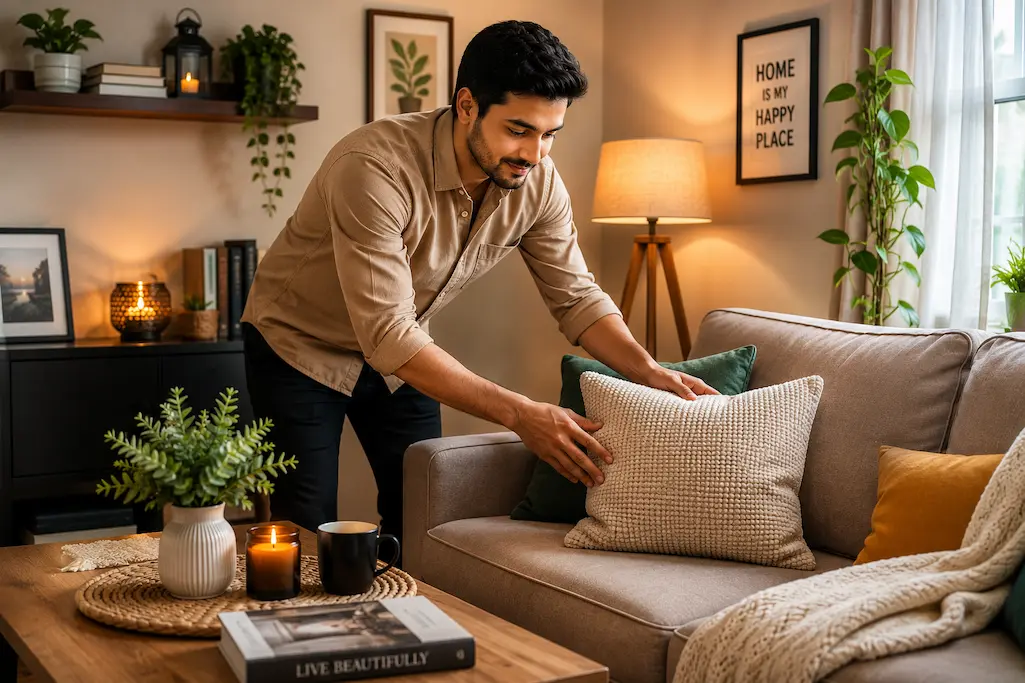
Comfort is not a couch. I used to think it was. I spent six months saving for a $900 sectional I saw in a showroom. It was plush. It was gray. It had throw pillows that matched the rug I did not own yet. I bought it. Had it delivered. Sat on it for the first time and felt… nothing. It was a couch. A nice couch. But my apartment still felt like a place I slept in, not a place I lived in.
The real changes came later. They cost almost nothing. A lamp moved six inches to the left. A blanket folded over the back of a chair. A candle I lit at 6 PM every evening for no reason except that I liked the smell. Those small things added up to a feeling I could not buy. Here is what I changed, why I changed it, and what I learned about the difference between a furnished apartment and a comfortable home.
What I Was Working With
My apartment is 780 square feet, same as I have mentioned in other guides. Two bedrooms, one bathroom, a kitchen, and a living room that serves as my office, dining area, and relaxation space. The walls are off-white, the carpet is beige, and the blinds are the cheap vinyl kind that came with the unit. When I moved in, the place looked like a rental. Which it was. But I wanted it to feel like mine.
My budget for comfort upgrades was $100. Total. Not per month. Not per room. One hundred dollars for the entire apartment. I had already spent my furniture budget on that disappointing sectional. This was about the details. The things you touch, smell, and notice without thinking.
What I Tried First (And Why It Failed)
My first attempt at comfort was buying things. A $40 throw blanket from Target. A $25 set of scented candles. A $15 faux fur pillow that shed everywhere. I brought them home, arranged them carefully, and stepped back to admire my work. It looked like a catalog photo. And it felt like a catalog photo too — staged, temporary, not mine.
The throw blanket was too nice to actually use. I folded it neatly on the arm of the couch and never unfolded it because I did not want to mess up the display. The candles smelled good in the store but gave me a headache after twenty minutes of burning. The faux fur pillow left orange fuzz on my black work pants every time I sat down. I donated the pillow, gave away the candles, and kept the blanket folded in the closet. It was not comfort. It was decoration.
I also tried rearranging furniture according to feng shui principles I read about online. I moved my bed to face the door. I angled my desk toward a window. I placed a mirror to “reflect positive energy.” It looked awkward. I bumped my knee on the bed frame three times in one week. The energy was not positive. It was annoyed. I moved everything back.
The Changes That Actually Worked
1. I Moved a Lamp
I had a floor lamp in the corner of the living room, pointed at the ceiling for ambient light. It was fine. Functional. Boring. One evening, while reading on the couch, I noticed the light was behind me, casting a shadow on my book. I dragged the lamp six inches to the left, so it shone over my shoulder instead of behind it. The difference was absurd. My reading nook became a reading nook. The light was warm. The shadow was gone. And I realized I had been sitting in the wrong light for two years.
That lamp move cost nothing. Zero dollars. And it changed how I felt about my entire living room. I wrote about how I improved lighting throughout my home in my lighting guide. The lamp was just the beginning.
2. I Added a “Transition” Ritual
I work from home. My desk is in the living room. For months, I would close my laptop at 6 PM and immediately feel restless. Work mode to relax mode had no boundary. Then I started a small ritual. At 6 PM, I close the laptop, put on a specific playlist I call “Evening,” and light a single candle. The candle is a $4 beeswax taper from the grocery store. No scent. Just warm light. The playlist is acoustic guitar songs I found on Spotify. Nothing fancy.
But the ritual works. The candle signals my brain that work is done. The music fills the silence that used to feel empty. And the act of intentionally transitioning makes the evening feel like a choice, not a default. I have been doing this for eight months. I look forward to 6 PM now. Not because I hate work. Because I love the ritual.
3. I Left a Blanket Out
Remember that $40 throw blanket? I took it out of the closet. I unfolded it. I draped it over the back of the couch, messy and inviting, not folded and perfect. And I started using it. Every evening. Wrapped around my legs while I read. Pulled over my shoulders when the AC kicked on. The blanket developed a soft spot where my knees always press. It looks used. It looks loved. That is what makes it comfortable.
Comfort is not pristine. Comfort is worn in. Like a favorite pair of jeans. Like a book with cracked spine. The blanket is not decorative anymore. It is functional. And because it is functional, it makes the room feel lived in. Real.
4. I Created a “Landing Zone”
Near my front door, I placed a small wooden tray I found at a thrift store for $3. On it: my keys, a small dish for loose change, and a coaster for my water bottle. That is it. Three objects. But when I come home, I drop my keys in the tray. I empty my pockets. I set down whatever I am carrying. And the rest of the apartment stays clear.
Before the tray, my keys lived on the kitchen counter. My wallet lived on the coffee table. My mail lived wherever I dropped it. The clutter spread like a virus. The tray stopped the spread. It is a small thing. But walking into a clear space instead of a scattered one changes your mood instantly. I wrote about managing daily items without mess in my complete guide. The landing zone was the first step.
5. I Changed the Sound
My apartment is quiet. Too quiet. The kind of quiet where you can hear the refrigerator hum and the neighbor’s dog bark three floors down. I bought a small white noise machine for $20 on Amazon. It sits on my nightstand and plays “brown noise” — a deeper, softer version of white noise. It masks the random sounds that used to wake me up. The dog barks. The elevator ding. The person who slams their door at midnight.
But I also use it during the day. When I work, the brown noise creates a bubble of focus. When I read, it replaces the silence that felt heavy. And when I sleep, it lets me drift off without listening for every creak in the building. The sound of my home changed. And the feeling changed with it.
6. I Put Something Soft Underfoot
The carpet in my bedroom is thin. Industrial. The kind landlords install because it lasts, not because it feels good. I bought a small sheepskin rug for $35 from IKEA. It is fake sheepskin. Obviously. But it is soft. I placed it beside my bed, where my feet land every morning. That first step of the day used to be onto cold, flat carpet. Now it is onto something that gives a little. Something warm. Something that says “good morning” instead of “get up.”
I also put a small rug in front of the kitchen sink. Standing on tile while washing dishes made my back ache. The rug costs $12. My back stopped aching. Small change. Big difference.
💡 What I Learned the Hard Way
Do not buy scented candles without testing them in your own space first. I bought a set of three “lavender vanilla” candles that smelled divine in the store. In my 780-square-foot apartment, the scent was overwhelming. It gave me a headache within twenty minutes. It clung to my clothes. It made my eyes water. I gave all three away to a friend with a larger house and better ventilation. Now I only buy unscented beeswax candles or I test a single candle for a full evening before committing to multiples. The store smell is not the home smell. Airflow matters. Room size matters. And your own nose matters more than the label.
When These Changes Won’t Work
⚠️ When These Changes Won’t Work
These changes are for people who have the basics covered. A roof that does not leak. Heat that works. A bed that does not sag. If your home has structural problems, safety issues, or serious maintenance needs, a candle and a throw blanket will not fix it. I am talking about comfort, not survival. Also, if you live with roommates or family members who have different standards, some of these changes require agreement. My partner and I negotiated the landing zone together. He wanted a charging station there too. We compromised: keys and change on the tray, chargers on a small shelf above. If you live alone, you have full control. If you do not, comfort is a conversation. One more thing: these changes are subtle. They will not impress visitors. Your home will not look like a magazine. It will feel like yours. That is the point. But if you are looking for dramatic before-and-after transformations, this is not that article.
What Others Told Me
I posted a question on Twitter last fall: “What small thing made your home feel comfortable?” The responses surprised me.
One person said: “I bought a $6 spray bottle and mist my plants every morning. The ritual makes me feel like a caretaker.” I do not have plants. But I understood the feeling. Rituals create comfort.
Another said: “I keep a specific mug for morning coffee. It is chipped and the handle is loose. But it is MY mug. No one else uses it. That small ownership makes the morning feel mine.” I started doing this. I have a blue ceramic mug I bought at a flea market for $2. It is too heavy. The glaze is uneven. And it is the only mug I use before 10 AM. It is mine.
The most unexpected response came from a guy who said: “I leave a book open on my coffee table. Face down, pages splayed. It makes the room feel like someone lives here.” I tried it. I leave my current read open on the side table next to the couch. It is a small signal. A sign of life. And it makes the room feel less like a display and more like a home.
The Cost Breakdown
Here is exactly what I spent and what each change cost:
| Change | Cost | Why It Mattered |
|---|---|---|
| Moved the lamp | $0 | Fixed the reading light I had been tolerating for two years |
| Evening ritual (candle + playlist) | $4 (candle) | Created a boundary between work and rest |
| Unfolded the throw blanket | $0 (already owned) | Made the couch feel used, not staged |
| Landing zone tray | $3 (thrift store) | Stopped clutter from spreading through the apartment |
| White noise machine | $20 | Replaced oppressive silence with focused calm |
| Bedside rug | $35 | Made the first step of every morning feel gentle |
| Kitchen sink rug | $12 | Eliminated back ache from standing on tile |
| Flea market mug | $2 | Created a morning ritual of ownership |
Total spent: $76. Under budget. And more comfortable than the $900 couch ever made me feel.
How This Connects to My Other Home Improvements
Comfort does not exist in isolation. It builds on organization, lighting, and space. I wrote about how I made my small room look bigger — the changes that made my bedroom feel open instead of cramped. I also wrote about budget-friendly ways to improve your living space, which covers the bigger upgrades that complement these small touches. And my guide to refreshing without renovation explains how I changed the feel of my home without changing the structure.
FAQ
Do I need to spend money to make my home comfortable?
No. The most impactful change I made — moving the lamp — cost nothing. The blanket was already owned. The ritual cost $4. Money helps, but intention matters more. A $900 couch with no intention behind it is just expensive furniture. A $3 tray with a purpose is a comfort tool.
What if my home is temporary?
I have lived in my apartment for three years. It is still a rental. I still have beige carpet and vinyl blinds. But the lamp is mine. The mug is mine. The ritual is mine. Comfort is portable. When I move, the tray comes with me. The blanket comes with me. The habits come with me. The apartment is temporary. The feeling is not.
How do I find my own comfort changes?
Pay attention to irritation. What annoys you daily? The light behind your book? The cold floor in the morning? The silence that feels heavy? The clutter that greets you at the door? Comfort is often the absence of irritation. Fix the small annoyances and comfort appears naturally. You do not need to invent comfort. You need to remove discomfort.
Can too many changes make a space feel cluttered?
Yes. I stopped at six changes because adding more started to feel like decoration again. The line between comfort and clutter is thin. I evaluate every new addition with one question: “Does this remove an irritation or add a decoration?” If it is decoration, I skip it. If it removes irritation, I consider it. The goal is functional comfort, not curated aesthetics.
What about seasonal comfort changes?
I rotate small things. In winter, the sheepskin rug stays. In summer, I swap it for a flat woven mat that feels cooler underfoot. The blanket gets lighter in July. The candle gets replaced by a small desk fan for white noise instead of the machine. Comfort adapts to the season. The principles stay the same. The tools change.
Related Articles
- How I Improved Lighting in My Home — The full story of how moving that one lamp led to a complete lighting rethink across every room
- How I Made My Small Room Look Bigger — The changes that made my bedroom feel open, which contributes to overall home comfort
- Budget-Friendly Ways to Improve Your Living Space — The bigger upgrades that complement these small, daily comfort touches
Conclusion
The $900 couch is still in my living room. I sit on it every day. But it is not the reason my home feels comfortable. The comfort comes from the lamp that shines over my shoulder. The blanket that is messy and used. The tray that catches my keys. The sound that fills the silence. The rug that greets my feet.
Comfort is cumulative. One small change does not transform a space. But six small changes, chosen with intention, create a feeling that no amount of money can buy. My home is still a rental. It still has beige carpet and vinyl blinds. But when I walk through the door, I feel relief. Not because the space is perfect. Because the space is mine.
If your home feels like a place you sleep in, not a place you live in, start with one irritation. Move one lamp. Add one sound. Create one ritual. Do not aim for transformation. Aim for one percent better. The comfort builds. Slowly. Quietly. Until one evening, you light a candle, wrap yourself in a blanket, and realize you are exactly where you want to be.
Sources and References
- American Psychological Association — Multitasking: Switching Costs — Research on how environmental distractions and mental clutter affect focus and well-being. Informed my decision to create a dedicated evening ritual that signals a clear transition from work to rest.
- Sleep Foundation — White Noise and Sleep — Information on how consistent background noise can mask disruptive sounds and improve sleep quality. Validated my use of a white noise machine for both sleep and daytime focus.
- Energy Star — Lighting and Fans — Guidance on selecting appropriate lighting for different activities and spaces. Supported my approach to task-specific lighting adjustments for reading and relaxation areas.

Hamza Farooq is a home improvement and organization writer who shares practical advice on cleaning, simple DIY fixes, and smart home organization. He focuses on creating easy-to-follow guides that help readers solve everyday household problems with realistic, affordable solutions. His goal is to make home maintenance simpler, more efficient, and accessible for anyone looking to improve their living space.