
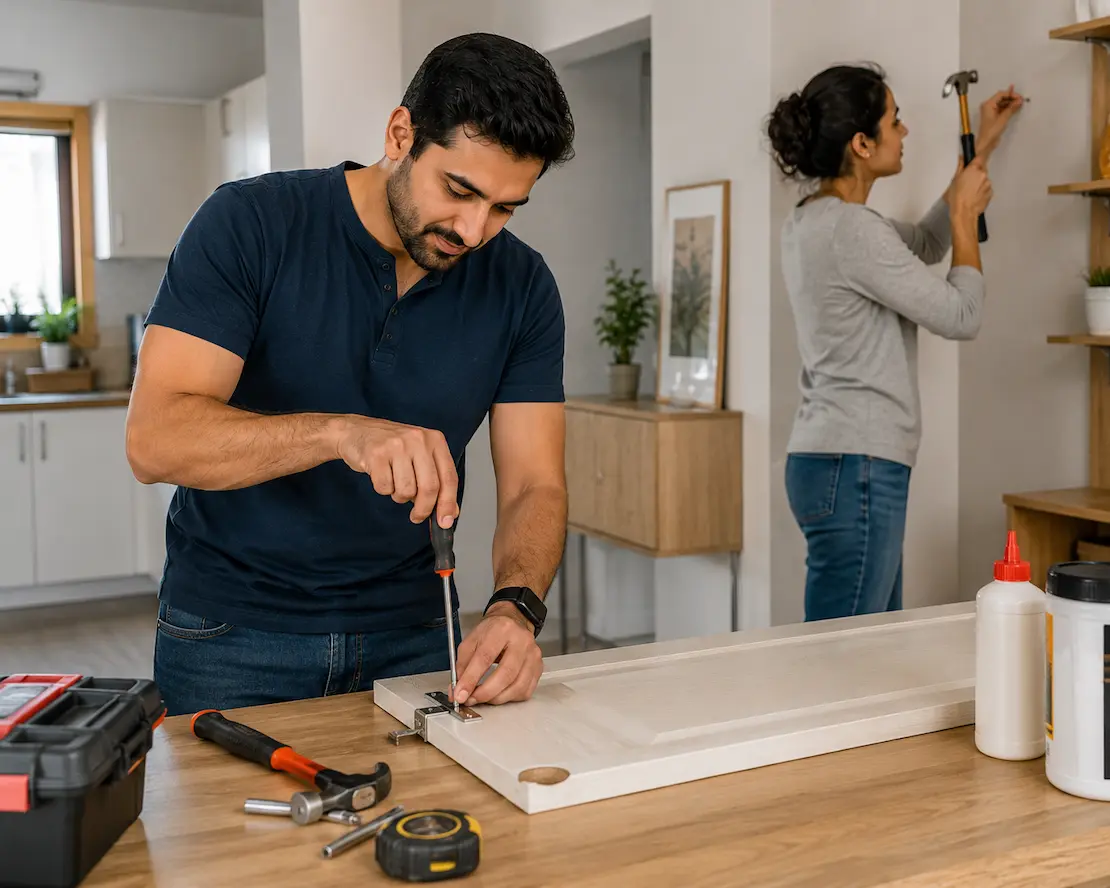
I once tried to fix a leaky faucet with a butter knife and optimism. The optimism broke first. Then the butter knife bent. Then the leak became a spray that soaked my shirt and my dignity. I stood in my kitchen holding a bent knife and a wet t-shirt, wondering where I went wrong.
I went wrong at the beginning. I did not know the basics. I knew enthusiasm. Enthusiasm is not a tool.
These are the things I learned after that day. The fundamentals. The repairs that come up repeatedly in every home. The ones that look simple until you are holding a bent knife and questioning your life choices.
What I Was Working With
My apartment is old. Not charming old. Tired old. The kind of old where every repair reveals another repair. The faucet was original. The walls are plaster over lath. The electrical panel has fuses, not breakers. I am not a handyman. I am a person who cannot afford to call one for every squeak.
I own a basic toolkit. Hammer. Screwdriver set. Adjustable wrench. Pliers. A level I use once a year. A tape measure. A flashlight. That is it. No power drill. No saw. No ambition for either.
These tips assume the same. Basic tools. Basic problems. No contractor required.
Tip 1: How to Actually Turn Off Water
Before you touch any faucet, toilet, or pipe, find the shut-off valve. Not the main. The local one. Under the sink. Behind the toilet. Near the appliance.
I did not know this. I turned off the main water to fix a faucet. My partner could not flush the toilet for two hours. I thought I was being thorough. I was being inconvenient.
Local valves are usually oval handles. Turn clockwise to close. Righty-tighty. If the valve has not been used in years, it may be stiff. Do not force it. Spray a little penetrating oil. Wait ten minutes. Try again. Forcing a seized valve can snap it. Then you are replacing a valve, not fixing a faucet.
Test the valve before you start. Turn it off. Run the faucet. Confirm the water stops. Then begin your repair. This seems obvious. I skipped it once. The water did not stop. The valve was broken inside. I found out the wet way.
I wrote a full guide on faucet repair after my butter knife incident. The first step is always the valve. Always.
Tip 2: The Right Screwdriver Saves Everything
I owned one screwdriver for years. A Phillips. Size 2. I used it for everything. Stripped screws. Damaged heads. Frustration. I blamed the screws.
The screws were fine. The driver was wrong.
Phillips heads come in sizes 0, 1, 2, and 3. Most household screws are 2. But cabinet hinges often use 1. Light fixtures sometimes use 0. Door hinges can use 3. Using the wrong size strips the head. The driver slips. The metal rounds. Then you need pliers, extractors, or replacement.
I bought a set. Four sizes. Cost eight dollars. I have not stripped a screw since. The right tool is cheaper than the wrong tool plus the damage it causes.
Same for flatheads. Slotted screws need a driver that fits the slot width exactly. Too narrow and it slips. Too wide and it damages the surrounding surface. Match the driver to the screw. Not approximately. Exactly.
Tip 3: How to Find a Stud Without a Stud Finder
I do not own a stud finder. I have tried three. Two were wrong. One beeped randomly at the floor. I threw them all away.
Instead, I use a nail. A small finishing nail. And a hammer.
Start where you think the stud is. Usually sixteen inches from a corner. Or beside an outlet, which is often mounted to a stud. Hammer the nail gently through the drywall. If it hits wood within half an inch, you found it. If it goes in freely for an inch or more, you missed. Move an inch left or right. Try again.
The holes are tiny. Invisible after a touch of spackle. Less damaging than a heavy picture falling because you anchored it to drywall alone.
I have found every stud in my apartment this way. It is slow. It is reliable. It does not require batteries. I patched the test holes using the method in this guide. Took five minutes. Invisible result.
Tip 4: When Duct Tape Is Not the Answer
I love duct tape. I have used it for temporary fixes that became permanent. A torn vacuum hose. A frayed shoelace. A loose cabinet handle. Duct tape holds the world together.
But not everything.
Do not use duct tape on heating vents. The heat melts the adhesive. It becomes a sticky mess that attracts dust and fails structurally. Use aluminum foil tape. Designed for high heat. Actually works.
Do not use duct tape on electrical insulation. The adhesive can conduct electricity slightly. It degrades. It leaves residue that makes proper repair harder. Use electrical tape. Black. Stretchy. Designed for the job.
Do not use duct tape on wet surfaces. It will not adhere. It will peel. It will mock you. Use waterproof tape or silicone sealant for plumbing emergencies.
Duct tape is for dry, non-critical, non-heat, non-electrical temporary holds. Know its limits. Respect them. I used toothpicks instead of duct tape for a loose door handle. Better fix. Lasted longer.
Tip 5: How to Reset a Tripped Breaker (Or Replace a Blown Fuse)
My apartment has fuses. Screw-in. Edison base. Like a light bulb. If yours has breakers, this is easier. Find the panel. Open it. Look for the switch that is not aligned with the others. Push it fully off, then on. Done.
Fuses are different. They blow. You replace them. But first, figure out why. A blown fuse means something drew too much current. Usually a space heater. Or a hair dryer on the same circuit as the microwave. Or too many things plugged into one outlet.
Replace the fuse with the same amperage. Never higher. A 15-amp fuse protects 14-gauge wire. A 20-amp fuse on 14-gauge wire lets the wire overheat before the fuse blows. That is how fires start. Match the amperage exactly.
I keep spare fuses in a small box near the panel. Labeled. Organized. Because finding a fuse in the dark is not fun. I have done it. With a phone flashlight and mild panic.
💡 What I Learned the Hard Way
I once replaced a fuse while the circuit was still live. The fuse touched the metal panel as I screwed it in. Sparks. A pop. My hand went numb for ten seconds. I was lucky. The fuse was fine. I was not. Always turn off the main breaker before replacing a fuse. Or call an electrician. I now turn off the main. Every time. Even when I am sure. Even when it is inconvenient. Because ten seconds of numbness is a warning. Next time could be worse.
Tip 6: How to Patch a Small Hole Properly
Nail holes. Anchor holes. The damage from my stud-finding method. Small holes need spackle. Not toothpaste. Not baking soda paste. Actual spackle.
Use a putty knife. Or a butter knife, if that is what you have. I still use butter knives. Just not for plumbing anymore. Apply spackle slightly higher than the wall surface. Let it dry. Sand flush. Paint.
For holes larger than a quarter, use a patch kit. Mesh tape over the hole. Joint compound over the tape. Two thin coats. Sand between. The mesh prevents cracking.
I patched six holes last month. One was from a failed curtain rod. One from a failed shelf. Four from my stud-finding method. The wall looks new. The failures are invisible. That is the goal of repair. Not perfection. Invisibility.
Quick Reference: Tool vs. Problem
| Problem | Wrong Approach | Right Approach | Cost of Right Approach |
|---|---|---|---|
| Leaky faucet | Butter knife, optimism, no valve shut-off | Shut local valve, replace washer or cartridge | $3–$15 in parts |
| Stripped screw | Wrong size driver, more force | Correct size driver, gentle pressure | $8 for a proper set |
| Hanging something heavy | Drywall anchor alone, guess location | Find stud with test nail, anchor to wood | $0 (nail you already own) |
| Blown fuse | Replace with higher amperage | Match amperage exactly, find overload cause | $2 per fuse |
| Small wall hole | Toothpaste, baking soda, ignore it | Spackle, sand, paint | $4 for spackle |
⚠️ When This Won’t Work
If you smell gas, leave. Do not repair. Do not investigate. Leave. Call the gas company from outside. If water is actively flooding — a burst pipe, a failed water heater — turn off the main and call a plumber. These tips are for maintenance and minor repair, not emergencies. Also, if you are not comfortable with electricity, do not replace fuses or breakers. Hire an electrician. The money is less than a hospital bill. Finally, if a repair requires a permit — electrical work, gas lines, structural changes — do not DIY. Permits exist for safety. Skipping them risks your home, your insurance, and your life. I have never done permitted work. I know my limits. Know yours.
Frequently Asked Questions
Do I need a power drill?
No. Not for basic repairs. A screwdriver set handles most household tasks. A drill is faster. It is not necessary. I have lived without one for eight years. I borrow one twice a year for heavy projects. The rest of the time, manual tools work fine. Slower. But fine.
What is the one tool I should buy first?
A proper screwdriver set. Not a multi-bit. Individual drivers. Phillips 1, 2, and 3. Flathead small, medium, and large. An adjustable wrench. Pliers. With those four items, you can handle 80 percent of basic home repairs. Everything else is specialization.
How do I know if I am in over my head?
If you are watching a tutorial video for the third time and still confused, stop. If the repair involves water, gas, or electricity and you are not 100 percent certain, stop. If the tool required costs more than a service call, stop. Confidence is good. Overconfidence is expensive. I have paid for overconfidence with wet shirts, bent knives, and one numb hand.
Can I use YouTube to learn repairs?
Yes. But verify the source. Look for channels that mention code, safety, and common mistakes. Not just the highlight reel of a perfect repair. I learned more from videos where things went wrong than from polished tutorials. The mistakes teach you what to avoid. The successes just make it look easy.
What if I make it worse?
You will. Everyone does. The key is making it worse in a reversible way. Do not glue what should be screwed. Do not cut what should be unscrewed. Do not paint over what should be cleaned. Most bad DIY can be undone. Permanent damage comes from impatience, not incompetence. Take photos before you start. Label parts. Keep the original pieces. If you get stuck, a professional can fix your attempt. But only if your attempt was methodical.
Closing Thought
I still own a butter knife. It is bent. I keep it in my toolbox as a reminder. Not of failure. Of the gap between enthusiasm and knowledge.
Home repair is not about being handy. It is about being patient. Reading instructions. Using the right tool. Shutting off the water before you start. Knowing when to stop.
The basics are not glamorous. They do not get likes. But they save you money, time, and dignity. They turn a crisis into a project. A project into a skill. A skill into confidence that is actually earned.
Start with the valve. The screwdriver. The test nail. The spackle.
Leave the butter knife in the kitchen. Where it belongs.
Sources and References
- U.S. Consumer Product Safety Commission (CPSC) — Electrical safety guidelines for residential DIY repairs, including proper fuse replacement and circuit breaker safety.
- U.S. Environmental Protection Agency (EPA) Safer Choice Program — Recommendations for selecting safer cleaning and maintenance products for home repair projects.
- National Electrical Code (NEC), National Fire Protection Association (NFPA) — Standards for residential electrical work, including circuit protection and safe amperage ratings for household wiring.

Hamza Farooq is a home improvement and organization writer who shares practical advice on cleaning, simple DIY fixes, and smart home organization. He focuses on creating easy-to-follow guides that help readers solve everyday household problems with realistic, affordable solutions. His goal is to make home maintenance simpler, more efficient, and accessible for anyone looking to improve their living space.